#13
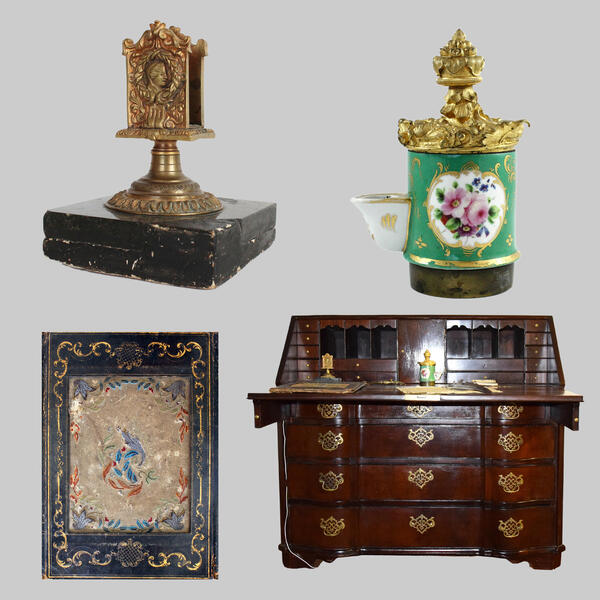
Dresser desk, Blotter, Match holder, Inkwell
#14
#15
#16
The word ‘commode’, which is how the call a dresser desk in Russia, is French and means ‘convenient’. The prototype of the dresser was a chest, to which drawers and legs were added over time. This piece of furniture came into use at the beginning of the 18th century. This dresser appeared in France a little earlier, in the middle of the 17th century. It was made of various types of wood, decorated with expensive materials including mother of pearl, gilded and bronze overlays. The dresser served as a work table. It came in different forms: traditional, console, chest of drawers.
A dresser with drawers, along with a so-called secretary dresser or a dresser-table, is a typical piece of 19th century furniture. It was both for keeping things and writing letters. The displayed exhibit is in the office of Matvey Muravyov-Apostol, who, even while living in a distant Siberian town, surrounded himself with a tastefully furnished interior.
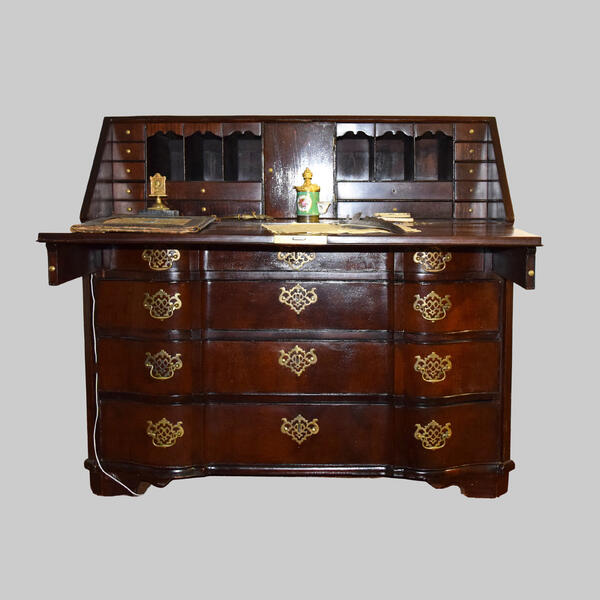
The dresser desk consists of two parts: the dresser with drawers and a desk. It was made in Russia in the first half of the 19thcentury. It was made using solid pine. The top was covered with veneer, thin slices of mahogany and varnish. Gracefully crafted handles with openwork fasteners were made of bronze.
The upper part of the dresser desk was folded back and turned into a kind of writing table. In it’s working position, this part was fixed with two retractable side plates or drawers.
The upper part was called the desk. It has a niche in the center with a little door and three drawers. There are seven symmetrically located drawers and three niches with a curtain on each side of the door,. The dresser desk consists of three high and one narrow drawers.
The dresser desk was transferred from the State Historical Museum in 1969 specifically to create a new exhibit in the memorial house of M.I. Muravyov-Apostol. In 2005, the staff of the Sverdlovsk Regional Museum of Local Lore restored the dresser. The experts removed the old varnish and glue and restored the back of the dresser. In addition, they reinforced the structure, restored the finish of the drawers, the office doors, covered them with mahogany veneer and varnish.
A dresser with drawers, along with a so-called secretary dresser or a dresser-table, is a typical piece of 19th century furniture. It was both for keeping things and writing letters. The displayed exhibit is in the office of Matvey Muravyov-Apostol, who, even while living in a distant Siberian town, surrounded himself with a tastefully furnished interior.
The dresser desk consists of two parts: the dresser with drawers and a desk. It was made in Russia in the first half of the 19thcentury. It was made using solid pine. The top was covered with veneer, thin slices of mahogany and varnish. Gracefully crafted handles with openwork fasteners were made of bronze.
The upper part of the dresser desk was folded back and turned into a kind of writing table. In it’s working position, this part was fixed with two retractable side plates or drawers.
The upper part was called the desk. It has a niche in the center with a little door and three drawers. There are seven symmetrically located drawers and three niches with a curtain on each side of the door,. The dresser desk consists of three high and one narrow drawers.
The dresser desk was transferred from the State Historical Museum in 1969 specifically to create a new exhibit in the memorial house of M.I. Muravyov-Apostol. In 2005, the staff of the Sverdlovsk Regional Museum of Local Lore restored the dresser. The experts removed the old varnish and glue and restored the back of the dresser. In addition, they reinforced the structure, restored the finish of the drawers, the office doors, covered them with mahogany veneer and varnish.
#17
Date: First half of the 19th century
Place: Russia
Technique: veneering, varnishing, casting
Dimensions: 111×120×61 cm
Collection: Wood/Furniture
Copyright: Tymuen Museum and Educational Association
Goskatalog Number: 8966492
Place: Russia
Technique: veneering, varnishing, casting
Dimensions: 111×120×61 cm
Collection: Wood/Furniture
Copyright: Tymuen Museum and Educational Association
Goskatalog Number: 8966492
#18
Blotter
#19
#20
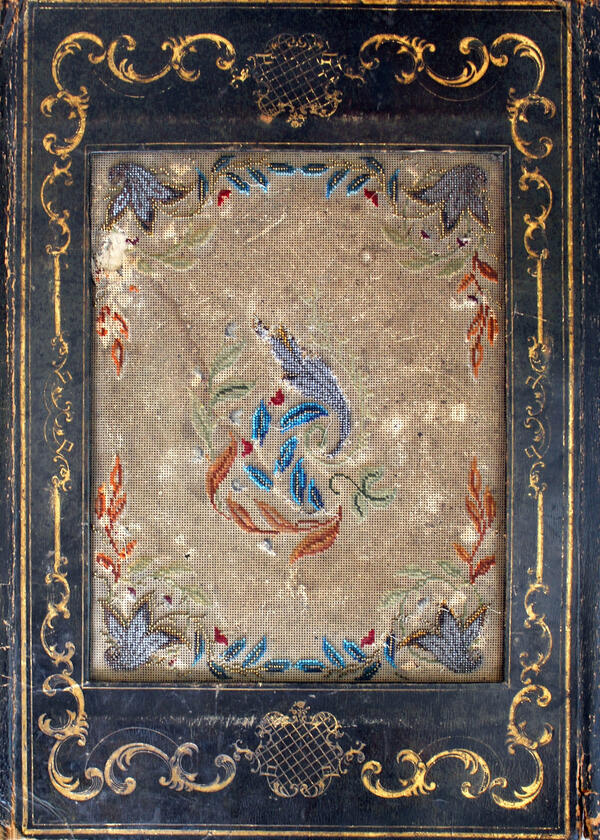
In the 19th century, the blotter was an indispensable desktop item. The very name ‘blotter’ comes from the French word ‘bouvard’, which speaks to the process of soaking up excess ink. Designed for business people, this elegant piece dates back to the mid-19th century, after the invention of special ink blotting paper. An elegant folder contained a notebook with sheets of blotting paper to prevent ink from smearing the paper, and a small amount of letter or writing paper, envelopes, correspondence, and other important papers. Blotters or leather folders were skillfully decorated with embroidery, various inscriptions, and inlays. Such decorations emphasized the special status of its owner and the office where they were kept.
The Siberian provincial city of Yalutorovsk saw 20 years of the life of exiled Decembrist, nobleman, hero of the Patriotic War of 1812, retired lieutenant colonel Matvey Ivanovich Muravyov-Apostol. According to the recollections of his contemporaries, he lived in an elite part of the city, in a very well furnished house. Three rooms in the house today are memorial: the hall, the study and the living room. Valuable information is also provided by the memoirs of the writer and artist Mikhail Znamensky, the study ‘had shelves of books, portraits of relatives lined the walls, including a large portrait of Napoleon, guns with hunting accessories…’. There was always order in the office and every object spoke of the high artistic taste of its owner. This old blotter found it’s place here as well. It is rectangular, made of thick cardboard, pasted over with brown paper. It has a curved valve with a metal lock. The valve and spine are covered with light brown leather. On both sides, along the edge there is a curved frame in the form of an embossed golden ornament of floral and geometric look. On the reverse side you can see an insert made of paper canvas with blue, brown, green and gray bead and thread embroidery. The embroidery ornament consists of plant elements. Inside the case there are two pockets pasted over with blue paper outside and pink paper inside.
The exhibit displayed here was acquired during a scientific trip to the city of Moscow in the antique department of the Moscow bookstore for a new exhibit in the house of Matvey Muravyov-Apostol, which opened after it’s restoration in 1994.
The Siberian provincial city of Yalutorovsk saw 20 years of the life of exiled Decembrist, nobleman, hero of the Patriotic War of 1812, retired lieutenant colonel Matvey Ivanovich Muravyov-Apostol. According to the recollections of his contemporaries, he lived in an elite part of the city, in a very well furnished house. Three rooms in the house today are memorial: the hall, the study and the living room. Valuable information is also provided by the memoirs of the writer and artist Mikhail Znamensky, the study ‘had shelves of books, portraits of relatives lined the walls, including a large portrait of Napoleon, guns with hunting accessories…’. There was always order in the office and every object spoke of the high artistic taste of its owner. This old blotter found it’s place here as well. It is rectangular, made of thick cardboard, pasted over with brown paper. It has a curved valve with a metal lock. The valve and spine are covered with light brown leather. On both sides, along the edge there is a curved frame in the form of an embossed golden ornament of floral and geometric look. On the reverse side you can see an insert made of paper canvas with blue, brown, green and gray bead and thread embroidery. The embroidery ornament consists of plant elements. Inside the case there are two pockets pasted over with blue paper outside and pink paper inside.
The exhibit displayed here was acquired during a scientific trip to the city of Moscow in the antique department of the Moscow bookstore for a new exhibit in the house of Matvey Muravyov-Apostol, which opened after it’s restoration in 1994.
#21
Date: First half of the 20th century
Technique: embossing, beading
Place: Russia
Dimensions: 42×28,5×1,5 cm
Collection: Other materials
Copyright: Tyumen Museum and Educational Association
Goskatalog Number: 4703142
Technique: embossing, beading
Place: Russia
Dimensions: 42×28,5×1,5 cm
Collection: Other materials
Copyright: Tyumen Museum and Educational Association
Goskatalog Number: 4703142
#22
Match holder
#23
#24
Match holders are a typical 19th century household item. They came about after the invention of so-called safe matches in 1844. The matches used up to that point could easily ignite, even from minimal friction with one another. The new chemical composition with the addition of red phosphorus made using them safe for anyone.
The match holder served as a sort of case for the matchbox. Match holders were generally based on the dimensions of the match boxes they were to hold. The makers took into account the item’s application and released several types, including tabletop, fireplace, and pocket versions. Tabletop match holders were mounted onto a standing leg, decorated with precious stones and engraved drawings, which were filled with niello or colored enamel. Brass and copper were predominantly used in manufacturing fireplace match holders. Such match holders were intended for large matchboxes and were usually true works of art. Pocket match holders were completely metal with two holes.
Various materials were used in manufacturing match holders, including bronze, silver, aluminum and brass. Each of these materials gave the work a unique personality and quality.
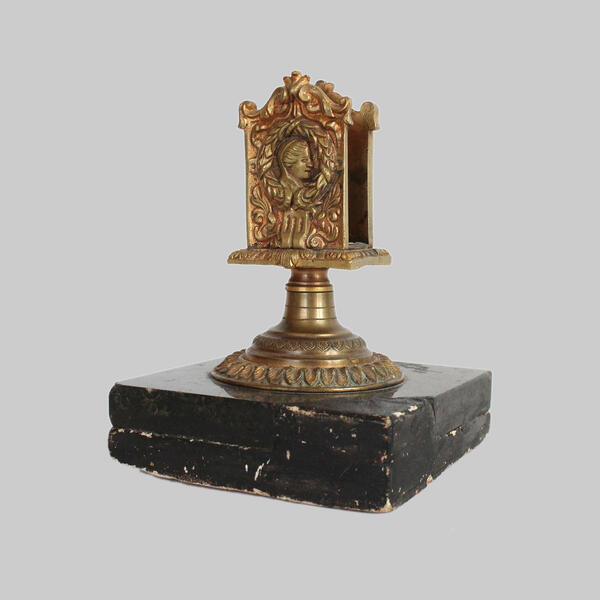
The match holder depicted here is a tabletop version, composed of three parts: the box holder, the leg, and the base. This holder is made of yellow metal with two parallel rectangular plates with a figured rise in the middle. On the front side you can see a relief image of a woman with a wreath on her head in profile. The leg was made short, with a circular cross-section decorated with small relief ornaments, and two belts with floral ornaments cut out on a round stepped base. The base is made of two square plates. The upper plate is made of black stone with green veins, while the lower plate is made of plaster, covered with black paint.
This match holder was added to the Yalutorovsk museum complex in 1994. It was acquired by museum staff during a business trip to St. Petersburg specifically for the exposition in the memorial house, which opened after it’s restoration.
The match holder served as a sort of case for the matchbox. Match holders were generally based on the dimensions of the match boxes they were to hold. The makers took into account the item’s application and released several types, including tabletop, fireplace, and pocket versions. Tabletop match holders were mounted onto a standing leg, decorated with precious stones and engraved drawings, which were filled with niello or colored enamel. Brass and copper were predominantly used in manufacturing fireplace match holders. Such match holders were intended for large matchboxes and were usually true works of art. Pocket match holders were completely metal with two holes.
Various materials were used in manufacturing match holders, including bronze, silver, aluminum and brass. Each of these materials gave the work a unique personality and quality.
The match holder depicted here is a tabletop version, composed of three parts: the box holder, the leg, and the base. This holder is made of yellow metal with two parallel rectangular plates with a figured rise in the middle. On the front side you can see a relief image of a woman with a wreath on her head in profile. The leg was made short, with a circular cross-section decorated with small relief ornaments, and two belts with floral ornaments cut out on a round stepped base. The base is made of two square plates. The upper plate is made of black stone with green veins, while the lower plate is made of plaster, covered with black paint.
This match holder was added to the Yalutorovsk museum complex in 1994. It was acquired by museum staff during a business trip to St. Petersburg specifically for the exposition in the memorial house, which opened after it’s restoration.
#26
Date: 19th century
Technique: casting, engraving, carving
Place: Russia
Dimensions: height 13.7 cm; base: - 10,5×10,5×2,6 cm
Copyright: Tyumen Museum and Educational Association
Collection: Metal
Technique: casting, engraving, carving
Place: Russia
Dimensions: height 13.7 cm; base: - 10,5×10,5×2,6 cm
Copyright: Tyumen Museum and Educational Association
Collection: Metal
#27
Inkwell
#28
#29
The first inkwells appeared in ancient times with the invention of ink, as there was a need for ways to store them. One of the first inkwells was found during archaeological excavations in the ancient Roman city of Herculaneum, destroyed after the eruption of Mount Vesuvius and buried under a large layer of volcanic ash many centuries ago. An inkwell in the form of a clay bowl retained a dark sediment at the bottom. Research has shown that this was old ink made of soot and diluted with oil.
In the Middle Ages, inkwells were made of leather, horn and metal. The British began to release them from glass. They managed to develop a new safe inkwell.
The neck of the inkwell had a special cone-shaped funnel that did not allow ink to flow out, even if the vessel was overturned. In different countries, depending on the era, inkwells of various shapes and sizes were made using porcelain, stone, metal or polymers.
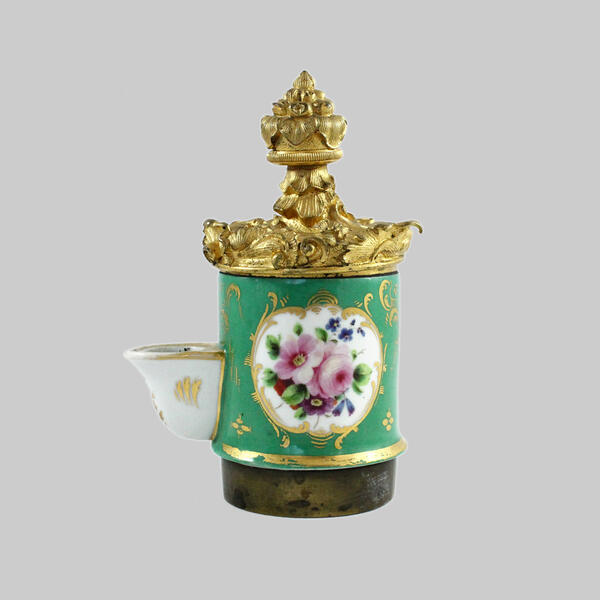
The inkwell displayed in the Decembrists in Yalutorovsk exhibit is made of porcelain, bronze, glaze and gilding. Presumably it was made at the Alexei Popov’s plant in the village of Gorbunovo, Dmitrovsky district, Moscow governorate in the 1840s-1850s.
The inkwell is made in the form of a cylinder with a groove on the side. The groove is a special device in the ink tank for dipping the pen into the ink. They installed it on a metal base, and on top it was covered with a metal lid decorated with a relief floral ornament. The surface of the inkwell is painted. On a green background, there are two curved reserves an area of the image that is not painted over during drawing. The reserves include bouquets of pink, red, blue, lilac flowers. Around the reserves and between them, you can see golden curves. The white groove was decorated with a golden outline and branches.
A cylindrical piston is installed inside the ink tank. It attaches to the lid and presses on the ink, which then enters the groove through the circular hole.
This inkwell was purchased in the antique department of a bookstore in Moscow for an exposition in the house of M.I. Muravyov-Apostol.
In the Middle Ages, inkwells were made of leather, horn and metal. The British began to release them from glass. They managed to develop a new safe inkwell.
The neck of the inkwell had a special cone-shaped funnel that did not allow ink to flow out, even if the vessel was overturned. In different countries, depending on the era, inkwells of various shapes and sizes were made using porcelain, stone, metal or polymers.
The inkwell displayed in the Decembrists in Yalutorovsk exhibit is made of porcelain, bronze, glaze and gilding. Presumably it was made at the Alexei Popov’s plant in the village of Gorbunovo, Dmitrovsky district, Moscow governorate in the 1840s-1850s.
The inkwell is made in the form of a cylinder with a groove on the side. The groove is a special device in the ink tank for dipping the pen into the ink. They installed it on a metal base, and on top it was covered with a metal lid decorated with a relief floral ornament. The surface of the inkwell is painted. On a green background, there are two curved reserves an area of the image that is not painted over during drawing. The reserves include bouquets of pink, red, blue, lilac flowers. Around the reserves and between them, you can see golden curves. The white groove was decorated with a golden outline and branches.
A cylindrical piston is installed inside the ink tank. It attaches to the lid and presses on the ink, which then enters the groove through the circular hole.
This inkwell was purchased in the antique department of a bookstore in Moscow for an exposition in the house of M.I. Muravyov-Apostol.
#30
Date: 1840-1850s
Technique: casting, overglaze painting, gilding
Place: Moscow governorate, Dmitrovsky district, Gorbunovo
Dimensions: 16,3×6,3 cm
Collection: Ceramics
Copyright: Tyumen Museum and Educational Association
Goskatalog Number: 4379851
Technique: casting, overglaze painting, gilding
Place: Moscow governorate, Dmitrovsky district, Gorbunovo
Dimensions: 16,3×6,3 cm
Collection: Ceramics
Copyright: Tyumen Museum and Educational Association
Goskatalog Number: 4379851
read morehide
00:00
00:00
1x
Dresser desk, Blotter, Match holder, Inkwell
Collection
Exhibition
0
 Point your smartphone camera to open in the app
Open in app
Share