Font
Color
Graphics
Изображение точки

To see AR mode in action:

1. Install ARTEFACT app for iOS or Android;

2. Find the exhibition «The Kurgan Regional Art Museum»

3. Push the «Augmented reality» button and point your phone's camera at the exhibit;

Скрыть точки интересаПоказать точки интереса

Columbus’s Caravelles, Mother

0
Open in app
#5
Columbus’s Caravelles, Mother
#6
Columbus’s Caravelles
#2
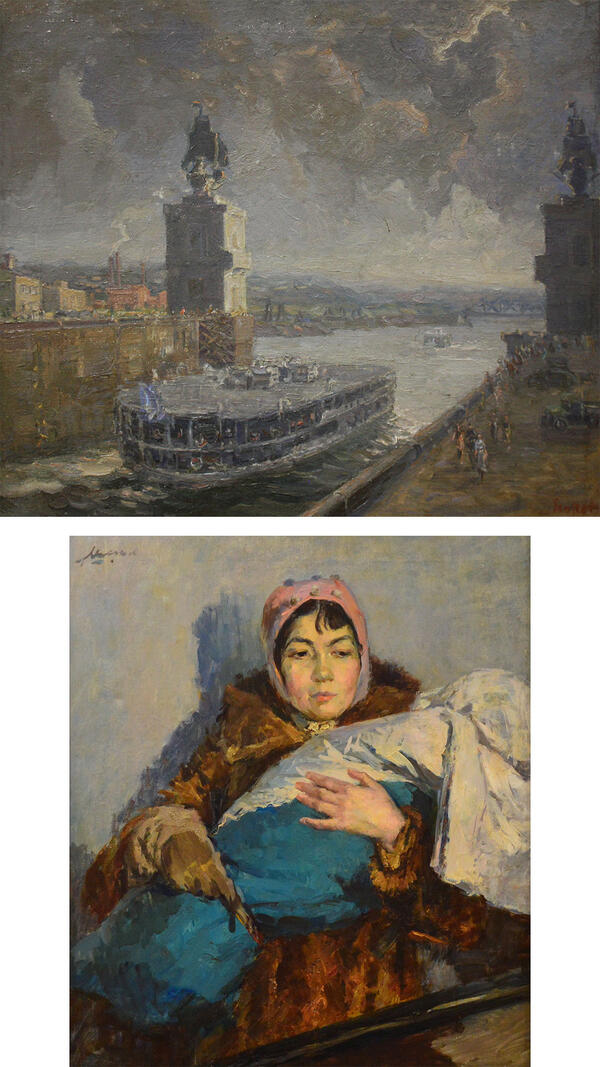
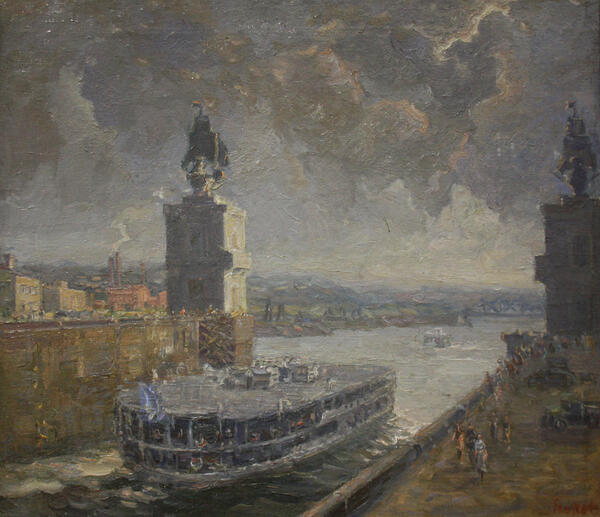
One of the projects carried out during the period of famous Stalin’s five-year plans was a massive reconstruction of the waterways of the Soviet Union. The growing production, expanding and construction of the new and already existing cities required great quantities of water which the existing rivers couldn’t supply. Except for that the new waterways were supposed to unite the northern and the southern seas with inland waters. In such a way the White Sea-Baltic Canal, the Volga-Don Canal, and the Moscow Canal were completed in record-breaking time.

The last one was supposed to fill Moscow with waters and turn it, according to Joseph Stalin, into the port of the five seas. In order to build the Moscow Canal, the special DmitLag, or Dmitrovsky Forced Labor Camp was organized. One of the areas, namely flood-gate № 3, was passing next to Dmitrov. The artist Yevgeniy Yegovov used to live there back then with his wife.

Yegorov studied at the Saratov Art and Pedagogical Institute in 1920-1923. He was influenced by German Expressionism and Van Gogh and worked a lot in graphic art, while most of his works were landscapes and genre paintings. The artist’s works constitute the individual and avant-garde approach to art. Yegorov created many satirical works in caricature genre, worked in expressionist manner.

His work “The Moscow Canal. Columbus”s Caravels’ is completely different in its manner. Yevgeny Yegorov was appointed as a main painter of Dmitrov and was supposed to decorate the celebrations of the canal opening. At the day of the event on July 15, 1937 he presented the city with the painting Canal Opening, and completed a number of drawings, engravings, and paintings. The artist had to work in a manner of Social realism, which was an antithetical style for him, that’s why we have a very curious example here revealing the new side of Yegorov’s art.

However, even in this commissioned work the artist managed to capture not just the triumph of the construction and power of the Soviet Union, but drama and inner reflection on the price of such construction. During his trips around the canal under construction Yevgeniy Yegorov saw the scenes of hard, backbreaking labour of the workers. He saw all the unbelievable suffers the prisoners were going through. It looks like the painting is made of the brush strokes electrified with the lightning, which is just about to happen. The general palette tends to grey and blue-grey tones. They neither have a ‘flight of a brush’ typical for the artist, nor light colours.

Yegorov died in evacuation in 1942 of tuberculosis. The painting given to the Kurgan museum by his widow Muza Aleksandrovna for a number of years has been in the museum’s main exposition as an outstanding example of the 1930s art.
#7
Mother
#4
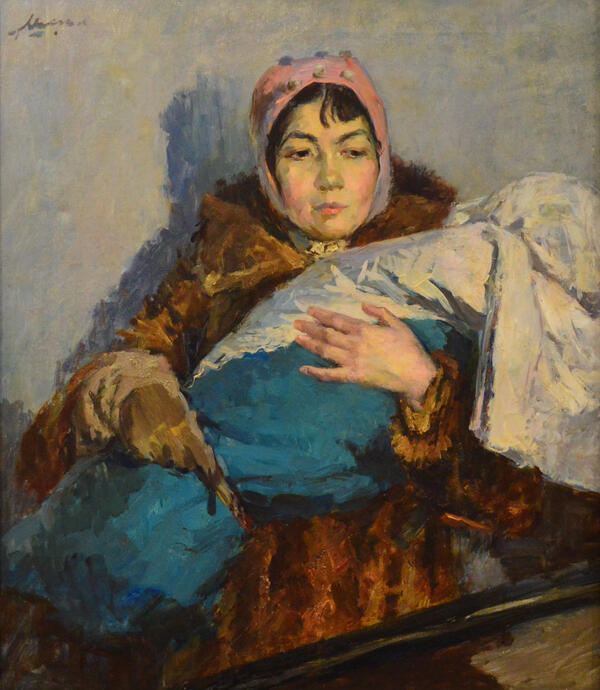
The sketch for the painting entitled On the Escalator, shortly named Mother, was made by a Soviet painter Grigory Shegal, a corresponding member of the Academy of Arts and an author of many paintings on historical events, landscapes, portraits, and still lifes. Shegal expressed himself as a true artist of his time reflecting the values of a new man and a new country in his art.

Grigory Shegal was born in 1889, so at the moment of changing of the political system he was a grown man. Shegal accepted the spirit and the challenge of new reality and became an active participant of the art life. His works were the kaleidoscope of faces and images showing our fellow countrymen as well as the main events in the social and economic life (On to the Technique Mastering, At the Book, The Portrait of the Engine Driver, and others).

The portrait sketch Mother from the collection of the Kurgan Regional Art Museum was painted one year before the start of the Great Patriotic War and it shows the image of a young ruddy woman holding a baby in her hands. She’s absorbed in her thoughts and doesn’t get distracted. The sketch was painted by the artist while working on the canvas entitled On the Escalator of Moscow Metro created in 1941-1943. At the moment the painting is in the collection of the Art Museum of Altai.

Construction of the Moscow metro was a remarkable event in the capital’s life. The metro wasn’t just a new transport system, it was supposed to demonstrate the whole beauty and festivity of the Soviet reality. According to the author’s idea, the people of different ages and social classes of the Soviet society (young people, children and old people, soldiers and students, intellectuals and villagers) were supposed to appear in the painting going up and down at the escalator.

The mother’s image also corresponded to the author’s idea about the variety of the Soviet people. In the list of Shegal’s works given in the Sofya Razumovskaya’s monograph this sketch is entitled Mother (Bashkir Woman ot the Escalator). The woman shown in the sketch indeed has distinctive Eastern facial features. It’s remarkable that it’s the image of a mother with a child which is the central one in the painting. The artist slightly changed the angle and visually enlarged the blanket covering the baby. In terms of colour it’s the lightest place in the painting. The viewer’s attention immediately gets drawn to this very image. The artist’s choice was therefore not accidental.

Shegal was working on this painting during the war time. The painting rich with people’s feelings and emotions gives a main idea (placed in doubt by the war) about the value of human life. This work is one of the most expressive images of mothers in the whole collection of the Kurgan museum.
read morehide
00:00
00:00
1x

Columbus’s Caravelles, Mother

0
Point your smartphone camera to open in the app
Share
VkontakteOdnoklassnikiTelegram
Share on my website
Copy linkCopied
Copy
Open in app
To see AR mode in action:
  1. Install ARTEFACT app for 
  2. iOS or Android;
  3. Find and download the «Paintings in Details» exhibition
  4. Push the «Augmented reality» button and point your phone's camera at the painting;
  5. Watch what happens on your phone screen whilst you flip through the pictures.
 
We use Cookies
Cookies on the Artefact Website. We use cookies to ensure that we give you the best experience on our website. If you continue without changing your settings, we'll assume that you are happy to receive all cookies on the Artefact website. However, if you would like to, you can change your cookie settings at any time.
Learn more about cookie useHide
Content is available only in Russian

X

Нашли опечатку?...

%title%%type%