Font
Color
Graphics
Изображение точки

To see AR mode in action:

1. Install ARTEFACT app for iOS or Android;

2. Find the exhibition «Ancient Cultures of the Trans-Ural Steppe»

3. Push the «Augmented reality» button and point your phone's camera at the exhibit;

Скрыть точки интересаПоказать точки интереса
Показать в высоком качестве
#2
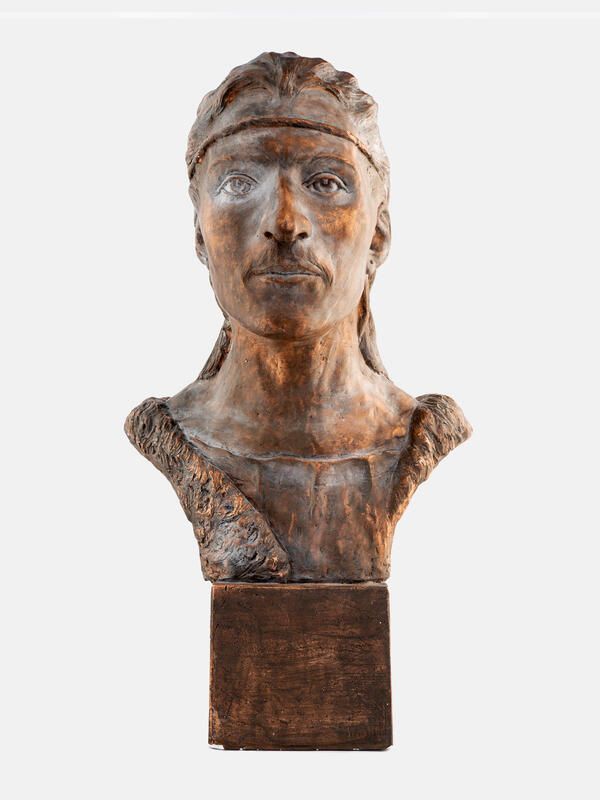
Bust of a man. Aleksandrovsky IV burial ground
#6

The sculptural reconstruction of the face is based on the skull of a man, which was discovered in mound 5 of Aleksandrovsky IV burial ground. This burial ground is the earliest monument of the Bronze Age in the Arkaim valley, located 320 meters from the fortified settlement of Arkaim.

The skull is of the Caucasoid type. Its specific features are the low face (extremely low face and orbit compared to other skulls of the series), small canine fossa, nasal bones with a sharp M-shaped incisure in the rhinal part. They are often found in craniological materials of the Botai and Sintashta cultures. The above-described characteristics suggest a share of the Uraloid anthropological component in the population.

The anthropologist Alexey Nechvaloda carried out a number of skull reconstructions of Bronze Age and Early Iron Age monuments for the exhibition and projects of the “Arkaim” Museum-Reserve. The reconstruction of the physical appearance of people who lived in the distant past begins with the determination of age, sex and individual features of the person under study (traces of past injuries and chronic diseases, deformation of the mouth due to loss of teeth, and age-related changes).

The next stage is the restoration of the external appearance based on the skull. This technique, which continues to be perfected today, was developed by the famous anthropologist Mikhail Gerasimov. He revealed the dependence between the structure of bones and the thickness of muscles on them. The work is completed by reproduction of hairstyle and clothes according to historical data. A mold, removed from the bust, is used to make plaster or plastic copies, and the skull that was used is returned to the repository. Today, the results of research by Mikhail Gerasimov, his students and followers are widely used in museum practice, historical reconstructions, plastic surgery and forensics.

The reconstruction of the skull resulted in the presented sculptural portrait of a man with a Caucasoid face. The short hair combed into a parting on the right side falls to the back of the head. The edges of the garment with a wide vertical neckline are shaped like a coarse cloth. On the neck is a pendant in the form of an animal fang on a thin string.
#7
Name: Bust of a man. Aleksandrovsky IV burial ground
Author: Alexey Nechvaloda
Date of creation: 2010
Place of creation: Ufa, Republic of Bashkortostan, Russia
Technique: tinted plaster; three-dimensional sculpture
Dimensions: 49,5×29 cm
#3
Bust of a man. Bolshekaragan burial ground
#13

The sculptural reconstruction of the face is based on the skull of a man, which was discovered in mound 25 of the Bolshekaragan burial ground in 1992. Dmitry Zdanovich led the research of the mound. The Bolshekaragan burial ground is located in the Kizilsky district of Chelyabinsk region, 3.5 kilometers east-northeast of the village of Aleksandrovskoye, on the left bank of the Bolshaya Karaganka River.

The ancient people of Arkaim and Sintashta culture mainly belonged to the Caucasoid anthropological type. However, in terms of appearance and origin they were not homogeneous, especially in the early stages, when this society was emerging. According to the results of one of the latest studies, where DNA samples of people from burial grounds of the Arkaim time were used, two thirds of the population of Arkaim and “The Land of Cities” descended from steppe herders who came from the regions of the Pre-Caucasus (Pit Grave cultural and historical community). One third was made up of the local Eneolithic population. The representatives of the population were notable for their good health for that time and were not subjected to excessive physical strain. They did not suffer from hunger, their food was soft and contained a lot of protein; there are traces of healed fractures on the bones, which indicates the presence of some level of medical knowledge.

The anthropologist Alexey Nechvaloda carried out a number of skull reconstructions of Bronze Age and Early Iron Age monuments for the exhibition and projects of the Arkaim Museum-Reserve.

The reconstruction of the physical appearance of people who lived in the distant past begins with the determination of age, sex and individual features of the person under study. The next stage is the restoration of the external appearance based on the skull. This technique, which continues to be perfected today, was developed by the famous anthropologist Mikhail Gerasimov. The work is completed by reproduction of hairstyle and clothes according to historical data. A mold, removed from the bust, is used to make plaster or plastic copies, and the skull that was used is returned to the repository.

#8
Name: Bust of a man. Bolshekaragan burial ground
Author: Alexey Nechvaloda
Date of creation: 2008
Place of creation: Ufa, Republic of Bashkortostan, Russia
Technique: wood, tinted plaster; three-dimensional sculpture
Dimensions: 41×28 cm
#4
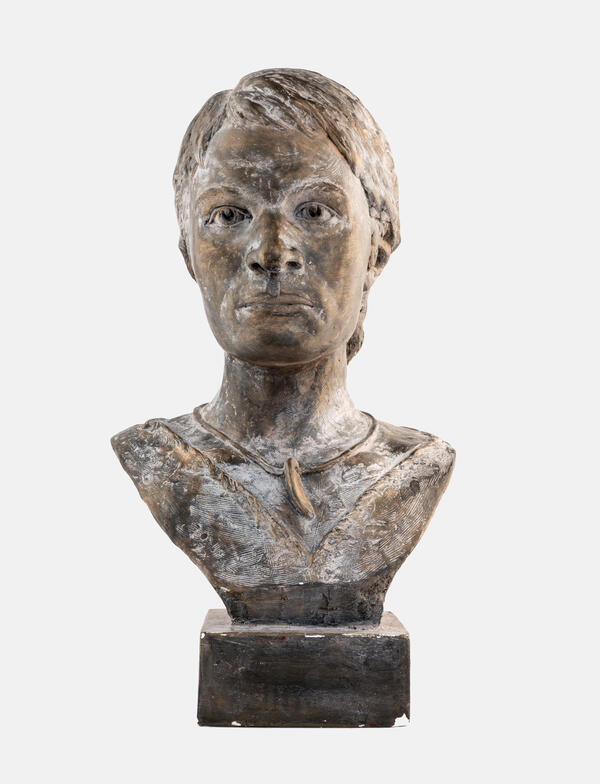
Bust of a woman. Bolshekaragan burial ground
#12

Anthropologists suggest that the Arkaim population included “steppe” Caucasoids, a partly southern Caucasoid component and a mixed Caucasoid-Uraloid anthropological type. A significant part of female skulls is defined as Uraloid.

According to the experts who studied the burials of the Arkaim necropolis, the average life expectancy of the Arkaim population was 30–40 years. Representatives of the population were notable for their good health for that time and were not subjected to excessive physical strain. Their food was soft and contained a lot of protein, and there are traces of healed fractures on the bones, which indicates the presence of some level of medical knowledge.

The anthropologist Alexey Nechvaloda carried out a number of skull reconstructions of Bronze Age and Early Iron Age monuments for the exhibition and projects of the “Arkaim” Museum-Reserve. The reconstruction of the physical appearance of people who lived in the distant past begins with the determination of age, sex and individual features of the person under study — these are traces of injuries and chronic diseases, deformation of the mouth when teeth fall out, and age-related changes. Anthropologists determine age by tooth abrasion and cranial sutures, as well as by the results of the study of the facial skeleton.

The next stage is the restoration of the external appearance based on the skull. This technique, which continues to be perfected today, was developed by the famous anthropologist Mikhail Gerasimov. He revealed the dependence between the structure of bones and the thickness of muscles on them. The technique involves the restoration of masticatory muscles, which determine the outline of the lower half of the face. Using tables of soft tissue thickness in different parts of the head, the surface of the face is formed, and then the parts — nose, eyes and mouth — are modeled. The work is completed by reproduction of hairstyle and clothes according to historical data. A mold, removed from the bust, is used to make plaster or plastic copies, and the skull that was used is returned to the repository. Today, the results of research by Mikhail Gerasimov, his students and followers are widely used in museum practice, historical reconstructions, plastic surgery and forensics.

#11
Name: Bust of a woman. Bolshekaragan burial ground
Author: Alexey Nechvaloda
Date of creation: 2008
Place of creation: Ufa, Republic of Bashkortostan, Russia
Technique: wood, tinted plaster; three-dimensional sculpture
Dimensions: 54×24 cm
#5
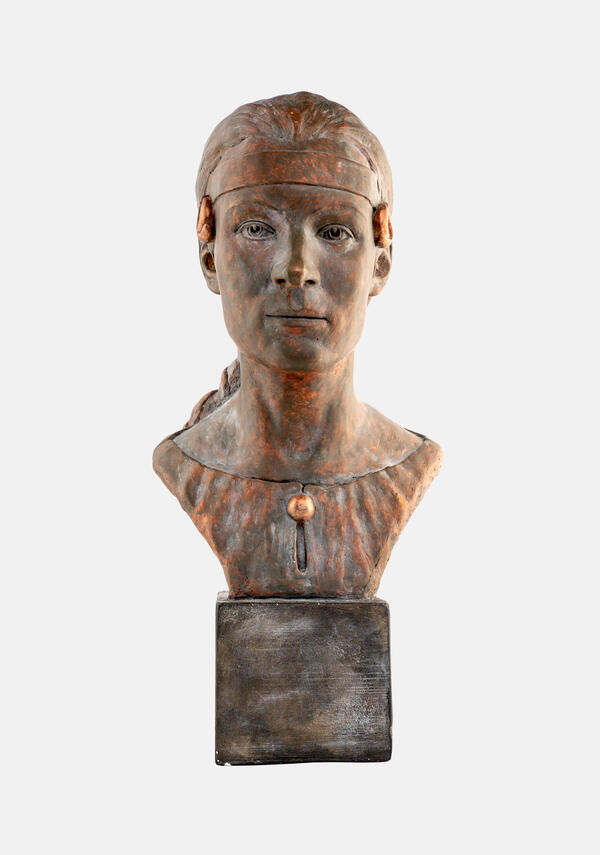
Bust of a woman. Kizilsky I burial ground
#9

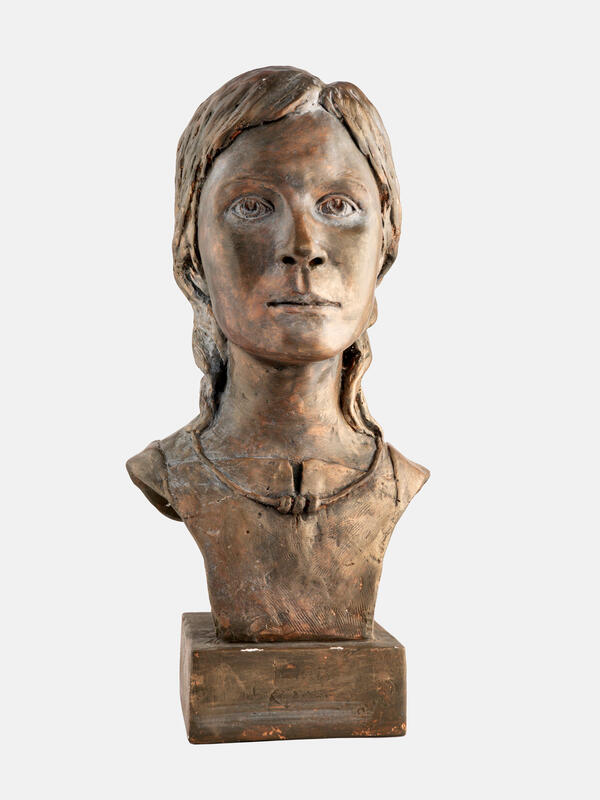
The sculptural reconstruction of the face is based on the skull of a woman, which was discovered in mound 2 of the Kizilsky I burial ground. The mound was studied under the guidance of the archaeologist Tatiana Sergeevna Malyutina in 2009.

During the excavation of the burial ground three skulls were found — one of a man, one of a woman and one of a child. The skulls of the man and woman are dolichocranial (a skull shape characterized by a significant predominance of the longitudinal diameter over the transverse diameter). They have a broad, taller, mostly sharply horizontally profiled face, sloping forehead, and a medium or small angle of occipital flexure. These features are close to the characteristics of the Pit Grave Eastern European cranial series. The specific feature of this series is a small protrusion of the nasal bones.

The anthropologist Alexey Nechvaloda carried out a number of skull reconstructions of Bronze Age and Early Iron Age monuments for the exhibition and projects of the “Arkaim” Museum-Reserve. The reconstruction of the physical appearance of people who lived in the distant past begins with the determination of age, sex and individual features of the person under study — these are traces of injuries and chronic diseases, deformation of the mouth when teeth fall out, and age-related changes. Anthropologists determine the age by tooth abrasion and cranial sutures, as well as by the results of the study of the facial skeleton.

The next stage is the restoration of the external appearance based on the skull. This technique, which continues to be perfected today, was developed by the famous anthropologist Mikhail Gerasimov. He revealed the dependence between the structure of bones and the thickness of muscles on them. The technique involves the restoration of masticatory muscles, which determine the outline of the lower half of the face. Using tables of soft tissue thickness in different parts of the head, the surface of the face is formed, and then the parts — nose, eyes and mouth — are modeled. The work is completed by reproduction of hairstyle and clothes according to historical data. A mold, removed from the bust, is used to make plaster or plastic copies, and the skull that was used is returned to the repository.

#1
Name: Bust of a woman. Kizilsky I burial ground
Author: Alexey Nechvaloda
Date of creation: 2010
Place of creation: Ufa, Republic of Bashkortostan, Russia
Technique: tinted plaster; three-dimensional sculpture
Dimensions: 49×24,5 cm
#10
read morehide
Point your smartphone camera to open in the app
Share
VkontakteOdnoklassnikiTelegram
Share on my website
Copy linkCopied
Copy
Open in app
To see AR mode in action:
  1. Install ARTEFACT app for 
  2. iOS or Android;
  3. Find and download the «Paintings in Details» exhibition
  4. Push the «Augmented reality» button and point your phone's camera at the painting;
  5. Watch what happens on your phone screen whilst you flip through the pictures.
 
We use Cookies
Cookies on the Artefact Website. We use cookies to ensure that we give you the best experience on our website. If you continue without changing your settings, we'll assume that you are happy to receive all cookies on the Artefact website. However, if you would like to, you can change your cookie settings at any time.
Learn more about useHide
Content is available only in Russian

X

Нашли опечатку?...

%title%%type%