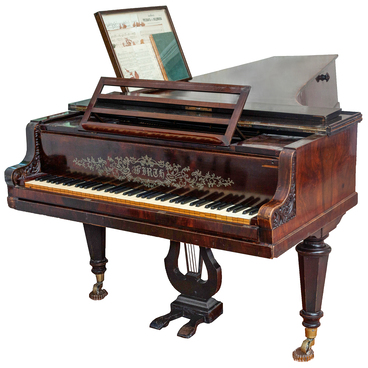
The collection of the House-Museum contains a sheet music folder with the work “Lucia di Lammermoor” by the Italian composer Gaetano Donizetti. A Tragic Opera in Three Acts.’ It belonged to Olga, the middle daughter of the Ulyanovs.
The musical notation of all parts of ‘Lucia di Lammermoor’ was printed in the late 1870s — early 1880s in Simbirsk printing house, which belonged to the merchant Alexander Tokarev. The Ulyanovs ordered the covering separately. On the inner side of the binding cover cardboard lid there is a sticker: ‘The printing house and bindery of A. T. Tokarev in Simbirsk’.
At the bottom of the title page there is a blue stamp: ‘Music store of A. B. Gutheil’, commissioner of the imperial theaters in Moscow. The store belonged to the Russian sheet music publishing firm that Alexander Gutheil founded in 1859 in Moscow. The firm specialized in the production of opera claviers by Russian and European composers, but it never had its print shop.
A clavier, or Klavierauszug, is an arrangement for piano and singing of a piece of music that a composer wrote for an ensemble of instruments. With claviers, complex operas and ballets could be played and sung at home.
Olga Ulyanova was born on November 4 (16th Old Style), 1871. She was the fourth child in the family of Ilya and Maria Ulyanov. Olga, like her mother, loved music and singing and spent many hours at the piano. When the family was forced to leave Simbirsk for Kazan, Olga began to attend lessons with the well-known musician and conductor Alexander Orlov-Sokolovsky.
Olga did not abandon music even when she moved to St. Petersburg and entered the Physics and Mathematics Department of the Bestuzhev course. She wrote to her relatives: ‘I play at the courses in public. Beethoven is very popular here.’
Ulyanova participated in concerts for the benefit of the girl students in need, provided sheet music for her younger sister, just as her elder brother Alexander once brought her sheet music.
“Let her try to learn a Haydn sonata. If she doesn’t like it, I’ll advise her not to drop it, because it’s the kind of thing you have to learn well…” — Olga Ulyanova in a letter to her mother Maria Alexandrovna about Maria Ulyanova.
Anna Ulianova-Elizarova wrote that Olga through her assiduity and determination achieved more in music than her sisters and “played difficult classical pieces.”