Font
Color
Graphics
Изображение точки

To see AR mode in action:

1. Install ARTEFACT app for iOS or Android;

2. Find the exhibition «Tyumen — The War — The Great Victory»

3. Push the «Augmented reality» button and point your phone's camera at the exhibit;

Скрыть точки интересаПоказать точки интереса
Показать в высоком качестве
#1
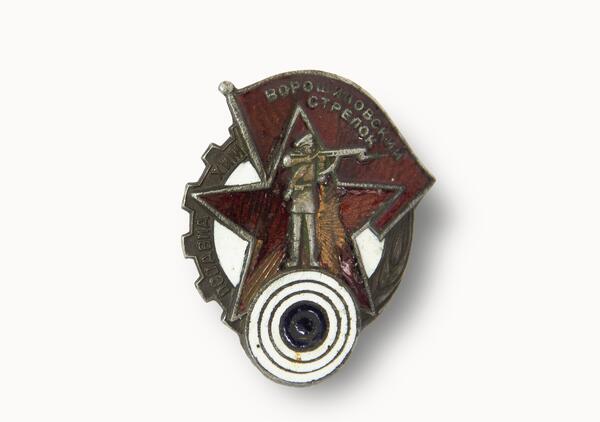
“Voroshilov Sharpshooter” badge
#2
In the early 1930s, the Soviet Union actively promoted the engagement and training of civilians in military affairs. For these purposes, the Society for the Assistance of Defense, Aircraft and Chemical Construction of the Soviet Union was formed in Moscow in 1927. It was also known as Osoaviakhim.

Its history can be traced back to the Military Scientific Society which was created during the Russian Civil War. Osoaviakhim existed until 1948 when it was reorganized into three separate voluntary societies. In 1951, they were once again combined into DOSAAF — the Volunteer Society for Cooperation with the Army, Aviation, and Navy.

Osoaviakhim contributed to the development of areas that were strategically important for the Soviet Union, including aviation, chemical defense, shooting skills, and sanitary defense. Its main goal was to involve the population in strengthening the nation’s defense capacities, as well as to organize supplementary reserves.

This was done mainly by establishing so-called grassroots units (clubs) at enterprises, where employees could complete training and pass a test to obtain distinguishing badges.

During its existence, Osoaviakhim established such badges as “Ready for Labor and Defense of the USSR”, “Ready for Air and Chemical Defense”, “For Sanitary Defense”, and “Voroshilov Rider”. To organize military training of the population, as well as to revive and develop shooting sports, in 1932, the Central Council of Osoaviakhim of the USSR also approved the title and badge “Voroshilov Sharpshooter”.

The badge consists of several parts. The main one is a round medallion painted with white enamel. Along the left edge, there is a part of a gear with the abbreviation “Osoaviakhim” inscribed on it. On the right, there is an ear of wheat. In the center, there is a five-pointed star painted with ruby enamel. It features the image of a shooter aiming a rifle. Above him, there is a scarlet banner with an inscription in gold letters that reads, “Voroshilov Sharpshooter”. Below, there is a white target with black circles.

The name of the badge is associated with an anecdote from the life of Kliment Yefremovich Voroshilov. It happened during qualification firing for commanders in the summer of 1932. The shooters went to their targets and reported their results to Voroshilov.

One target was completely untouched, and the shooter tried to justify his failure by the fact that the revolver was bad. Taking the revolver, Voroshilov shot at the target seven times, getting a high score of 59 points. Returning the weapon to the officer, Voroshilov said, “There are no bad weapons, there are bad shooters.” This story was published in a newspaper.
#3
Наименование: “Voroshilov Sharpshooter” badge
Дата создания: 1934
Место создания: the USSR
Техника: stamping, metal
Размеры: 3,1×3,9×0,5 cm
#4
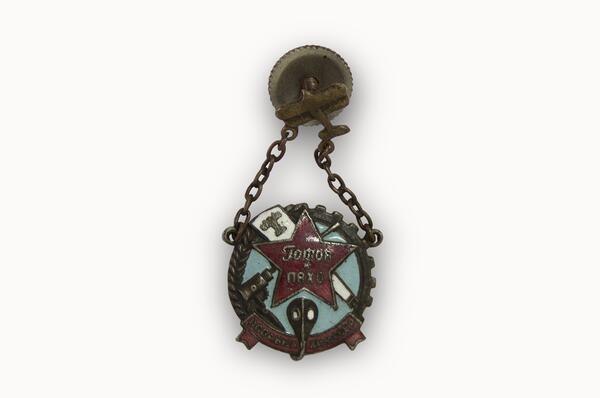
“Ready for Air and Chemical Defense” badge
#5
The “Ready for Air and Chemical Defense” badge from the exhibition “Tyumen — The War — The Great Victory” was produced in the USSR between 1935 and 1939. It has a round shape with gear elements and features images of an anti-aircraft gun, a gas mask, and an aircraft illuminated by a searchlight beam.

On top of these images, there is a red star with the inscription “Ready for Air and Chemical Defense” in three lines. At the bottom of the badge, there is a red ribbon with the inscription “Osoaviakhim of the USSR”. With the help of two side lugs and chains, the badge is connected to a suspension device in the form of a biplane.

The program of the sports and defense standard “Ready for Air and Chemical Defense” was introduced by the Central Council of Osoaviakhim in September 1934, and in August 1935, its badge was approved.

Each member of society who successfully passed the tests of the standard and actively participated in air and chemical defense events organized at home, work, collective farm, or school could receive such a badge.

These standards included the knowledge of a gas mask and the ability to use it correctly, the knowledge of air and chemical defense tasks, the ability to fight fires and provide first aid to fire victims. During the existence of the standard, over 38 million people underwent training in the area of air and chemical defense.

In 1940 alone, 9.8 million Soviet citizens passed the tests to qualify for the 1st-class standard. Judging by the articles in the newspapers of that time, the quality of training was not always good enough. In the summer of 1936, the 2nd class of the standard was introduced, but it did not become widespread.

To qualify for the 2nd class, it was necessary not only to pass the tests but also to be a shock worker and an active member of the air and chemical defense events of one’s house or factory and to have a gas mask. On January 28, 1937, the collective badge “Ready for Air and Chemical Defense” was approved, which was mounted on the facades of buildings.

In 1939, the design of 1st- and 2nd-class badges was changed. After the beginning of the Great Patriotic War, the production of badges was stopped, although people continued qualifying for the standard until 1946. Badges were mass-produced at different factories for several years. This is why there were many numerous variations in terms of stamp details, such as the gas mask shape or aircraft silhouette, and the material, such as bronze or steel.
#6
Наименование: “Ready for Air and Chemical Defense” badge
Дата создания: the 1920s — the 1930s
Место создания: the USSR
Техника: stamping
Размеры: 6×3×0,5 cm
#7
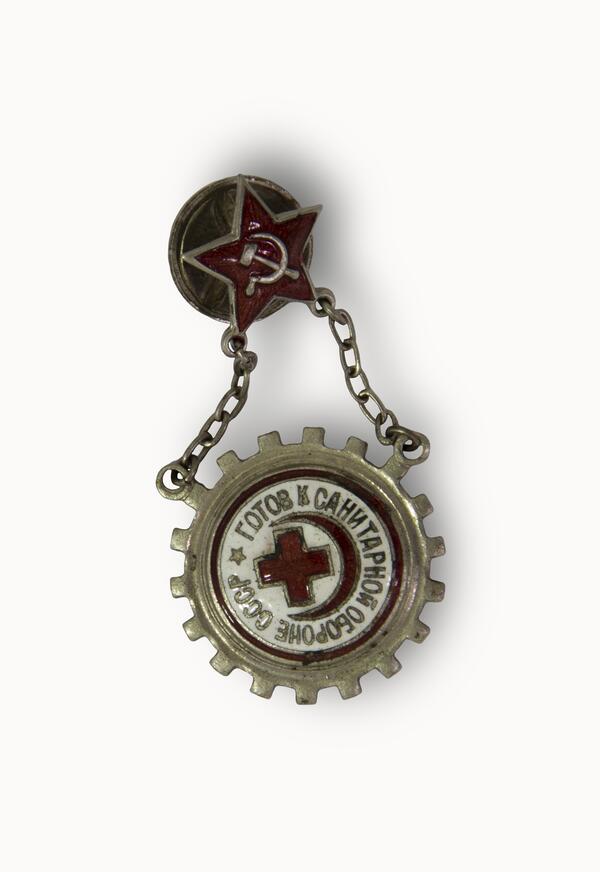
“Ready for Sanitary Defense of the USSR” badge
#8
The program of mass sanitary training of the population was implemented by the Union of the Red Cross and Red Crescent Societies of the USSR between 1934 and 1967. It included the knowledge of the rules of first aid, hygiene, sanitary and chemical defense.

After qualifying for the standards, Soviet citizens received a certificate and a badge “Ready for Sanitary Defense”. Voluntary aid posts and detachments were formed from among the activists of sanitary defense clubs. After 1967, a similar training program was implemented as part of the civil defense system.

The standards of military and sanitary knowledge for adults “Ready for Sanitary Defense of the USSR” were approved by the Executive Committee of the Union of the Red Cross and Red Crescent Societies of the USSR in 1934. The standards included requirements in the following areas: military sanitary defense, sanitary certificates for air defense, housing hygiene, food hygiene, personal hygiene, physical education, and red cross work.

The badge was made of tombac. It had a shape of a toothed gear with a diameter of 30 mm, in the center of which there were a red cross and a red crescent against a white background — the emblem of the Union of the Red Cross and Red Crescent Societies of the USSR. Along the circumference, there was the inscription that read, “Ready for Sanitary Defense of the USSR”. The badge was suspended on two chains and attached to a five-pointed star with a hammer and sickle. The badge was fixed with a pin.

In 1935, the Executive Committee of the Union of the Red Cross and Red Crescent Societies approved the regulations and standards of qualifying for the badge “Ready for Sanitary Defense of the USSR”, which included four sections: first aid and hygiene during hiking; air defense; school hygiene and sanitation; the organizational structure of the Red Cross and Red Crescent Societies. The badge was made of bronze and painted with hot enamel. It had a size of 22×22 mm.

The same year, the Executive Committee established the 2nd-class badge. It was awarded to those who passed stricter requirements. On a white flag above the gear, there was the number 2 with a red star inside. The badge was fixed with a screw. The production of 1st- and 2nd-class badges was stopped in June 1941 and resumed at the end of 1945 in the shape of a rhombus.
#9
Наименование: “Ready for Sanitary Defense of the USSR” badge
Дата создания: the 1930s
Место создания: the USSR
Техника: stamping
Размеры: 6,5×3×0,5 cm
#10
“Excellent Shooter” badge
#11
The “Excellent Shooter” badge was established by order of the Revolutionary Military Council on July 10, 1922. It was presented for successful combat training to Red Army officers and soldiers.

Its predecessors were the “1st-class Intelligence Officer” badge which was considered very prestigious in the Imperial Russian Army, as well as the “Excellent Rifle Shooter” badge, which was awarded between 1879 and 1917 and was divided into three classes during the reign of Nicholas II. Similar badges were also awarded in other countries to honor good shooters in cavalry and infantry troops.

The “Excellent Shooter” badge had the shape of a five-pointed star with elongated lower rays. It was painted with red enamel. In the center, there was an image of a hammer and sickle. On top of the star, there was an image of a Red Army soldier wearing a Budyonovka and an overcoat and holding a rifle. Behind the Red Army soldier, there was an image of a mounted machine gun. The lower rays of the star were connected by a ribbon with the inscription “Excellent Shooter”.

In 1928, the system of military awards and decorations was updated in the Soviet Union. New designs of badges were approved. Badges were divided into two classes, which corresponded to the first and second years of military service. The awards were presented based on the results of summer or winter training.

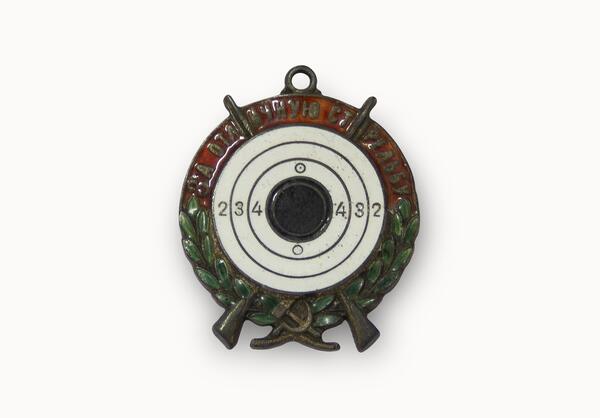
In 1938, by order of the People’s Commissar of Defense, the badge received a new design. It had the shape of a figured shield with a round white target on it. Above the target, there was a red five-pointed star with a hammer and sickle. The target was flanked by laurel branches.

The laurel branch was used on many military badges and medals: it symbolized the highest military glory. Behind the target, two crossed rifles were depicted on the badge. The reverse side was smooth and had an engraved inscription in five lines indicating the date and name of the recipient.

The “Excellent Shooter” badge from the museum’s collection used to belong to Nonna Alexeyevna Smirnova. She donated badges and medals, as well as her materials and archives, to the Tyumen Museum in 1989.
#12
Наименование: “Excellent Shooter” badge
Дата создания: the 1930s
Место создания: the USSR
Техника: stamping
Размеры: 3,2×2,7×0,5 cm
#13
“Shock Worker of 1932” badge
#14
In 1932, the Soviet Union widely celebrated the 15th anniversary of the Great October Socialist Revolution. It was also the final year of the first five-year plan. The best shock workers were awarded commemorative badges. 53,000 bronze and 10,000 silver badges were made.

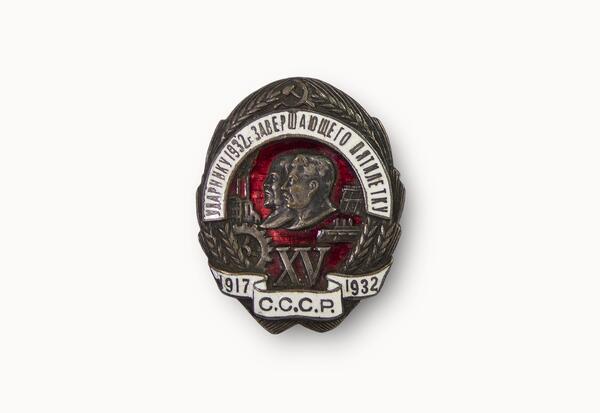
On the obverse, the badge was framed with ears of corn which symbolized labor. They had the same meaning on the coat of arms of the USSR. At the top of the badge, there was a hammer and sickle, which symbolized the union of workers and peasants. Below, in a semicircle, there was the inscription, “Shock Worker of 1932, Final Year of the Five-Year Plan”.

In the center, there were side-face portraits of the leaders of the world proletariat — Vladimir Ilyich Lenin and Joseph Vissarionovich Stalin. They were flanked by the images of a factory, a gear, a hydroelectric power station, and a motor ship. Below in the center, there were Roman numerals “XV”. Even lower, there was a white ribbon with the inscription “1917 USSR 1932”.

The first five-year plan had a great influence on the later development of the Soviet Union. The main tasks were to replace obsolete equipment with new advanced technology and to transform the USSR from an agrarian country into an industrial one.

As a result, the share of industrial output in relation to agricultural production rose from 48% at the beginning of the five-year plan (1928) to 70% by the end of its fourth year. By that time, the five-year program of general industrial production had been fulfilled by 94%.

The industrial output more than tripled compared to the pre-war level. As for the heavy industry production program, it was completed by 108%. At the same time, agriculture also developed rapidly.

Collective farms united over 60% of peasant farms covering more than 70% of all peasant territories. The Soviet Union started harvesting 1,200–1,400 million poods of marketable grain every year. Over 200,000 collective farms and about 5,000 state farms were established which were brand new large enterprises.
#15
Наименование: “Shock Worker of 1932” badge
Дата создания: 1932
Место создания: the USSR
Техника: stamping
Размеры: 4,4×3,6×0,5 cm
#16
read morehide
00:00
00:00
1x
Point your smartphone camera to open in the app
Share
VkontakteOdnoklassnikiTelegram
Share on my website
Copy linkCopied
Copy
Open in app
To see AR mode in action:
  1. Install ARTEFACT app for 
  2. iOS or Android;
  3. Find and download the «Paintings in Details» exhibition
  4. Push the «Augmented reality» button and point your phone's camera at the painting;
  5. Watch what happens on your phone screen whilst you flip through the pictures.
 
We use Cookies
Cookies on the Artefact Website. We use cookies to ensure that we give you the best experience on our website. If you continue without changing your settings, we'll assume that you are happy to receive all cookies on the Artefact website. However, if you would like to, you can change your cookie settings at any time.
Learn more about useHide
Content is available only in Russian

X

Нашли опечатку?...

%title%%type%