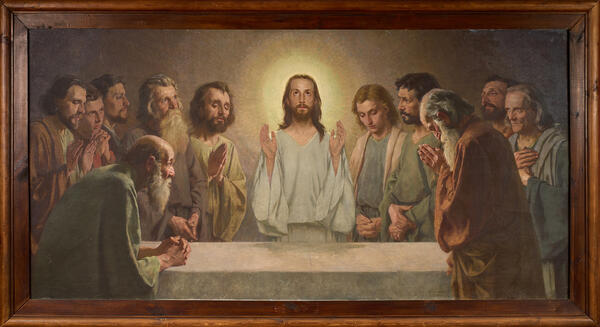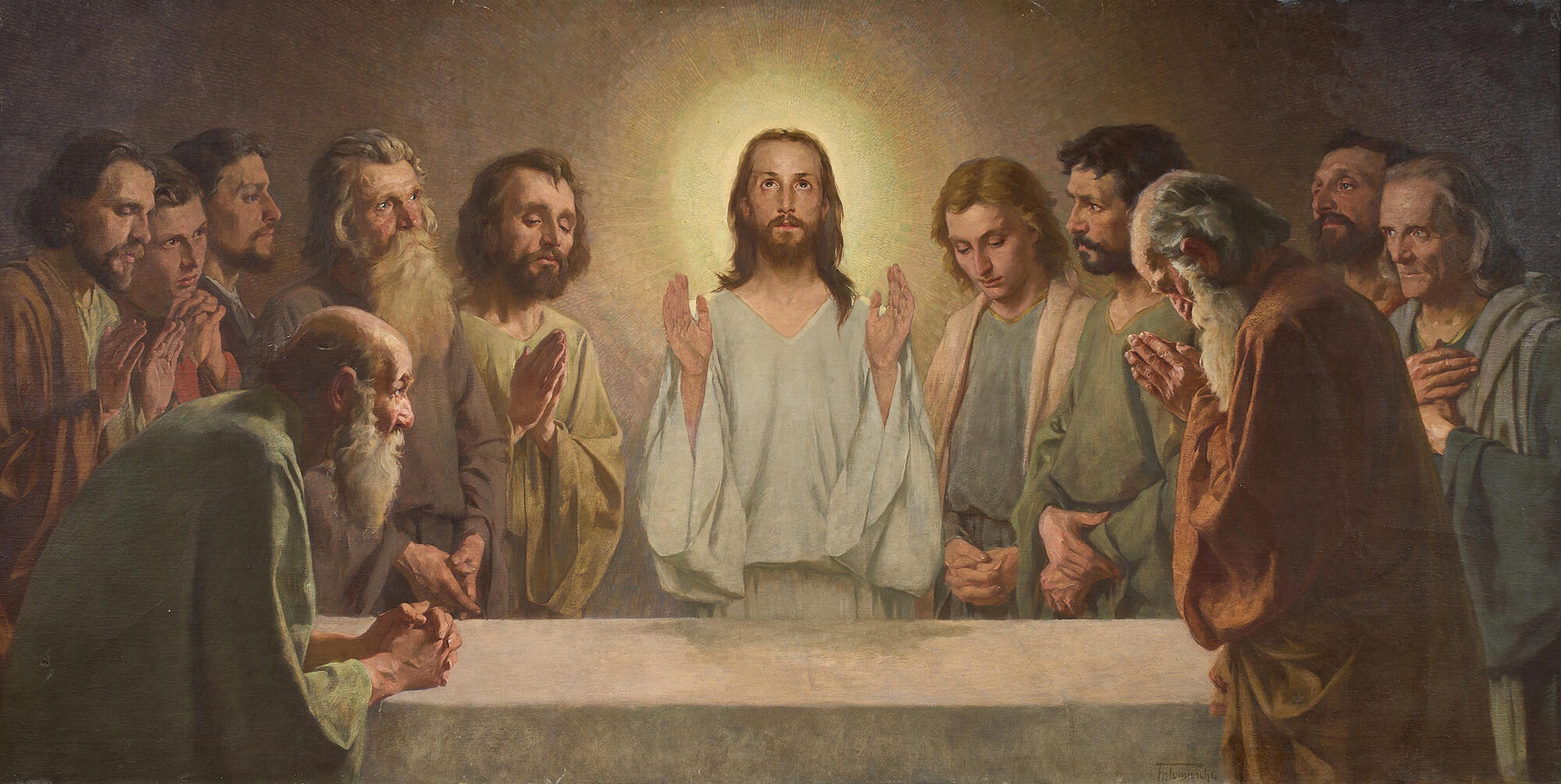


The painting by the Austrian artist Franz Tomashu “The Last Supper”, depicting Jesus Christ with His disciples, was originally kept in the Astrakhan estate of the Austrian merchant and passionate collector Otto Yakovlevich Wiblinger. The painting was displayed in the dining room of the Catholic house.
The artist turned to one of the key events described in the New Testament — the last meal that Jesus Christ had with His disciples on the eve of the Passion. Jesus Christ is depicted with His hands raised in the center of the composition surrounded by 11 disciples; the twelfth disciple, Judas, is missing. The artist did not award him a place in the painting. The last meal of Christ with His disciples takes place at an empty table, which serves as a barrier between the viewer and the characters of the scene. The compositional center of the canvas symbolically represents a cross formed by the figure of Christ and the horizontal tabletop that rather resembles a deathbed.
The image of Christ, interpreted by the artist in a generalized manner, is likened to a giant candle. The figure of the Savior seems to glow and illuminate the human figures surrounding Him. The light falls on the faces of the apostles, making their coarse vestments shine.
Franz Tomashu masterfully conveys the softness of expressively outstretched hands and the shock on the faces of the participants of the scene, turned to the compositional center of the painting, dominated by the figure of Christ.
The painting by Franz Tomas follows the framework of the academic tradition, which is generally characteristic of the work of this Austrian master. Thanks to a simple and evocative composition and expressive chiaroscuro interpretation of the images, the artist manages to convey the drama and inner tension of the sacred scene.