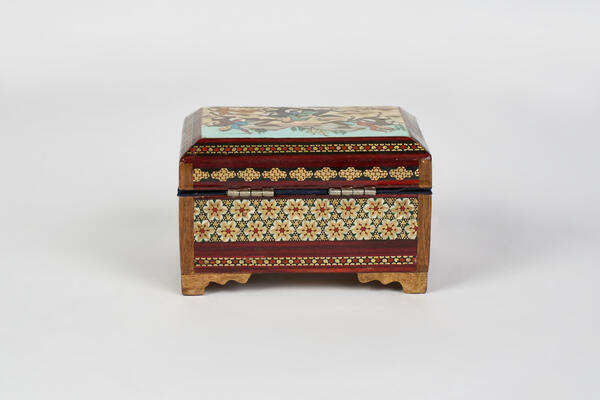
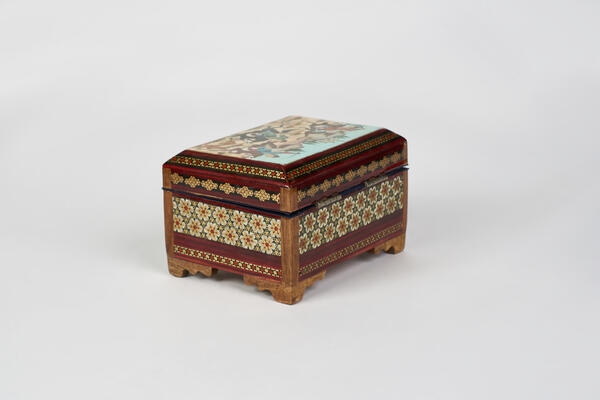
Khatam is the Persian art of inlaid woodwork. Windows and doors, chests and caskets, backgammon and chess boards, picture frames and stands for the Koran, as well as writing instruments — many such items were decorated with hexagonal patterns of small equilateral triangles. Patterns can also be five-, eight- and ten-sided, but it is the hexagons that remain the most popular geometric form.
Khatam artists opt for various woods: orange, pink, ebony, walnut, jujube, and eucalyptus. Black triangles are made of walnut and ebony, brown triangles are made of orange wood, while jujube is used for more expensive products.
In addition to wood, this inlay technique also uses bone (camel, cow and elephant), as well as oyster shells. White triangles are made of bone or mother-of-pearl.
Among other materials, the khatam technique utilizes metal wires — mainly copper, and for expensive products — silver or gold.
Each piece of wood and each fragment of bone that make up the future inlay pattern must be triangular in cross-section. Artists skilled in the khatam technique buy inlay materials from trusted suppliers: carpenters give wooden pieces the needed triangular shape, while the bone is thoroughly boiled, cleaned of fat and impurities and also given a triangular shape. Metal “strings” are stretched through a special machine.
The master carefully puts the triangular “sticks” together, alternating wood, bone and metal fragments in a certain order. At least 48 of these “sticks” are needed to make one “gol” (“flower”) resembling a star. Each “gol” is made separately, then the pieces are carefully glued together. Only after that, all these “stars” are joined together, eventually obtaining a workpiece of up to 30 centimeters in length. It is a long, hard and painstaking job.
It is very important that there are no gaps in the
finished work, and the components of each “flower” and the “flowers” themselves
are firmly attached to one another. A respectable workshop stores hundreds of
such workpieces — and the patterns are different on all of them. Then the
master selects the pattern he needs and cuts thin plates from the workpiece one
by one. The wooden base of the product (frame, casket or pencil case) is made
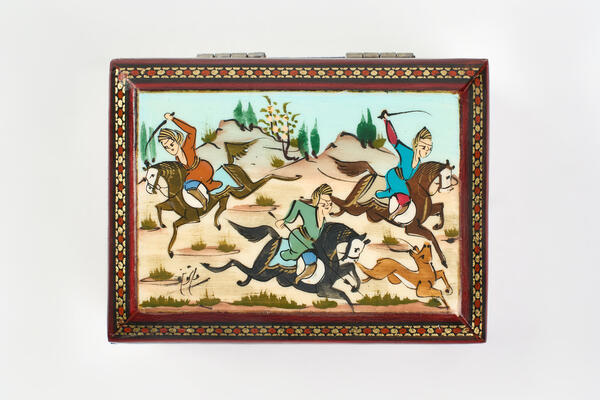
by the master in advance. The lids of wooden caskets decorated with inlays in
the khatam technique most often feature lacquer miniature paintings.