

#2
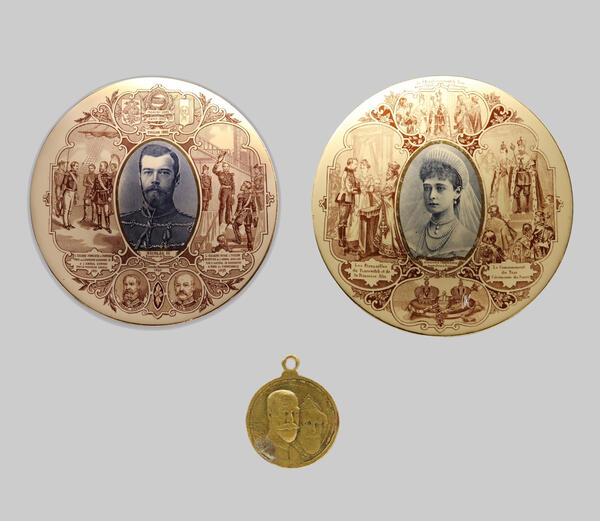
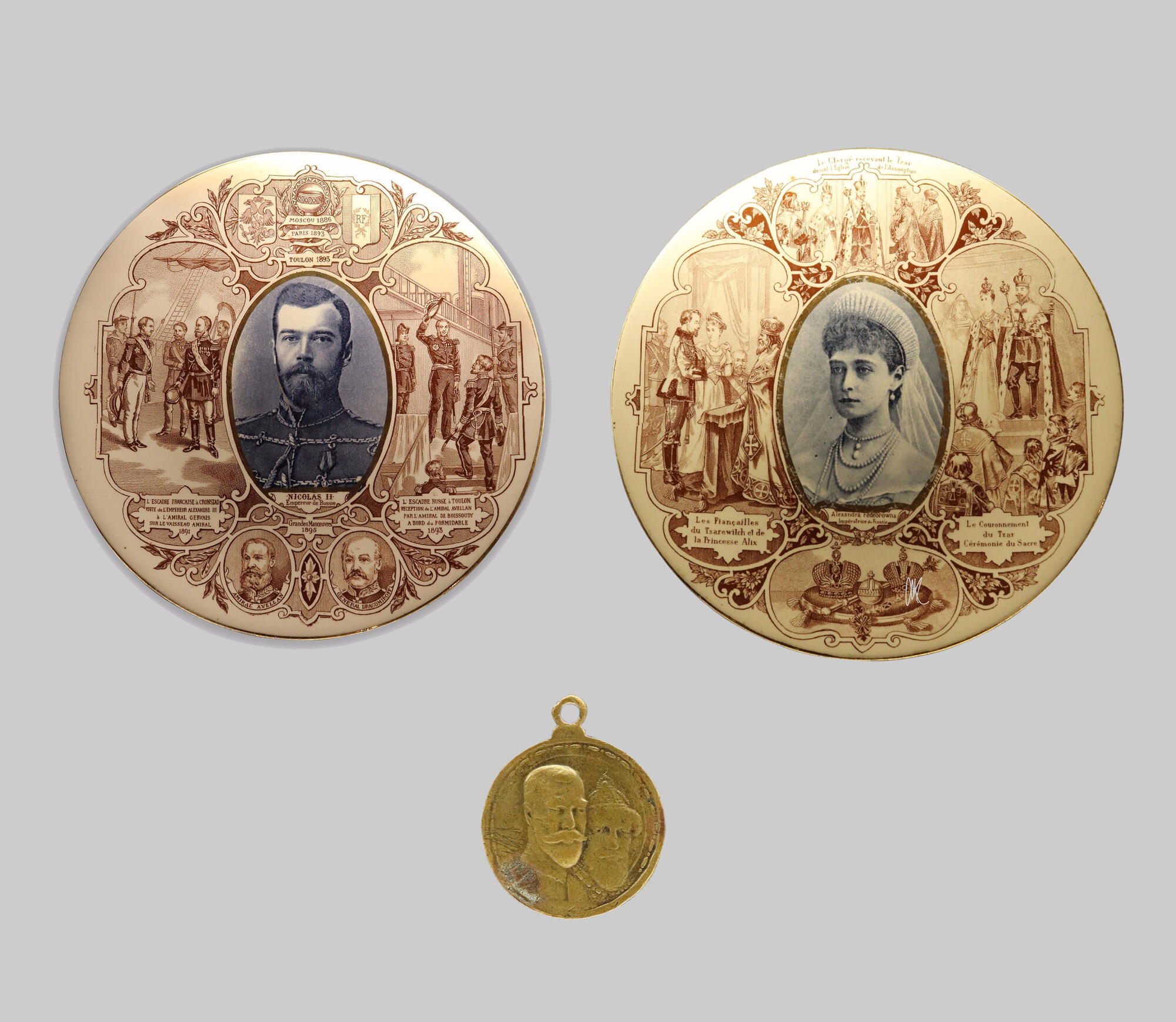
A plates with a portraits, a medals
#15
#3
#4
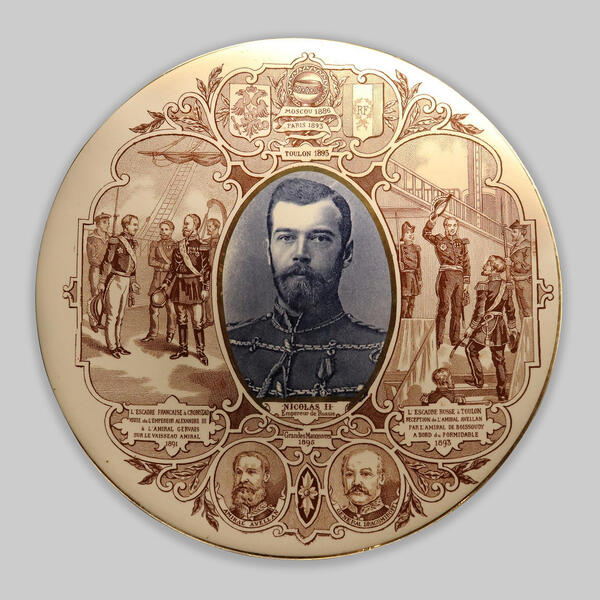
The limited release of plates was timed to coincide with the royal visit of Emperor Nicholas II and Empress Aleksandra Feodorovna to France in 1896. At the turn of the 20th century, works with portraits of the imperial couple were in the lead in the list of souvenir products manufactured by many French companies.
The plates, which are on display at the Palace Complex of Oldenburgs, were produced at the Sarreguemines factory, which is located in Lorraine, in northeastern France. Sarreguemines pottery ware has been famous since the 1790s, when three Strasbourg tobacco traders - Joseph Fabri and two Jacoby brothers, Augustine and Nicola-Henri, - built a pottery factory in Sarreguemines, on the left bank of the Saar. At the turn of the 20th century, Sarreguemines was considered one of the largest pottery ware producers in Europe. More than 3,000 people worked at its factories, which were located in various cities.
Photographs of the photographer Aniklot Pazetti became the basis for the decoration of the commemorative plates. In April 1882, together with Stepan Soloviev, he opened a photographic studio on Nevsky Prospect. Almost immediately after the opening, in June 1882, the workshop of Soloviev and Pazetti was honored with attention by Dowager Empress Maria Feodorovna. Subsequently, the photographer was more than once honored to fulfill orders both for the imperial couple themselves and for other members of the royal family. He took pictures of the imperial members in his studio on Nevsky Prospect, in the Winter Palace and in Tsarskoye Selo. In 1896, Aniklot Pazetti received a bronze medal at the All-Russian Exhibition of the Russian Photographic Society in Moscow for the portraits of the emperor and his wife.
The family of Emperor Nicholas II often used the services of Aniklot Pazetti. He was a real artist and could create an atmosphere of ease, thanks to which the pictures turned out to be lyrical and natural. Working with the Empress proved to be an effective advertisement for Pazetti, which made his photo studio famous for many years. Besides imperial members, famous writers, artists, musicians and other figures of that time were very fond of taking pictures at Pazetti’s.
The plates, which are on display at the Palace Complex of Oldenburgs, were produced at the Sarreguemines factory, which is located in Lorraine, in northeastern France. Sarreguemines pottery ware has been famous since the 1790s, when three Strasbourg tobacco traders - Joseph Fabri and two Jacoby brothers, Augustine and Nicola-Henri, - built a pottery factory in Sarreguemines, on the left bank of the Saar. At the turn of the 20th century, Sarreguemines was considered one of the largest pottery ware producers in Europe. More than 3,000 people worked at its factories, which were located in various cities.
Photographs of the photographer Aniklot Pazetti became the basis for the decoration of the commemorative plates. In April 1882, together with Stepan Soloviev, he opened a photographic studio on Nevsky Prospect. Almost immediately after the opening, in June 1882, the workshop of Soloviev and Pazetti was honored with attention by Dowager Empress Maria Feodorovna. Subsequently, the photographer was more than once honored to fulfill orders both for the imperial couple themselves and for other members of the royal family. He took pictures of the imperial members in his studio on Nevsky Prospect, in the Winter Palace and in Tsarskoye Selo. In 1896, Aniklot Pazetti received a bronze medal at the All-Russian Exhibition of the Russian Photographic Society in Moscow for the portraits of the emperor and his wife.
The family of Emperor Nicholas II often used the services of Aniklot Pazetti. He was a real artist and could create an atmosphere of ease, thanks to which the pictures turned out to be lyrical and natural. Working with the Empress proved to be an effective advertisement for Pazetti, which made his photo studio famous for many years. Besides imperial members, famous writers, artists, musicians and other figures of that time were very fond of taking pictures at Pazetti’s.
#5
Full name: A souvenir plate with a portrait of Emperor Nicholas II at the center
Author: Pazetti Aniklot
Date: 1896 year
Dimensions: Diameter - 21.5 cm
Copyright: Autonomous Cultural Institution of the Voronezh Region “Historical-Cultural Center “Palace Complex of the Oldenburgs”
Collection: Autonomous Cultural Institution of the Voronezh Region “Historical-Cultural Center “Palace Complex of the Oldenburgs”
Author: Pazetti Aniklot
Date: 1896 year
Dimensions: Diameter - 21.5 cm
Copyright: Autonomous Cultural Institution of the Voronezh Region “Historical-Cultural Center “Palace Complex of the Oldenburgs”
Collection: Autonomous Cultural Institution of the Voronezh Region “Historical-Cultural Center “Palace Complex of the Oldenburgs”
#16
A souvenir plate with the image of Empress Aleksandra Feodorovna
#6

#7
In 600 AD, ancient Chinese craftsmen began to create products that were highly durable with minimal subtlety. This is how the whole world learned about porcelain That material was an exceptional invention of the Chinese, which they did their best to keep secret. However, in 1300, Chinese porcelain plates began to appear gradually in European royal palaces. It was very expensive, so it was most often used not to serve dishes, but to decorate the interior. Only from the 17th century ‘tarel’ - the Russians quickly converted this word into ‘plate’ - began to become a household item and from the beginning of the 18th century it became simply irreplaceable in feasts.
However, the decorative life of the plate did not end there, but only began to develop. At the end of the 19th century, collecting decorative plates became fashionable. Service items in blue and white tones, as well as ancient and rare items, were a success. ‘Tarels’ in Russia were awarded to loyal tsarist servants for their special services. Such dishes were decorated with monograms and put in a prominent place in the house. Over time, commemorative plates began to be produced for various important events.
The limited release of plates was timed to coincide with the royal visit of Emperor Nicholas II and his spouse to France in 1896. At that time, many goods were produced in the Russian or pseudo-Russian style: Le Tsar soap, sweets with the Russian emblem or flag, dishes with tsars’ portraits, toys in the form of a Russian bear, as well as in the forms of the sovereign, empress and even Grand Duchess Olga. The tsar was portrayed by Maslenitsa “jumping devils”, the famous toy “man and bear” turned into tsar and Felix Fora. Advertising took advantage of the fashion: “Pink pills” were recommended to keep people healthy for the days of the tsar’s arrival; and on the backs of his portraits, which were handed out for free on the streets, advertisements for shoemakers and glovers were printed.
Similar plates are on display in the permanent exhibition of the Constantine Palace in St. Petersburg and the Metropolitan Museum in New York. The plates are also presented in the catalog of souvenirs for the visit of Emperor Nicholas II to France, which was published in 1897.
However, the decorative life of the plate did not end there, but only began to develop. At the end of the 19th century, collecting decorative plates became fashionable. Service items in blue and white tones, as well as ancient and rare items, were a success. ‘Tarels’ in Russia were awarded to loyal tsarist servants for their special services. Such dishes were decorated with monograms and put in a prominent place in the house. Over time, commemorative plates began to be produced for various important events.
The limited release of plates was timed to coincide with the royal visit of Emperor Nicholas II and his spouse to France in 1896. At that time, many goods were produced in the Russian or pseudo-Russian style: Le Tsar soap, sweets with the Russian emblem or flag, dishes with tsars’ portraits, toys in the form of a Russian bear, as well as in the forms of the sovereign, empress and even Grand Duchess Olga. The tsar was portrayed by Maslenitsa “jumping devils”, the famous toy “man and bear” turned into tsar and Felix Fora. Advertising took advantage of the fashion: “Pink pills” were recommended to keep people healthy for the days of the tsar’s arrival; and on the backs of his portraits, which were handed out for free on the streets, advertisements for shoemakers and glovers were printed.
Similar plates are on display in the permanent exhibition of the Constantine Palace in St. Petersburg and the Metropolitan Museum in New York. The plates are also presented in the catalog of souvenirs for the visit of Emperor Nicholas II to France, which was published in 1897.
#8
Full name: A souvenir plate with the image of Empress Aleksandra Feodorovna
Author: Pazetti Anaclet Alfred
Date: 1896 year
Dimensions: Diameter - 21.5 cm
Copyright: Autonomous Cultural Institution of the Voronezh Region Historical-Cultural Center ‘Palace Complex of the Oldenburgs’
Collection: Autonomous Cultural Institution of the Voronezh Region Historical-Cultural Center ‘Palace Complex: of the Oldenburgs’
Author: Pazetti Anaclet Alfred
Date: 1896 year
Dimensions: Diameter - 21.5 cm
Copyright: Autonomous Cultural Institution of the Voronezh Region Historical-Cultural Center ‘Palace Complex of the Oldenburgs’
Collection: Autonomous Cultural Institution of the Voronezh Region Historical-Cultural Center ‘Palace Complex: of the Oldenburgs’
#17
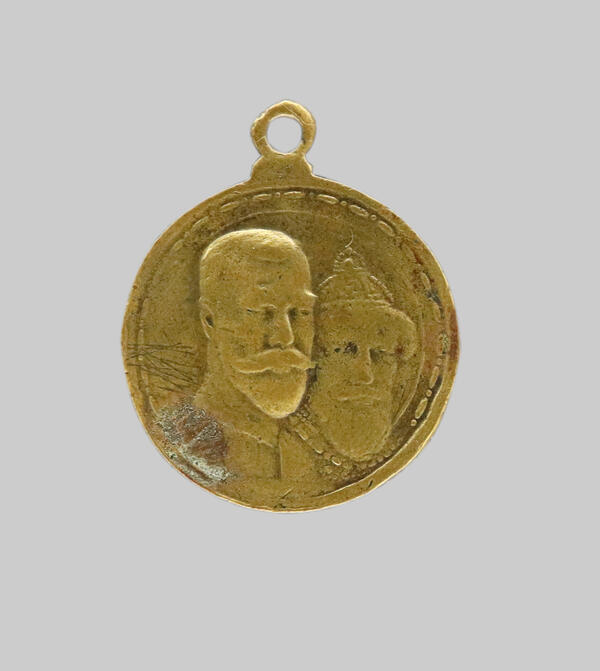
In Commemoration of the 300-th Anniversary of the Reign of the Romanov House. A medal
#9
#10
Emperor Nicholas II established the medal ‘In Commemoration of the 300-th Anniversary of the Reign of the Romanov House’ on February 21, 1913.
Its front side contained portraits of Tsar Mikhail Fedorovich - the founder of the royal dynasty - and the ruling emperor, Nicholas II himself. There is an inscription on the reverse side: ‘In Commemoration of the 300th Anniversary of the Reign of the Romanov House on 1613-1913.’
The medal was intended for persons who took part in the organization of celebrations on the occasion of the 300th anniversary of the Romanov dynasty. In fact, the right to wear the medal was granted to a wide range of people, but it was necessary to buy it. It was awarded free of charge only to certain categories of citizens: those who at the time of the celebration were in public service in the military, naval, civil or court departments, members of the State Council or the State Duma of the Russian Empire, clergy and religious officials of all religions, officials of the maritime and civil departments in retirement who had the right to wear a uniform, teachers and educators of both sexes in all state higher, secondary and lower educational institutions, artists of imperial theaters, sisters of mercy of the Russian Red Cross Society, volost foremen, chairmen of volost courts, village elders, persons awarded Military orders, all persons who actively participated in the preparation and organization of the celebration of the anniversary or who took part in the celebrations themselves, artisans, medalists and workers who made medals at the mint.
The main circulation of medals amounted to over 1,500,000 copies and it was produced at the Saint Petersburg mint. In total, by June 26, 1914, the mint received at least two million orders for the manufacture of medals.
Anton Vasyutinsky was the author of the project of the medal. The bas-relief on its front side was created by sculptor Mikhail Kerzin. Private workshops could produce similar medals. Their products sometimes differed significantly in image detail. Most often, medals in private workshops were made of silver, sometimes gilded, less often of gold. Besides this, there were popular versions of the medal with a diameter of 15-16 mm.
Its front side contained portraits of Tsar Mikhail Fedorovich - the founder of the royal dynasty - and the ruling emperor, Nicholas II himself. There is an inscription on the reverse side: ‘In Commemoration of the 300th Anniversary of the Reign of the Romanov House on 1613-1913.’
The medal was intended for persons who took part in the organization of celebrations on the occasion of the 300th anniversary of the Romanov dynasty. In fact, the right to wear the medal was granted to a wide range of people, but it was necessary to buy it. It was awarded free of charge only to certain categories of citizens: those who at the time of the celebration were in public service in the military, naval, civil or court departments, members of the State Council or the State Duma of the Russian Empire, clergy and religious officials of all religions, officials of the maritime and civil departments in retirement who had the right to wear a uniform, teachers and educators of both sexes in all state higher, secondary and lower educational institutions, artists of imperial theaters, sisters of mercy of the Russian Red Cross Society, volost foremen, chairmen of volost courts, village elders, persons awarded Military orders, all persons who actively participated in the preparation and organization of the celebration of the anniversary or who took part in the celebrations themselves, artisans, medalists and workers who made medals at the mint.
The main circulation of medals amounted to over 1,500,000 copies and it was produced at the Saint Petersburg mint. In total, by June 26, 1914, the mint received at least two million orders for the manufacture of medals.
Anton Vasyutinsky was the author of the project of the medal. The bas-relief on its front side was created by sculptor Mikhail Kerzin. Private workshops could produce similar medals. Their products sometimes differed significantly in image detail. Most often, medals in private workshops were made of silver, sometimes gilded, less often of gold. Besides this, there were popular versions of the medal with a diameter of 15-16 mm.
#11
Full name: In Commemoration of the 300-th Anniversary of the Reign of the Romanov House. A medal
Author: Project of the medal - Vasyutinsky Anton Fedorovich, bas-relief on the obverse - Kerzin Mikhail Arkadyevich
Date: 1913 year
Technique: embossing
Dimensions: 3,5×2,8 cm
Collection: Autonomous Cultural Institution of the Voronezh Region Historical-Cultural Center ‘Palace Complex of the Oldenburgs’
Copyright: Autonomous Cultural Institution of the Voronezh Region Historical-Cultural Center ‘Palace Complex of the Oldenburgs’
Goskatalog Number: 11143925
Author: Project of the medal - Vasyutinsky Anton Fedorovich, bas-relief on the obverse - Kerzin Mikhail Arkadyevich
Date: 1913 year
Technique: embossing
Dimensions: 3,5×2,8 cm
Collection: Autonomous Cultural Institution of the Voronezh Region Historical-Cultural Center ‘Palace Complex of the Oldenburgs’
Copyright: Autonomous Cultural Institution of the Voronezh Region Historical-Cultural Center ‘Palace Complex of the Oldenburgs’
Goskatalog Number: 11143925
read morehide
00:00
00:00
1x
A plates with a portraits, a medals
Exhibition
5
 Point your smartphone camera to open in the app
Open in app
Share