

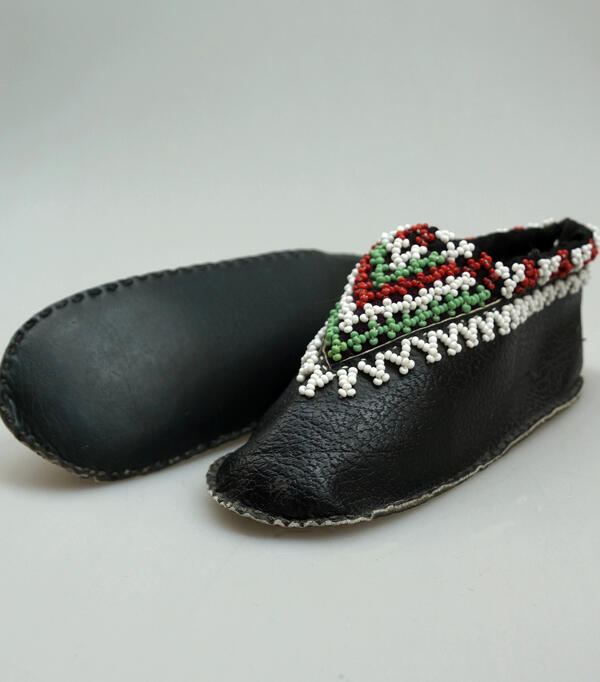
The exhibition presents leather slippers, national summer women’s shoes of the indigenous Northern peoples. In the Khanty language, they are called “niry”.
The Ob Ugrians had different kinds of traditional shoes, depending on the season. In summer, the so-called piston-shaped shoes were worn: heelless slippers or boots with a curved platform and skin gathered in folds above the foot. A high leather boot-top could be attached to short niry (or chirki). Poor families, who owned only a few deer, used the skin sparingly and, if possible, replaced it with fabric. High boots protected their owner from insects. Such thin boots were worn in fall and sometimes even in winter, weather permitting.
Niry were made of elk or deer “kamus” skins (skins taken from the legs of an animal) or of leather, including fish skin. Before sewing shoes, the kamuses were always smoked, so that the footwear would not be damaged by moths. The soles were cut out of strong and non-slip “brushes” (skins between the hooves of a deer or elk) or of the deer forehead skin. Before putting on the niry, the Khanty wrapped the legs in cloth or put on warm stockings, which were made of wool or fur.
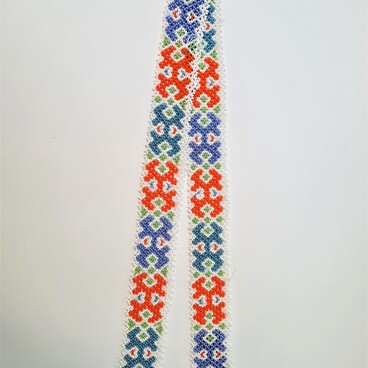
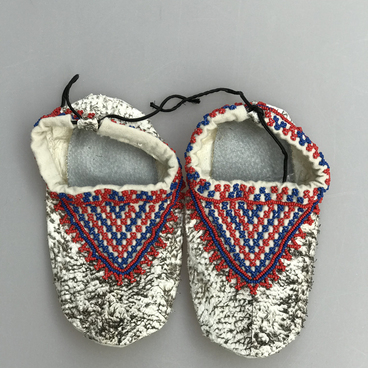
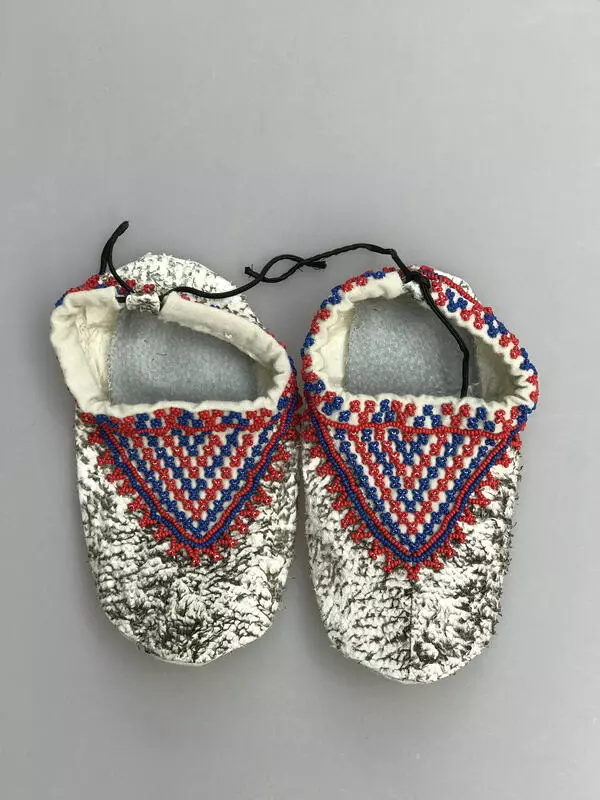
The indigenous peoples mostly decorated footwear with embroidery, and summer women’s niry were beaded. And the northern Khanty decorated their shoes with fabric appliques.
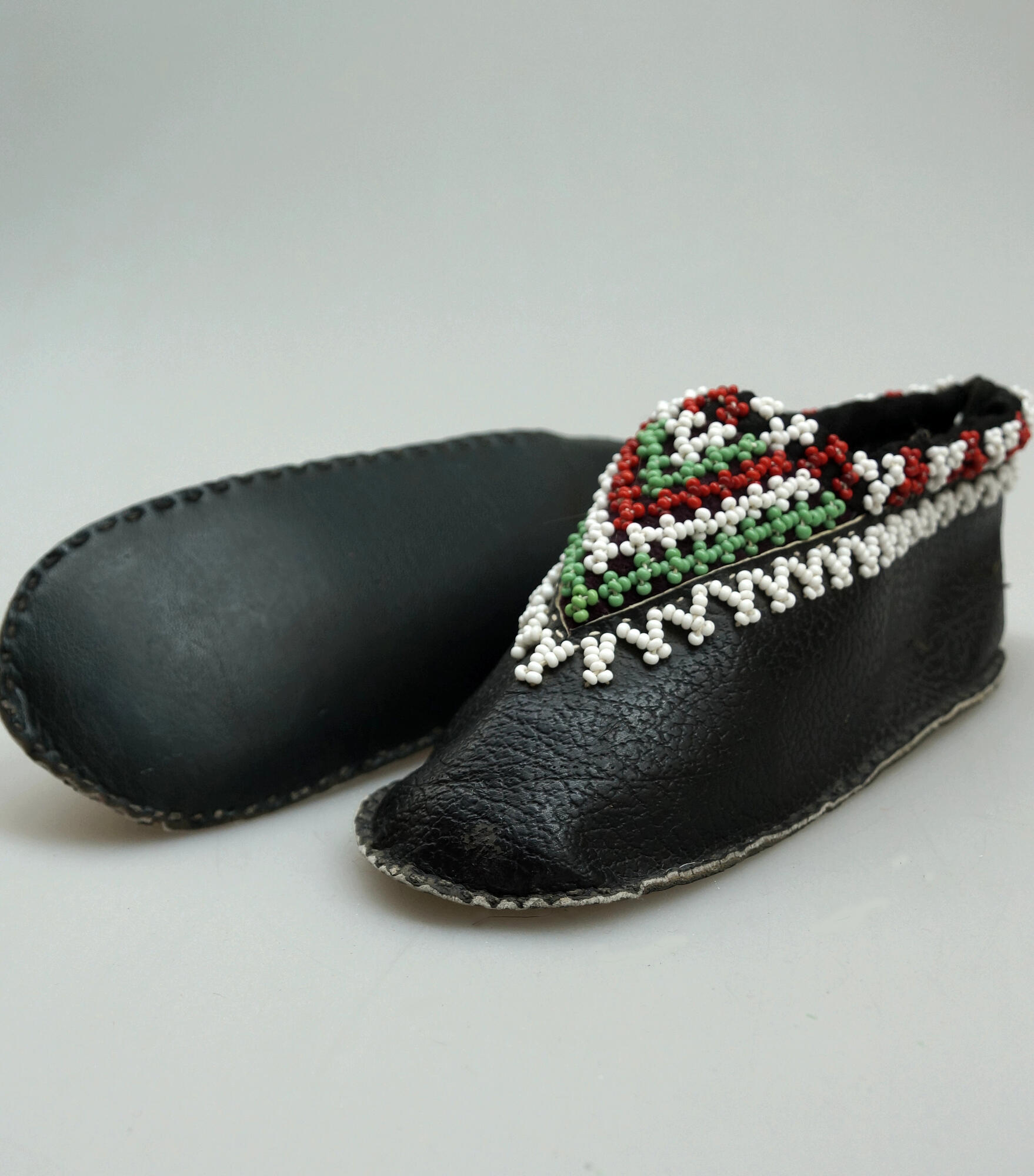
The leather niry that are on display at the exhibition were made around the middle of the 20th century in the village of Kazym in the Beloyarsky district of the Khanty-Mansi Autonomous Okrug. The slippers are made of four parts, and different materials were used. The shoe sole and top of forefront were made of black leather. A triangular insert at the vamp (the upper front part of a boot) and the collar is trimmed with a drawstring made of brown fabric. A drawstring is a stitched or folded string in the seam of the material of a garment or a bag, which can be pulled to tighten or close it. When tightened, it helps create curved folds. An elastic band is inserted into the drawstring of the niry, tied with a knot at the back. The trim, insert and collar around the insert and edging are ornamented with beads.
The Ob Ugrians had different kinds of traditional shoes, depending on the season. In summer, the so-called piston-shaped shoes were worn: heelless slippers or boots with a curved platform and skin gathered in folds above the foot. A high leather boot-top could be attached to short niry (or chirki). Poor families, who owned only a few deer, used the skin sparingly and, if possible, replaced it with fabric. High boots protected their owner from insects. Such thin boots were worn in fall and sometimes even in winter, weather permitting.
Niry were made of elk or deer “kamus” skins (skins taken from the legs of an animal) or of leather, including fish skin. Before sewing shoes, the kamuses were always smoked, so that the footwear would not be damaged by moths. The soles were cut out of strong and non-slip “brushes” (skins between the hooves of a deer or elk) or of the deer forehead skin. Before putting on the niry, the Khanty wrapped the legs in cloth or put on warm stockings, which were made of wool or fur.
The indigenous peoples mostly decorated footwear with embroidery, and summer women’s niry were beaded. And the northern Khanty decorated their shoes with fabric appliques.
The leather niry that are on display at the exhibition were made around the middle of the 20th century in the village of Kazym in the Beloyarsky district of the Khanty-Mansi Autonomous Okrug. The slippers are made of four parts, and different materials were used. The shoe sole and top of forefront were made of black leather. A triangular insert at the vamp (the upper front part of a boot) and the collar is trimmed with a drawstring made of brown fabric. A drawstring is a stitched or folded string in the seam of the material of a garment or a bag, which can be pulled to tighten or close it. When tightened, it helps create curved folds. An elastic band is inserted into the drawstring of the niry, tied with a knot at the back. The trim, insert and collar around the insert and edging are ornamented with beads.