John the Theologian, the Apostle of Love, was the youngest and most beloved disciple of Christ. After Peter and Andrew, Christ called on him and his elder brother Jacob, the sons of Zebedee and Salome (one of the myrrh-bearing women), and gave them the nickname “sons of thunder”.
John, among the chosen ones, witnessed the raising of the Daughter of Jairus and the Transfiguration, followed the Teacher in the garden of Gethsemane and to the house of the high priest Caiaphas, followed him on the way to the cross with sorrow and remained next to the Mother of God at the cross. John cared for the Mother of God on the instruction of Christ. John took the Mother of God into his house and never left her until the end of her earthly life.
Then he went to preach to Ephesus and other cities of Asia Minor, where many miracles were performed through his prayers and many people accepted the Christian faith. During the reign of the persecutor of Christians, Emperor Nero, the apostle was tried in Rome and sentenced to death, but neither poison nor a cauldron of boiling oil could harm him.
Then John was sent into exile to the island of Patmos. There he confronted magicians, healed the possessed and resurrected the dead through his prayers, and finally almost the entire population of the island turned to Christ. There, John received the Revelation, which he dictated to his disciple, Prochorus.
Returning to Ephesus, an elderly man, the apostle dictated to Prochorus the Gospel, which supplemented the three earlier ones. The New Testament also includes three Epistles of John to Christians.
John was the only one of the disciples of Christ to live for more than a hundred years and escape martyrdom. Anticipating his end, he asked his disciples to put him alive into a cruciform grave and cover him with earth, protecting his face with a handkerchief. Soon the grave was opened, but no one was found. It is believed that John the Theologian was taken up to heaven, like the Mother of God and the ancient prophets Elijah and Enoch. For a long time, a thin layer of dust appeared on the grave of the apostle, from which people received healing. A holiday has been established in honor of this miracle.
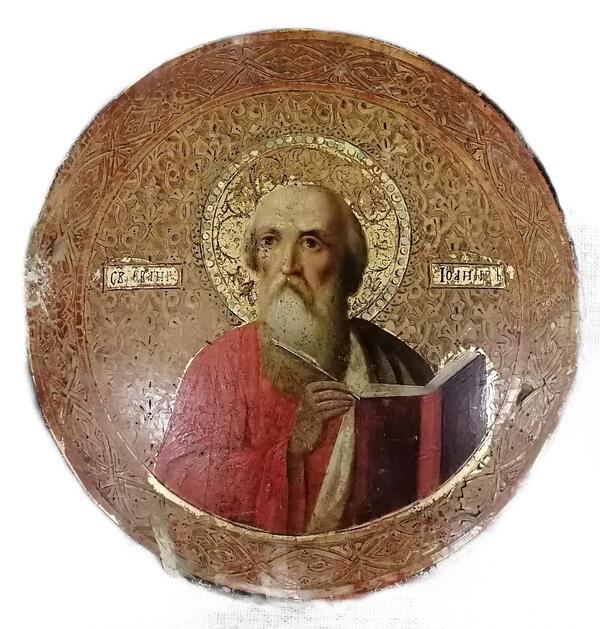
In the 3rd–4th centuries, the figure of John the Theologian first appears on images in the catacombs among the four evangelists or, more often, the twelve apostles who come to Christ.
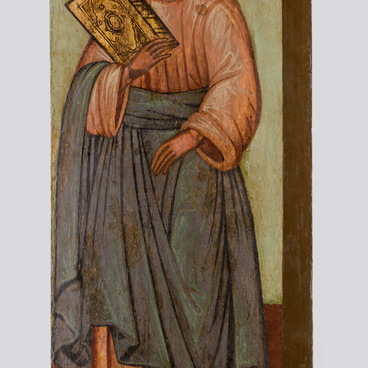
This icon was included in the royal doors of an iconostasis. The royal doors themselves symbolize the entrance to paradise; an Annunciation Icon is placed at the top, and images of the evangelists are under it. The master painted this image in a realistic manner with the technique of ochering, that is, adding light brown shades over darker brownish colors used for the saint’s face and exposed body parts (the brown color was called sankir).
The icon came to the Balakhna museum from the Federal Cultural Heritage Preservation Service of Nizhny Novgorod.
John, among the chosen ones, witnessed the raising of the Daughter of Jairus and the Transfiguration, followed the Teacher in the garden of Gethsemane and to the house of the high priest Caiaphas, followed him on the way to the cross with sorrow and remained next to the Mother of God at the cross. John cared for the Mother of God on the instruction of Christ. John took the Mother of God into his house and never left her until the end of her earthly life.
Then he went to preach to Ephesus and other cities of Asia Minor, where many miracles were performed through his prayers and many people accepted the Christian faith. During the reign of the persecutor of Christians, Emperor Nero, the apostle was tried in Rome and sentenced to death, but neither poison nor a cauldron of boiling oil could harm him.
Then John was sent into exile to the island of Patmos. There he confronted magicians, healed the possessed and resurrected the dead through his prayers, and finally almost the entire population of the island turned to Christ. There, John received the Revelation, which he dictated to his disciple, Prochorus.
Returning to Ephesus, an elderly man, the apostle dictated to Prochorus the Gospel, which supplemented the three earlier ones. The New Testament also includes three Epistles of John to Christians.
John was the only one of the disciples of Christ to live for more than a hundred years and escape martyrdom. Anticipating his end, he asked his disciples to put him alive into a cruciform grave and cover him with earth, protecting his face with a handkerchief. Soon the grave was opened, but no one was found. It is believed that John the Theologian was taken up to heaven, like the Mother of God and the ancient prophets Elijah and Enoch. For a long time, a thin layer of dust appeared on the grave of the apostle, from which people received healing. A holiday has been established in honor of this miracle.
In the 3rd–4th centuries, the figure of John the Theologian first appears on images in the catacombs among the four evangelists or, more often, the twelve apostles who come to Christ.
This icon was included in the royal doors of an iconostasis. The royal doors themselves symbolize the entrance to paradise; an Annunciation Icon is placed at the top, and images of the evangelists are under it. The master painted this image in a realistic manner with the technique of ochering, that is, adding light brown shades over darker brownish colors used for the saint’s face and exposed body parts (the brown color was called sankir).
The icon came to the Balakhna museum from the Federal Cultural Heritage Preservation Service of Nizhny Novgorod.