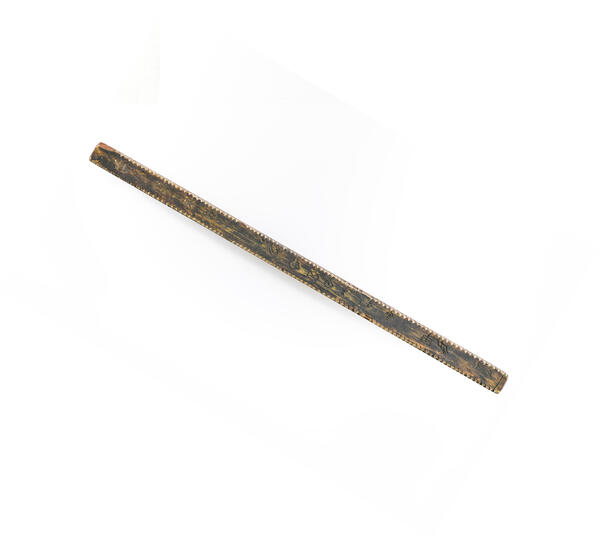
In some regions of Russia, menologions were folk wooden calendars, where different marks were cut for each day. The version, which is housed in the collection of the Bishop’s House, is a square rectangular bar, which is 87 centimeters long. Each side is painted to represent a particular season: white for winter, green for spring, red for summer, and yellow for fall. The cuts on all sides are the designations of the days. Months are separated by small indents, but their names are not labeled in any way. Other markings can be seen on the sides: crosses of different shapes, circles, straight lines, and letters. They were used to mark church holidays, important events in the family, and the dates on which different works were to begin.
The first calendars of the Russian peasant farmers appeared because their whole life was connected with the change of season. They had to plan work in the field, prepare supplies for the winter and feed for livestock, calculate the timing of parturition in cattle, sheep and swine. In addition, religion played a big role in the life of peasants.
In Old Rus, the calendar year began on March 1 — along with the cycle of agricultural works. In 1492, Prince Ivan III of Moscow issued a decree, according to which the calendar year was to begin from September 1. This was the custom in Byzantium, and Russia adopted many of its cultural and religious traditions. Almost a century later, in 1581, the printer Ivan Fyodorov created the first printed Orthodox calendar. The first secular calendar, without church feasts, appeared only during the reign of Peter the Great. By that time, the start date of the year had changed again: the emperor moved it to January 1.
The first calendars of the Russian peasant farmers appeared because their whole life was connected with the change of season. They had to plan work in the field, prepare supplies for the winter and feed for livestock, calculate the timing of parturition in cattle, sheep and swine. In addition, religion played a big role in the life of peasants.
Forgetting about a fast, a religious holiday, or a saint’s memorial day was considered a sin. Therefore, all important dates were marked in wooden calendars. Such a calendar was convenient to keep and carry along, so people often took it with them when they went to work in the field or fish, so as not to miss the significant dates. It was not necessary to buy calendars: they were made of any suitable wooden bar, and it did not take much time to make them. Therefore, this type of calendar quickly became popular.
In Old Rus, the calendar year began on March 1 — along with the cycle of agricultural works. In 1492, Prince Ivan III of Moscow issued a decree, according to which the calendar year was to begin from September 1. This was the custom in Byzantium, and Russia adopted many of its cultural and religious traditions. Almost a century later, in 1581, the printer Ivan Fyodorov created the first printed Orthodox calendar. The first secular calendar, without church feasts, appeared only during the reign of Peter the Great. By that time, the start date of the year had changed again: the emperor moved it to January 1.