In the 17th century, Western Europe was fond of baroque motifs that were present not only in secular, but also in church art. At that time rather unusual icons in terms of technique appeared. In Russia they were called “dvoevzor” (double-sided) or “troevzor” (three-sided) icons. The first of the dated Russian “many-faced” icons was created in 1791.
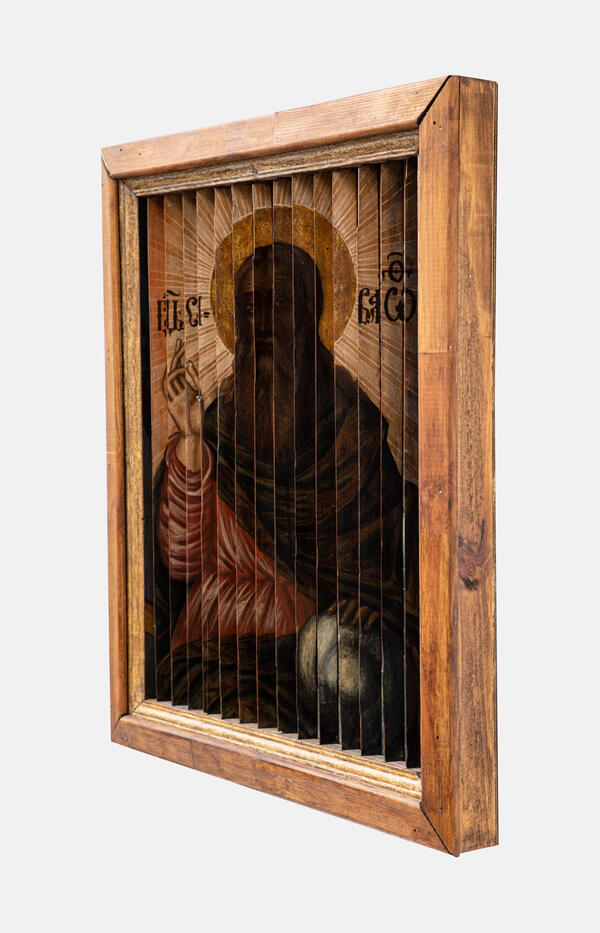
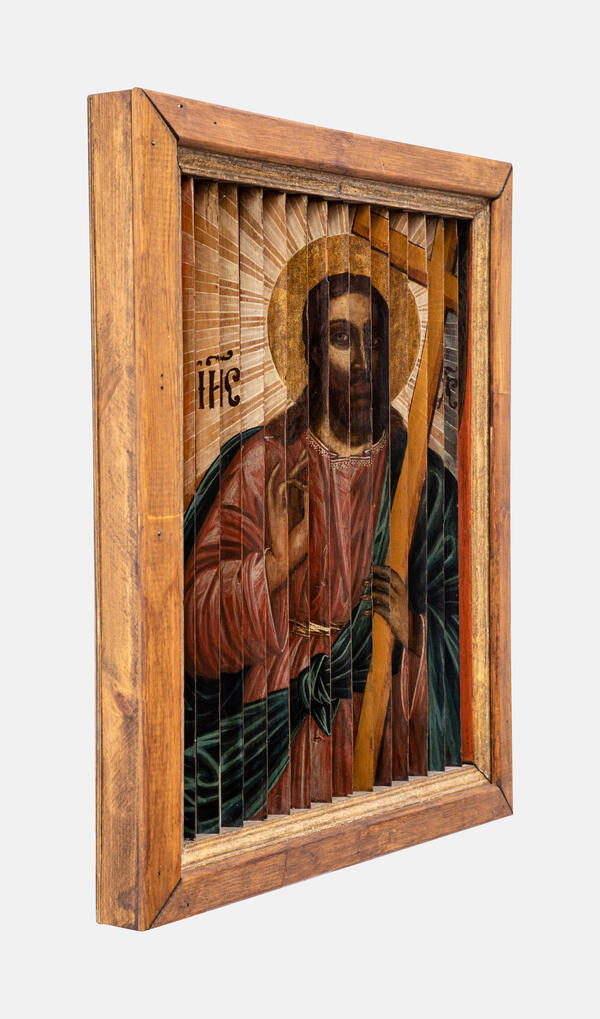
Their peculiarity was that instead of a single board, 14 vertical triangular plates were attached to the frame: they were arranged perpendicular to each other so that different iconographic plots were visible at different angles.
It was possible to see the image depicted in the “dvoevzor” only from the sides; from the front, the viewer would see only fragments of two images mixed together. In order to make sure the believers would choose an appropriate angle, large candlesticks were placed right in front of such icons.
More widespread were the “troevzor” images, they could be looked at from any angle and their design harmoniously fit well-known Orthodox Christian plots. There are a lot of “troevzor” icons preserved, although their iconographic repertoire is quite limited.
The most common were the “troevzor” icons with the image of the Holy New Testament Trinity. From the front, one would see the Holy Spirit — a dove with outstretched wings in a cloud. From the left, the face of Jesus Christ would appear: He makes the sign of the cross with two fingers. From the right the beholder would see the image of God the Father.
A less common plot is the Annunciation, in which from different angles one would see the God of Hosts, the Blessed Virgin Mary and the Archangel Gabriel. Finally, the third known icon of this type depicts the famous scene — Christ in the Dungeon (the Pensive Christ) with the Theotokos and John the Forerunner.
Not only the unusual design itself came from Western European art, but also some details of the image: Christ holds the Calvary Cross in His hands, and God the Father holds a round sphere.
Most likely, such icons were created for city churches. First, a sufficiently spacious room was required for the beholder to properly perceive the icon. Second, such technical novelties were alien to the traditional peasant worldview.
The place of origin of such works within Russia has not been established, but they could be found everywhere: in the Volga region, central regions, southern provinces and in the North — until the late 19th century.