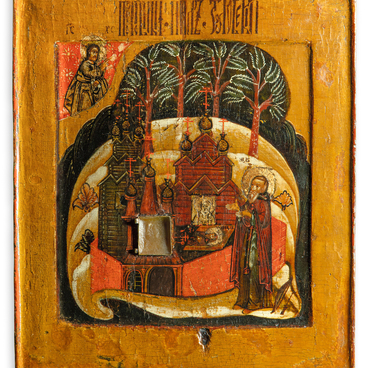
Nicholas the Wonderworker was the only saint in Russia whose hagiographic icons were known as early as the mid-13th century. This type of icon known as hagiographic depicts the acts and miracles of great saints. It was developed in Byzantium and is characterized by a detailed depiction of miracles and a large number of border scenes that complement the centerpiece.
The icon from the collection of the Andrei Rublev Museum originated in the Church of Saint Paraskevi (Pyatnitskaya Church) in Dmitrov, Moscow Oblast. In style and format, the icon is similar to the work of Dionysius and other icon painters of his artistic circle. In the centerpiece, the saint is depicted full-size, standing solemnly and wearing bishop’s robes. The hagiographic scenes depict his childhood, death, and miracles, such as rescuing a ship and saving a boy taken captive by the Saracens. The painter added features of his time to the icon. For example, in the burial scene, there is a typical Russian bell tower, and the prison cell in the border scene “Appearance Before Three Men” looks like an ordinary house with barred windows.
The composition of the centerpiece can be traced back to the image of Saint Nicholas that was venerated in Zaraysk, a small, fortified town on the border between the Principalities of Moscow and Ryazan. Legend has it that the image, brought to Zaraysk from Korsun (Chersonesus) in the 13th century, was miracle working. Saint Nicholas is depicted in liturgical garments, with his arms outstretched. He makes a blessing gesture with his right hand and holds the Gospel Book in his left hand.
The earliest known icons of St. Nicholas of Zaraysk date back to the late 16th century. For a long time, the start of the veneration of the Zaraysk icon was associated with the publication of “The Tales of Nikola Zarazsky”, a collection of several stories of various styles loosely connected with each other. Among the most notable stories is “The Tale of the Transfer of the Icon of Nikola Zarazsky from Korsun, ” which describes the delivery of the icon by the priest Yevstafy of Korsun who came to Russia with his wife and son. Another notable story is “The Tale of the Destruction of Ryazan by Batu Khan”.
The stories were considered a monument of ancient
Russian literature, associated with Ryazan and dating from the mid-13th century. However, researchers have doubted the fact that a text describing the
Mongol invasion of Russia could appear during the invasion itself. A thorough
text analysis showed that the stories are united “by the same design,
linguistic features, and sources”, that is, they were created by a single
author who focused on venerating local objects of worship. According to the
historian and source study expert Boris Mikhailovich Kloss, the texts were
created in 1560.