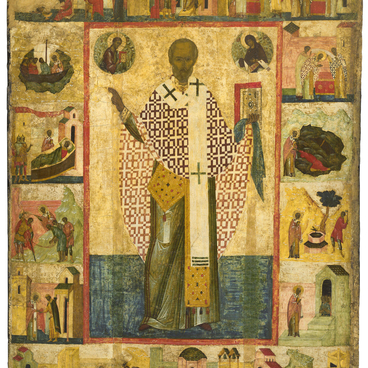
The mid-17th-century icon from the collection of the Andrei Rublev Museum is one of the earliest images of Nilus Stolobensky. He is depicted standing on Stolobny Island and praying to Jesus.
Venerable Nilus Stolobensky lived in the early 16th century. Willing to live an ascetic life, he established a hermitage on Stolobny Island in Lake Seliger. Legend has it that he used to sleep upright, leaning against hooks driven into the wall. Before his death, he dug his own grave and made a coffin for himself. According to his will, a monastery was founded on the site of his cell dedicated to the Epiphany. It came to be known as the St. Nilus Stolobensky Monastery.
Key information about the life and service of Nilus Stolobensky is presented in his hagiography. The earliest “Life of Nilus Stolobensky” is believed to have been compiled by Venerable Herman, the founder of the St. Nilus Stolobensky Monastery, and the monk Philotheus (Pirogov) from the St. Gerasimus Monastery on the Kaysarov Creek in Vologda. This version of the saint’s hagiography was distinguished by a lengthy preface in which the process of its creation was described.
Herman compiled information about Nilus Stolobensky and intended to give it to a more experienced and talented religious writer. When the clergyman Raphael visited Stolobny Island, Herman learned from him about “a holy and venerable man named Philotheus Pirogov, ” in the Holy Trinity Monastery of St. Gerasimus. Herman sent his notes to the writer through Raphael.
Thus, the story of the life of St. Nilus was described in the 16th century. It has been preserved to this day in a later version, as part of the Great Menaion Reader — a collection of stories compiled at the Trinity Lavra of St. Sergius Monastery in the 1630s. It includes tales about the arrival of St. Herman on Stolobny Island, the construction of the St. Nilus Stolobensky Monastery, the death of St. Nilus, and posthumous miracles that occurred at his grave. These miracles mainly involve healing of residents of the Ostashkov settlements and nearby villages.
The monastery was one of the most popular pilgrimage sites in Russia. During Soviet times, it was closed. In 1990, however, the St. Nilus Stolobensky Monastery was returned to the Russian Orthodox Church. In 2017, a ceremony was held to commemorate the 350th anniversary of the discovery of the relics of St. Nilus and the 25th anniversary of the revival of the monastery.
Many icons and statues of St. Nilus have been
preserved, created in the monastery’s workshops for pilgrims and visitors. On
the icons, St. Nilus Stolobensky is usually shown against the background of his
cell, a deserted island, or the St. Nilus Stolobensky Monastery. Later, he was
also sometimes depicted on a cloud or a distant shore of Lake Seliger.