Villagers devoted long autumn and winter evenings to monotonous housework. Women would gather in a hut, and, in a room illuminated by a rushlight, they would spin yarn, weave or do other handiwork while singing heartfelt songs and telling scary stories. In his memoirs, Feodor Ivanovich Chaliapin described how his mother and her neighbors would gather to work in a dim-lit room to the sound of rain and the hissing of embers in the water.
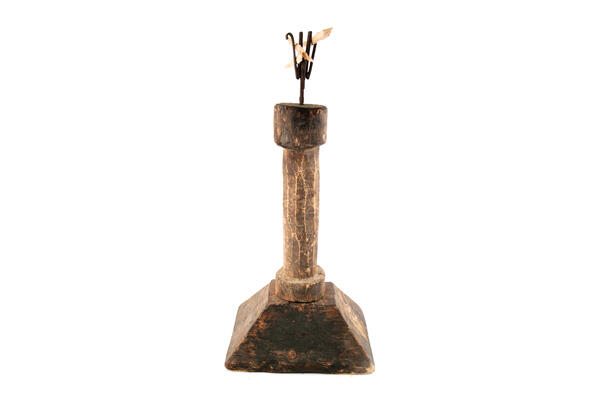
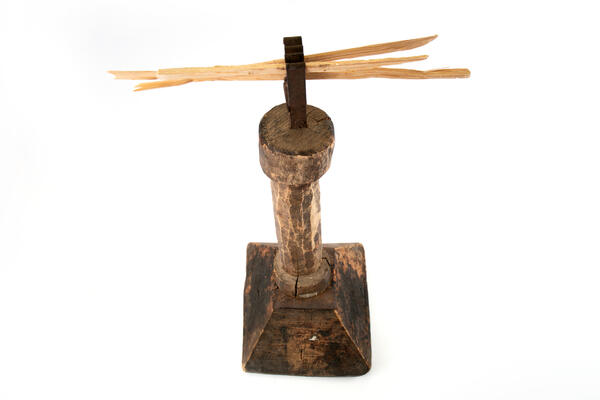
The main source of illumination for such gatherings was the torch holder or “svetets”, which was originally a simple forged fork with a split for placing a rushlight. The rushlight was fitted tightly enough to safely move the torch holder around the room or to mount it somewhere.
There were several types of torch holders: one was a rod with a gap for the rushlight which was inserted into a metal or wooden rack; the other was planted on a small post fixed to an oblong container; and, finally, the third was wall-mounted — it was bent at a right angle, fixed at one end to the wall with the other holding the rushlight.
Over time, several forks were combined to form one holder which allowed for better lighting. For stability, the torch holder featured a riveted massive hoop as counterbalance or mounted on a bucket of water. If the holder was attached to the wall, a container with water was placed below it, so that the falling coals were immediately extinguished to prevent fires.
Torch holders were held in high regard and, oftentimes, designed not only with convenience in mind, but also with the intent to look good. The fork grips were twisted, which made the torch holder look like a peacock’s tail. The upper part of the torch holder, was decorated with wrought-iron ornaments typical of church fences and palace windows of the 18th century.
Lighting rushlights in torch holders during the spring and summer period was uncommon. The rite of ignition was held from mid-August to mid-September. After the Annunciation (starting from the vernal equinox), came the end of using torch holders.
Torch holders were an indispensable attribute of peasant life until the Revolution of 1917.