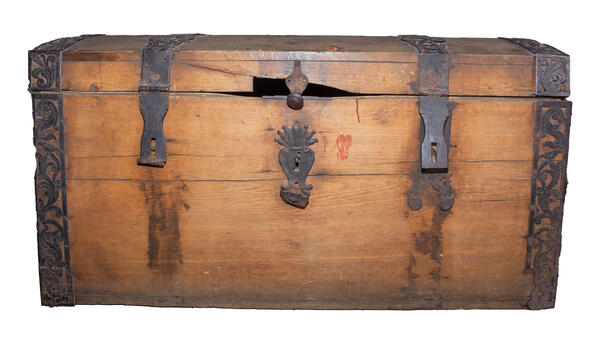
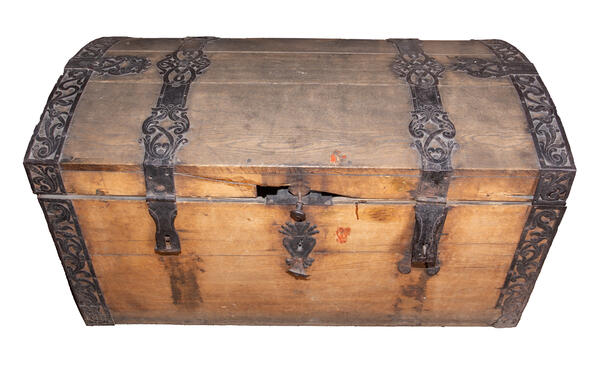
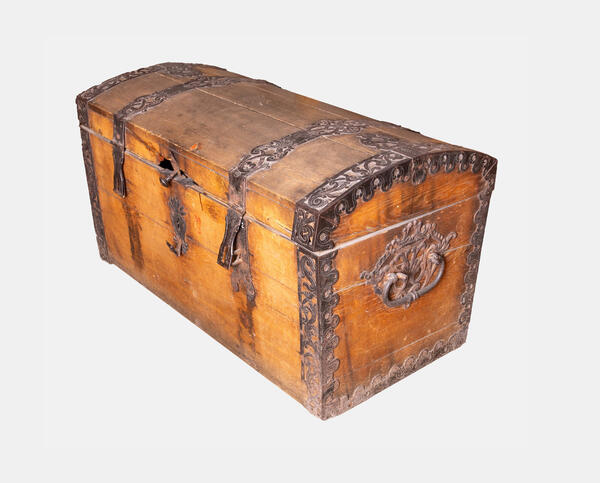
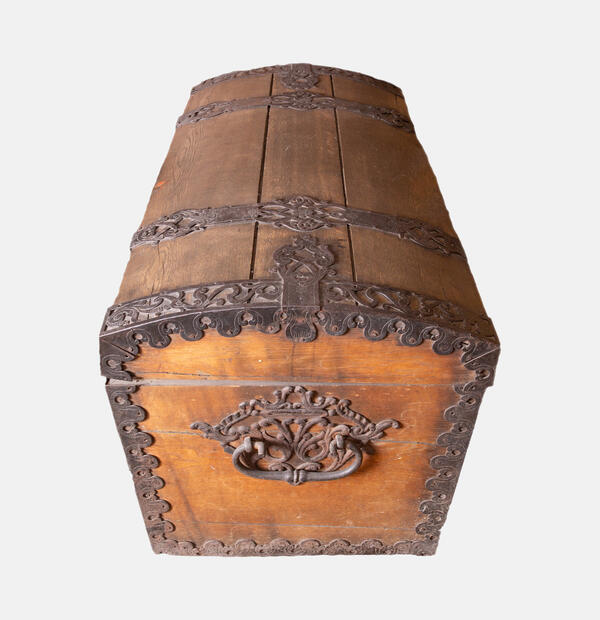
A trunk is a large container with a hinged flat or convex lid for storing clothing and household items. The trunk was an essential part of the interior of a peasant’s home. Moscow, Veliky Novgorod, Kholmogory, Veliky Ustyug, Vyatka, and some cities in the Urals were the centers of trunk making.
Trunks were typically made of flat pine, spruce, cedar, oak, linden or aspen planks, tightly nailed to each other. To make the trunk strong, it was reinforced by smooth or perforated iron strips. A lock was fitted on the front wall and handles were attached to the sides. Trunks had a practical and comfortable design for storing clothes, crockery, utensils, books, documents and money. To protect things from insects, wormwood was put inside. With a variety of shapes and sizes, trunks could also serve as tables, benches, beds and boxes for transporting household goods.
In addition to practical functions the trunk was endowed with a variety of symbolic meanings. So, the trunk in some cases was likened to a house, in particular, acted as a “folded up” interior space in the situation of moving from one house to another, for example, at a wedding. When carrying the bride’s dowry, money, bread, newly-harvested grain, garlic, oats, flax, etc. were placed in the corners of the trunk, which refers to the tradition of laying the foundation of a house when similar objects symbolizing share, wealth and fertility were placed under its corners. Before the wedding ceremony, the trunk was passed around with a burning candle and an icon, and salt was sprinkled on it to drive out evil spirits.
The trunk also symbolized women’s space, as it was a container of purely women’s things (towels, linen, clothes), acting in the wedding ritual as a material symbol of the bride’s lot. The semantics of the trunk also included the motif of the past, memory, continuity of generations, as it was the core of the property inherited by women. This idea is reflected in such cliché expressions as a “grandmother’s trunk”, as well as in the tradition of using old clothes taken from the trunk at weddings.
The idea of the past, of memory, points to another theme associated with the trunk — the theme of death. A year after the wedding a wife would prepare a special bundle of clothes for herself and her husband in case of death and then periodically restock it. In Southern Russian tradition the body of a stillborn child was kept in a trunk until the mother fully recovered. It was tradition that if a family member were to repent of wrongdoing, it would be done on the trunk.