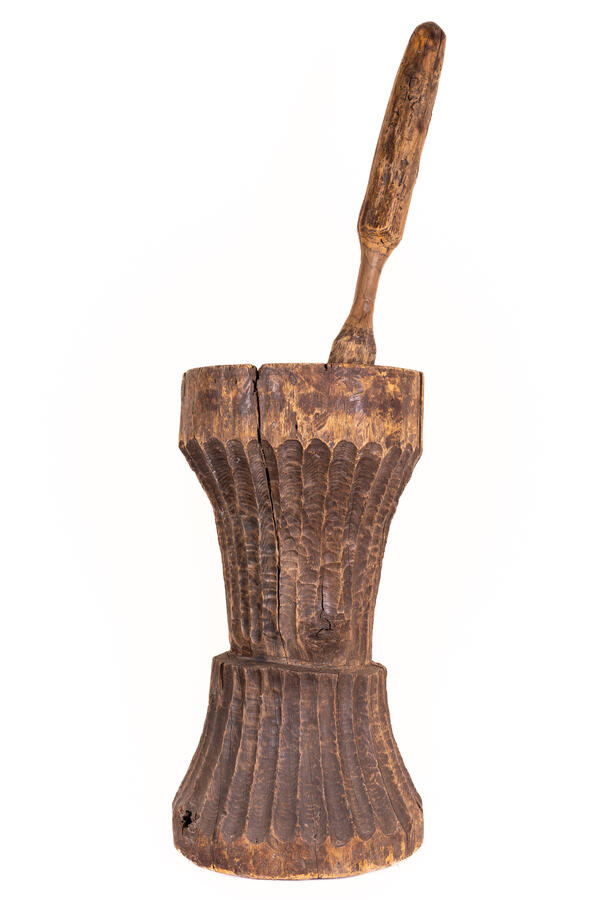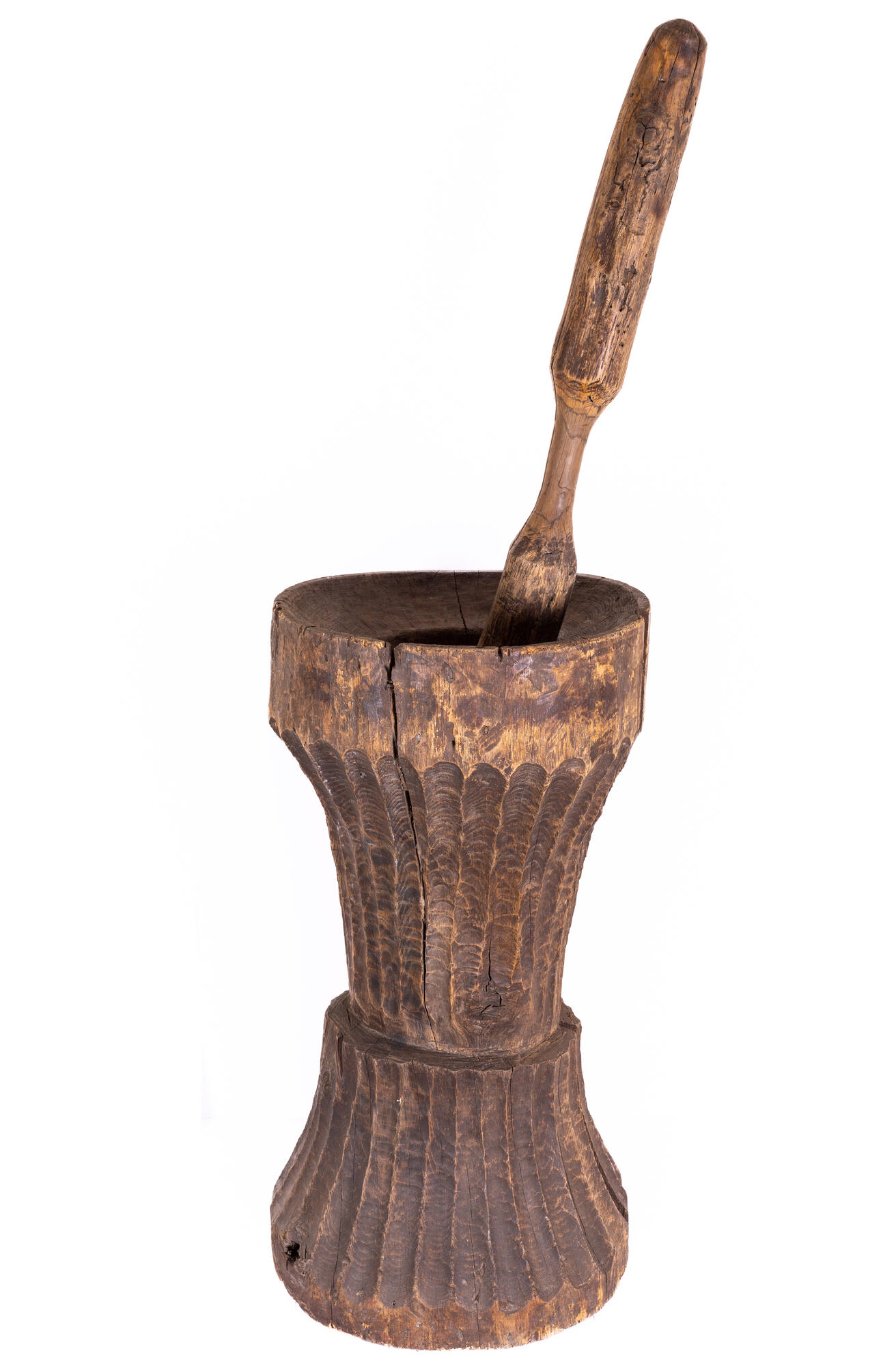


A mortar is a hollowed wooden device for making grits from unrefined wheat, barley, millet, buckwheat grains or flax and hemp fibers, as well as for mashing potatoes, crushing salt, and grinding flax and hemp seeds. It could also be used for washing and pounding linen canvas. A mortar was hollowed out of a thick birch or aspen trunk, it had a cylindrical or cone-shaped form outside and rounded inside. Most often it had a circle at the base, somewhat projecting against the walls, making the mortar quite stable. A pestle, which is a rather massive stick, often with grip in the middle, was used to pound. The size, shape and purpose of the pestle also varied depending on the properties of the products.
There were usually several mortars for different products: for a canvas (the tallest mortar, up to 80 centimeters), salt, potatoes, grain (wheat, buckwheat, millet), linseed and hemp. Men used a separate mortar to crush tobacco. When something needed to be ground particularly finely, the raw material was first pounded and then ground. Although mortars were rather tall, they were filled about 5% of their height at a time, leaving room for the pestle to move.
Ground grits were not stored for long, so a portion was prepared to be eaten within two weeks.
The comparison of a pestle and a mortar with a woman and a man is reflected in riddles (“Malanya is fat, thin Matvei is attached to her — he will not get off”), humorous definitions (a clumsy woman was described as a mortar, a shy man — as a pestle) and folk rituals.
In the wedding ritual, on the day of the wedding, women pounded water in a mortar, symbolically anticipating the first wedding night. In difficult childbirth, a woman in labor was offered a mortar to lean on.
A mortar was also used as an amulet in which a disease could be pounded away. During a fire, the mortar was turned upside down to keep the wind from blowing the sparks away.
In folklore, the mortar and pestle act as an attribute of evil forces, transport and weapon of Baba-Yaga. However, Yaga can be killed with her own pestle, turning her into stone. In domestic magic, the pestle and mortar were left for “matenka night evil spirit” to play then and not disturb a sleeping baby.