

#1
Padded chair, Card table
#2
#3

#4
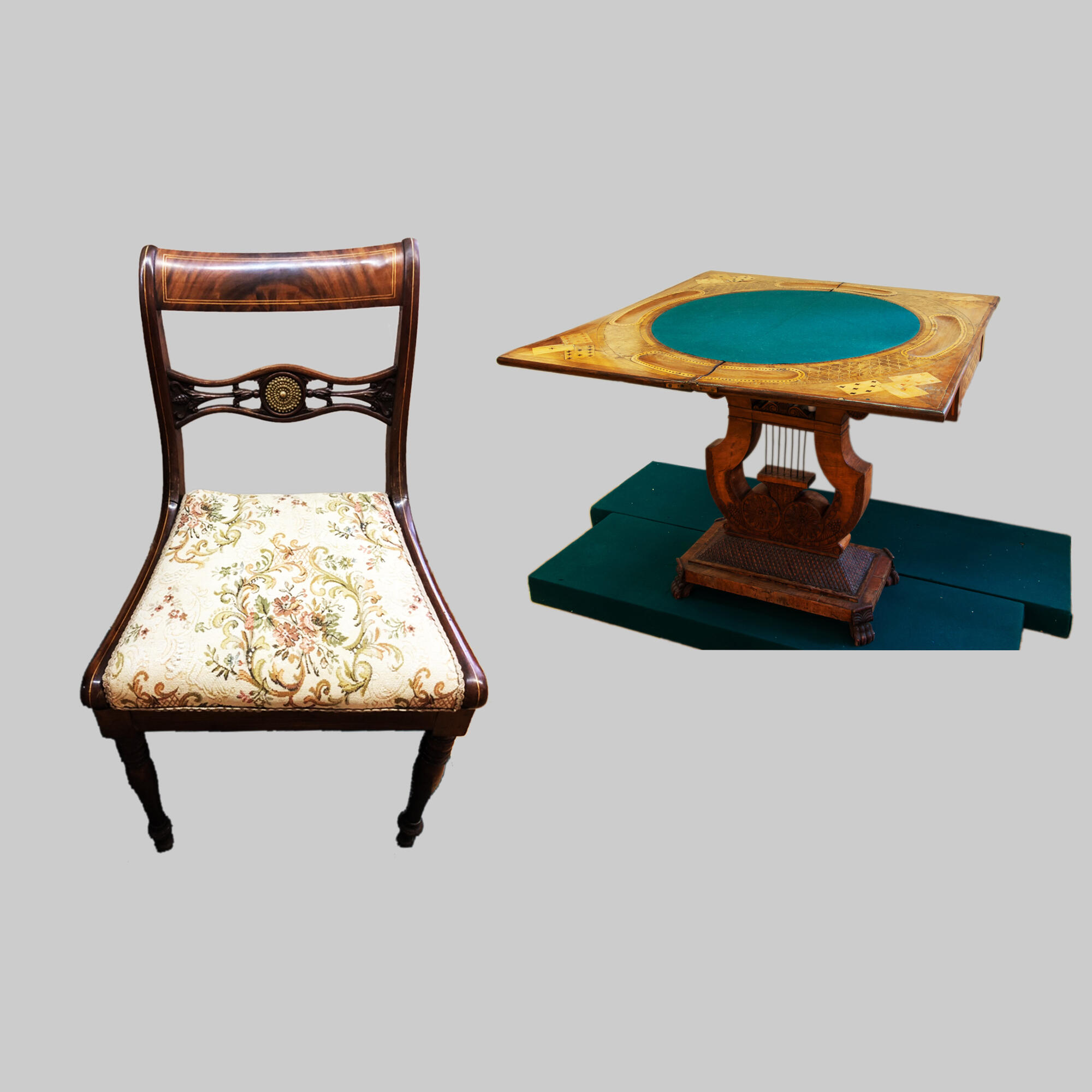
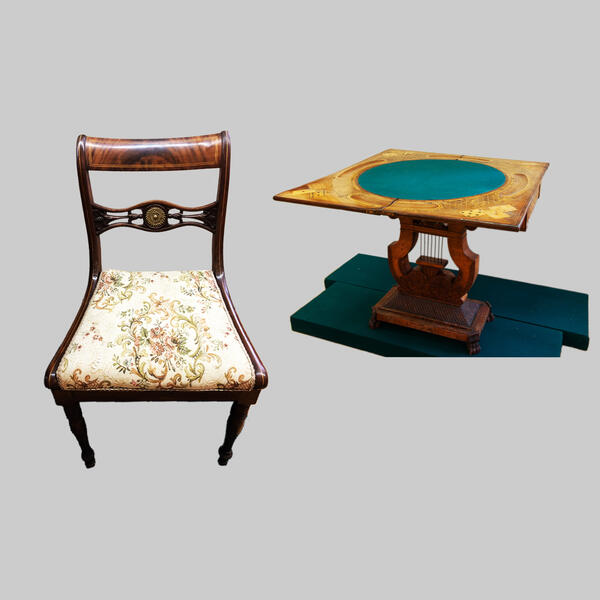
This is a chair with a padded seat. It is veneered with Karelian birch, and the back is decorated with a lyre stylized to resemble a pair of swans.
The seat is rectangular, slightly widening towards the front. The back has a rectangular frame with a wide top rail that is decorated with a pediment. Both the rail and the pediment have a black outline.
The main feature of Empire furniture is the strict adherence of its shapes to the rules of classical architecture, such as the division of the piece’s volume into three sections: the base, the body, and the final top part. This is a common way of separating architecture into distinct segments both horizontally and vertically.
Furniture makers began to use Karelian birch in the 1790s. Such wood was usually decorated by artistic carving, painting, and inlay. The birch had a chatoyant texture saturated with spots and small brown curves. Thanks to its variety of yellow shades, this type of wood gave the feeling of coziness and softness to the interior.
The chair came to the museum from the Maryino estate in the Bronnitsy District some time after the revolution, when estates were nationalized.
At the end of the 18th century, the small village of Maryino, which nowadays belongs to the territory of the city of Bronnitsy not far from Moscow, was the property of Dormidont Sergeyevich Khlopov. Then it passed to the Fonvizin family.
Mikhail Alexandrovich Fonvizin (1788–1854) distinguished himself in the Battle of Austerlitz at the age of seventeen. He was decorated with the Order of Saint Anna, 4th class. Fonvizin also fought in the Patriotic War of 1812. He fought in many battles.
After the war, Mikhail Alexandrovich became a member of several secret societies. Even though he and his brother Ivan were not on the Senate Square during the 1825 Decembrist revolt, they, like all other Decembrists, were sent into exile. Ivan Alexandrovich, a retired colonel, was judged rather mildly. He was allowed to stay in the Maryino estate under police supervision.
However, Mikhail Alexandrovich himself was sentenced to hard labor and sent into exile in Siberia. His wife Natalya Dmitrievna Fonvizina, nee Apukhtina (1805–1869), went with him, leaving two children in Maryino in the care of her mother and Ivan Fonvizin.
Mikhail Alexandrovich was one of the first to be allowed to return from exile in Siberia. Having arrived in Maryino in 1853, he found that neither his sons, nor his brother were alive anymore. Mikhail Fonvizin was granted permission to stay in his estate and raised two adopted children.
Mikhail Alexandrovich had less than a year left to live after returning from hard labor. He was buried in the Bronnitsy, on Sobornaya Square.
The seat is rectangular, slightly widening towards the front. The back has a rectangular frame with a wide top rail that is decorated with a pediment. Both the rail and the pediment have a black outline.
The main feature of Empire furniture is the strict adherence of its shapes to the rules of classical architecture, such as the division of the piece’s volume into three sections: the base, the body, and the final top part. This is a common way of separating architecture into distinct segments both horizontally and vertically.
Furniture makers began to use Karelian birch in the 1790s. Such wood was usually decorated by artistic carving, painting, and inlay. The birch had a chatoyant texture saturated with spots and small brown curves. Thanks to its variety of yellow shades, this type of wood gave the feeling of coziness and softness to the interior.
The chair came to the museum from the Maryino estate in the Bronnitsy District some time after the revolution, when estates were nationalized.
At the end of the 18th century, the small village of Maryino, which nowadays belongs to the territory of the city of Bronnitsy not far from Moscow, was the property of Dormidont Sergeyevich Khlopov. Then it passed to the Fonvizin family.
Mikhail Alexandrovich Fonvizin (1788–1854) distinguished himself in the Battle of Austerlitz at the age of seventeen. He was decorated with the Order of Saint Anna, 4th class. Fonvizin also fought in the Patriotic War of 1812. He fought in many battles.
After the war, Mikhail Alexandrovich became a member of several secret societies. Even though he and his brother Ivan were not on the Senate Square during the 1825 Decembrist revolt, they, like all other Decembrists, were sent into exile. Ivan Alexandrovich, a retired colonel, was judged rather mildly. He was allowed to stay in the Maryino estate under police supervision.
However, Mikhail Alexandrovich himself was sentenced to hard labor and sent into exile in Siberia. His wife Natalya Dmitrievna Fonvizina, nee Apukhtina (1805–1869), went with him, leaving two children in Maryino in the care of her mother and Ivan Fonvizin.
Mikhail Alexandrovich was one of the first to be allowed to return from exile in Siberia. Having arrived in Maryino in 1853, he found that neither his sons, nor his brother were alive anymore. Mikhail Fonvizin was granted permission to stay in his estate and raised two adopted children.
Mikhail Alexandrovich had less than a year left to live after returning from hard labor. He was buried in the Bronnitsy, on Sobornaya Square.
#5
Date: second half of the 19th century
Technique: carving, Karelian birch veneer
Dimensions: 95×48,2×45,3 cm
Collection: Furniture
Copyright: Ramenskoye History and Art Museum
Technique: carving, Karelian birch veneer
Dimensions: 95×48,2×45,3 cm
Collection: Furniture
Copyright: Ramenskoye History and Art Museum
#6
Folding table for a card game ombre
#7
#8
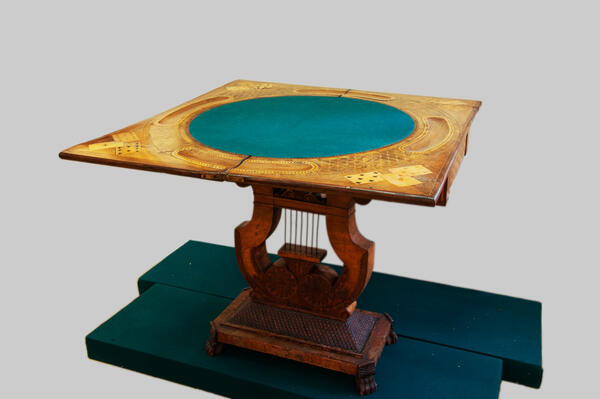
A table for playing cards. In Russia, this kind of table is known as the lomber table, owing its name to the card game ‘ombre’ (from Spanish hombre, meaning ‘man’). In a game of ombre, one person (the ‘man’) plays against a team of two, three, or more opponents. This game originated in Spanish aristocratic circles in the 14th century, before spreading throughout Europe. In Russia, this game was in fashion between the second half of the 18th and the early 19th century. The ombre was the only game to be spared by the ban on ‘gambling of any kind’ that was imposed by Catherine the Great at the very beginning of her reign.
This card table has a foldable tabletop. When folded, it looks like a regular coffee or dining table. During games, the table was unfolded, exposing its inner side. The exhibit on display is set up precisely in such a ‘game position.’
In its unfolded state, the board has a square shape, with special grooves for chalk on all four sides (chalk was used for making notes on the tablecloth). The corners are decorated with mosaic images of playing cards. When folded, the board is decorated with a mosaic rhombus pattern.
Card tables were an essential interior element of Russian residences. They were made of mahogany or local wood species painted to look like mahogany.
This table belonged to the Talyzin family from the Denezhnikovo estate situated in the Bronnitsy District.
Based on the known documents, the Talyzin family tree dates back to the 15th century. The names of its members are found in accounts of many significant events in the history of the Russian state.
The estate ensemble of Denezhnikovo was built by a member of the Admiralty Board since 1748, admiral Ivan Lukyanovich Talyzin (1700–1779). Ivan Lukyanovich was a relative of Nikita Ivanovich Panin, a diplomat in charge of the Russian foreign policy. Another relative of Ivan Talyzin was the Chancellor of the Russian Empire Alexey Petrovich Bestuzhev-Ryumin.
It was he who famously replied to the envoys of Peter III that they should ‘leave the way they came, for he had not seen any Emperor of Russia, and serves faithfully only to the sole Empress of All Russia, Catherine II.’
Eventually, Denezhnikovo passed on to Ivan Lukyanovich’s male heir, Alexander Fyodorovich Talyzin (1731–1787).
Alexander Talyzin played a prominent role in the plot to overthrow Peter III and crown Catherine the Great. The Empress entered Petersburg disguised in Talyzin’s uniform. This uniform was kept as an heirloom by the Apraksin family first in the village of Olgovo in the Moscow Province, and then in Denezhnikovo.
The son of Alexander Talyzin, Stepan (1765–1815), studied in Stuttgart and served in the Izmailovsky Regiment, leaving the army in the rank of lieutenant colonel in 1789. He fought in the Second Russo-Turkish War. Stepan Talyzin served under the command of the renowned Russian general Alexander Suvorov, where he enjoyed the attention of the field marshal.
After the death of Alexander Stepanovich Talyzin, Denezhnikovo was inherited by his children. In 1918, the estate was nationalized.
This card table has a foldable tabletop. When folded, it looks like a regular coffee or dining table. During games, the table was unfolded, exposing its inner side. The exhibit on display is set up precisely in such a ‘game position.’
In its unfolded state, the board has a square shape, with special grooves for chalk on all four sides (chalk was used for making notes on the tablecloth). The corners are decorated with mosaic images of playing cards. When folded, the board is decorated with a mosaic rhombus pattern.
Card tables were an essential interior element of Russian residences. They were made of mahogany or local wood species painted to look like mahogany.
This table belonged to the Talyzin family from the Denezhnikovo estate situated in the Bronnitsy District.
Based on the known documents, the Talyzin family tree dates back to the 15th century. The names of its members are found in accounts of many significant events in the history of the Russian state.
The estate ensemble of Denezhnikovo was built by a member of the Admiralty Board since 1748, admiral Ivan Lukyanovich Talyzin (1700–1779). Ivan Lukyanovich was a relative of Nikita Ivanovich Panin, a diplomat in charge of the Russian foreign policy. Another relative of Ivan Talyzin was the Chancellor of the Russian Empire Alexey Petrovich Bestuzhev-Ryumin.
It was he who famously replied to the envoys of Peter III that they should ‘leave the way they came, for he had not seen any Emperor of Russia, and serves faithfully only to the sole Empress of All Russia, Catherine II.’
Eventually, Denezhnikovo passed on to Ivan Lukyanovich’s male heir, Alexander Fyodorovich Talyzin (1731–1787).
Alexander Talyzin played a prominent role in the plot to overthrow Peter III and crown Catherine the Great. The Empress entered Petersburg disguised in Talyzin’s uniform. This uniform was kept as an heirloom by the Apraksin family first in the village of Olgovo in the Moscow Province, and then in Denezhnikovo.
The son of Alexander Talyzin, Stepan (1765–1815), studied in Stuttgart and served in the Izmailovsky Regiment, leaving the army in the rank of lieutenant colonel in 1789. He fought in the Second Russo-Turkish War. Stepan Talyzin served under the command of the renowned Russian general Alexander Suvorov, where he enjoyed the attention of the field marshal.
After the death of Alexander Stepanovich Talyzin, Denezhnikovo was inherited by his children. In 1918, the estate was nationalized.
#9
Author: unknown author
Date: 19th century
Technique: mosaic, carving
Dimensions: 77×95×47 cm
Collection: Furniture
Copyright: Ramenskoye History and Art Museum
Date: 19th century
Technique: mosaic, carving
Dimensions: 77×95×47 cm
Collection: Furniture
Copyright: Ramenskoye History and Art Museum
read morehide
00:00
00:00
1x
Padded chair, Card table
Collection
0
 Point your smartphone camera to open in the app
Open in app
Share