


#1
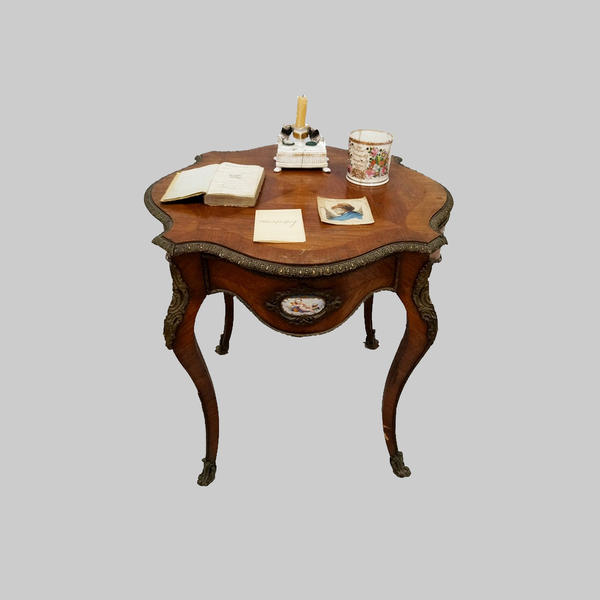
Table with Alexander Stupin’s personal belonging
#2
#8
On display at the Arzamas Art Museum there is the only lifetime edition by Dmitry Dmitrevsky, a translator and writer. The book is the second of the two parts constituting the Nature, a Mirror of the Creator’s Goodness and Wisdom, a rare book by an anonymous author whose name is yet to be discovered.
Dmitry Dmitrevsky was born to a religious activist’s family in the Ryazan Governorate. His elder brother, Ivan Dmitrevsky, was a prominent divinity scholar. Dmitry finished the Ryazan Theological Seminary and entered Moscow University in 1782. Later, he became part of the translators’ group of the university printing house. During the same period of time, he met Nikolai Novikov, a journalist and publisher. Dmitrevsky took to his ideas and contributed to the publication of Novikov’s works, namely Talks with God, or Reflections in the Morning Hours, Reflections on God’s Works in the Kingdom of Nature, and Talks with God, or Reflections in the Evening Hours. Dmitrevsky was Novikov’s pupil and companion, circulating the latter’s religious-ethical treatises in provinces. Art experts believe Dmitrevsky was a mason. All he published was anonymous. One of his most significant publishing projects was a book by Karl von Eckartshausen, a German mystic.
Dmitry Dmitrevsky’s own articles were published as well: Nikolai Karamzin’s Moskovsky Zhurnal published his Hymn (“What”s announced by all nature…”), Ivan Krylov’s Zritel published some of his works, too, but all of them without the author’s name.
Dmitrevsky was a prominent public figure as well. He was a member of the Moscow Society of Russian Language and Literature Lovers and the Imperial Moscow Society of Russian History and Antiques. Also, he was a professor, ethnographer, antique and contemporary popular art collector.
In terms of its language and design, the publication displayed by the Arzamas Art Museum follows the tradition of 18th century secular press, the time of efflorescence in Russian book making and printing. In the first quarter of the 18th century, Russia witnessed several national reforms in public government, armed forces, culture, science, and public education. All of those reforms met the vital needs of Russian society. An important role was played by printing. Emperor Peter I made book printing serve the interests of government reform and new culture development. He personally controlled the book printing and publishing business, identified the subjects for new books, monitored translations, and even edited some of the books.
#22
Author: unknown
Date: 1805
Technique: paper, leather, pressboard, binding, letterpress printing
Dimensions: 20×17×2 cm
Collection: Printed Books
Copyright: History and Art Museum of the city of Arzamas Municipal budget institution of culture, Nizhny Novgorod Region
#3
Mug
#9
Tea started to be consumed on a massive scale in Russia in the first half of the 17th century. Porcelain gradually became an integral part of Russian tea drinking. The porcelain mug from the collection of the Arzamas museum belonged to Alexander Stupin, the founder of the first provincial school of painting, an artist and a teacher from Arzamas.
As far back as 1618, Chinese envoys gifted a few crates of tea to Tsar Michael Romanov. According to some recollections, this is how Fiodor Baikov, a statesman and traveller of the 17th century, drank it in 1654: ‘tea boiled with cow’s milk and butter’; this matter-of-factness could make one ‘conclude that Baikov was talking about something quite well-known’.
In Russia, tea became popular primarily as a medicinal beverage, and soon people started to drink it for pleasure as well. By the middle of the 17th century, it had become possible to buy up to 10 varieties of tea in Moscow. In 1679, the government signed an agreement with China on regular shipments of the drink. All the tealeaves imported from the Orient went to Moscow where they were sold together with other goods, and despite the high price, a lot of people were willing to buy tea.
Tea consumption was rising rapidly in Russia. By the 19th century, it was drunk by people from all the social strata. The statistics for 1830–1840 revealed that in the regions where tea was drunk in larger volumes people consumed smaller quantities of strong alcoholic drinks.
Tea drinking in rich noble, merchant and bourgeois families always involved porcelain ware. Russian porcelain also referred to pieces of pottery and majolica produced in Russia from the middle of the 18th century. Art historians consider this period to be one of the most important in the Russian decorative arts. The principal supplier of porcelain was the Imperial Porcelain Factory opened in the capital in 1744.
#28
In 1960 the Arzamas museum added to its collection the porcelain mug gifted to Alexander Stupin on his name day. It was produced at the factory established by Francis Gardner, a Russified merchant from Scotland, who started private manufacture of porcelain in Russia in 1766.
#29
The factory was situated in a small village called Verbiltsy (today’s Verbilki) in the Dmitrovsky District of the Moscow Governorate. Gardner placed the coat of arms of Moscow on his items. Besides exclusive orders intended for courtiers and aristocrats, the Scotsman also launched large-scale porcelain manufacturing. His ware was of high quality, on a par with Meissen china, the first European porcelain.
In the late 18th century, Gardner handed the factory over to his son Frantz Gardner. For 126 years from the day when it opened, the factory was run by a few generations of the descendants of Gardner Senior.
The factory is still in operation, but now it is called Farfor Verbilok (Porcelain of Verbilki). The legendary factory preserves the traditions of pre-revolutionary porcelain-making and employs old methods for its ware.
#23
Author: Gardner Factory
Date: 19th century
Technique: porcelain, firing, underglaze
Dimensions: 11×10×9 cm
Collection: ceramics, porcelain
Copyright: History and Art Museum of the city of Arzamas Municipal budget institution of culture, Nizhny Novgorod Region
#4
Writing Set
#10
The ink set from the collection of Arzamas Art Museum was a personal object of Alexander Stupin — an artist and founder of the first provincial painting school in Russia.
Private correspondence became fashionable in high society in Europe in the XVIII century and writing sets served as desk decorations. Craftsmen created writing sets for all tastes: massive, delicate, elaborate and elegant. Writing sets were often decorated with the coat of arms or monograms of their owners. They had built-in clocks, mirrors, small hidden drawers and other fancy details. Affluent customers chose writing sets consisting of candleholders, trays for quills, sandboxes, paper knives.
Ink wells differed in size depending on the country and epoch. They were made of porcelain, metals, stone or polymers. For wealth homes, craftsmen made pieces of precious metals, richly chased with precious stones, painting and enamel.
Simpler sets consisted only of an ink well and sandbox on a stand. Portable travel sets were also popular, they were transported in a small box with flap lid. The bottom of such sets held a spill proof ink well, a small candleholder and a couple of sharpened quills.
#11
Alexander Stupin’s ink set is a square hollow base on four animal legs. On top are two lion figures divided by a candleholder. A little below are two containers for ink, sand and slots for quills.
#12
The main source of inspiration for the master who created the ink set were glazed terracotta of the Renaissance epoch. Imitations of ceramics of that time were popular in Italy in the late XIX century and soon became known in West Europe and Russia.
Similar ink sets took the central place on desks in the XIX century. They were used for business correspondence, writing documents, recording expenses and doing other writing jobs.
Exquisite writing desks were an inseparable part of the culture of writing and epistolary genre of the XIX century. With the advent of modern writing instruments they went out of use.
#24
Author: unknown
Date: late XVIII century
Technique: ceramics, underglaze painting, gold plating
Dimensions: 9.5×14×8 cm
Collection: Ceramics, porcelain
Copyright: History and Art Museum of the city of Arzamas Municipal budget institution of culture, Nizhny Novgorod Region
#5
An Invitation Card to the Presentation by Pyotr Yevgenyevich Kornilov, 1943
#13
The Arzamas Art Museum collection contains an invitation card to the presentation by art historian Pyotr Kornilov entitled New Works of Artist Pavel Vedenetsky (from the History of the Arzamas School of Painting) held on September 23, 1943, in the State Russian Museum.
#14
Pyotr Kornilov was born in 1896 in Simbirsk. Upon finishing a non-classical secondary school in Kazan, he enrolled in the St. Petersburg University. In 1925, Pyotr Kornilov returned to Kazan to work for the Central Museum of the Tatar Autonomous Soviet Republic as the Head of the Old Russian Art Department.
#15
Starting from 1932, Kornilov served as the Head of Graphic Art Department at the State Russian Museum, and then went to work for the Scientific Research Museum under the Academy of Arts. At the time of the Great Patriotic War he assisted in the evacuation of Russian art masterpieces and worked as a copy editor in the Iskusstvo (Arts) Publishing House supervising the publication of propaganda and printed materials.
#16
Candidate of Art Critique and Professor Pyotr Kornilov was a renowned art historian and bibliophile. He owned a collection of drawings and water colors of Russian artists of the late 19th — early 20th century. He established a system of cultural monument protection in Tatarstan and was a member of the Leningrad Society of Bibliophiles. One of Kornilov’s major scientific interests was the A.V. Stupin Arzamas School of Painting, the history of which was described in his book.
#17
In the late 1942, Pyotr Kornilov went to work in the Visual Arts Section of the Leningrad Municipal Council Executive Committee, Board of the Arts. In that organization, he printed artistically designed invitation cards.
#18
Including the one of V.P. Belkin (August 6, 1943), the Russian National Artist M. V. Nesterov (1862–1942), M.V. Nesterov in Memoirs and Correspondence (October 15, 1943), and ours New Works of Artist Pavel Vedenetsky (from the History of the Arzamas School of Painting) (September 23, 1943) exhibited as part of the Arzamas Arts Museum collection.
Kornilov’s collection contains a total of about ten thousand exhibits: books, prints, sculptures, and graphic artworks, including drawings by Georgy Vereysky, Nathan Altman, and Nicolay Andreyev. Kornilov gave away some of his collection items to publicly owned museums, specifically, the Russian Museum, and the V.I. Lenin Central Museum in Moscow. Kornilov collaborated with the Arzamas Museum for many years, and it owns a portion of his collection as well.
#25
Author: Pyotr Yevgenyevich Kornilov
Date: 1943
Technique: paper, ink; print, etching, manuscript
Dimensions: 14×9 cm
Collection: Documents
Copyright: History and Art Museum of the city of Arzamas Municipal budget institution of culture, Nizhny Novgorod Region
#6
Table with Alexander Stupin’s personal belongings
#21
The table with personal belongings of Alexander Stupin, founder of the first provincial paining school in Russia, is part of the interior recreated after a painting by Professor Nikolay Alexeev. It depicted Stupin in his studio.
The dressing table came to Russia from France. It appeared in the Baroque era, which prevailed in the 18th century when luxurious gowns were popular in France. An exquisite morning dress would be replaced with a magnificent outdoor dress, which in its turn would give way to a lush and sumptuous ballroom gown. Frequent changes of dresses were the reason, why this piece of furniture appeared, for it solved several tasks at once. At a dressing table it was possible not only to wash oneself but also to change dresses, tidy one’s hair, and freshen oneself up.
The new invention was highly appreciated mainly by representatives of high society. Gradually, instead of a mirror with a couple of drawers and a wash-bowl, exquisite dressing tables began to appear in bedrooms of all rich houses. However, at first, they looked like writing desks, and sometimes one table performed both functions simultaneously: the drawers could contain both quills, writing paper, and jars with cosmetic aids. Dressing tables were a necessary part of both women’s and men’s paraphernalia.
The table is made of rosewood obtained from subtropical tree Dalbergia decipularis of the genus Dalbergia, which grows only in Brazil. Rosewood is characterized by unusual colors: from creamу to rosy with red veins and a rose-like scent.
#26
Author: unknown
Date: 18th century — first half of the 19th century
Technique: Wood, carving, miniature, casting; ceramics, underglaze painting; porcelain; paper, printing; paper, engraving, etching; paper, ink, handwriting
Dimensions:
Collection: Wood; Ceramics, Porcelain; Documents; Graphic Art Copyright: History and Art Museum of the city of Arzamas Municipal budget institution of culture, Nizhny Novgorod Region
#7
Female head teaching aid
#19
Alexander Stupin is the founder of the first provincial art school in Russia, which was opened in 1802 in Arzamas of Nizhny Novgorod region. The collection of the History and Art Museum of the city of Arzamas includes a teaching aid Female head that was used for teaching purposes in the art school.
#20
The establishment and first years of A.V.Arzamas School coincided with the time when Russian artists and teachers were looking for new ways and methods in art education. Training in the Arzamas School was based on the model of Saint Petersburg Academy of Fine Arts, a higher education institution of the Russian Empire that existed from 1757 till its formal abolishment in 1918. The core disciplines were copying of originals, which were engravings of Russian and West European artists, drawing of sculpture and life drawing.
At the beginning of the 19th century it was extremely difficult to find nude models for painting lessons. As a local history expert Nikolay Schegolkov was writing, Arzamas people were ‘brought up in proven faith, … untouched by the corrupting influence of the West’. This was the reason why at the final stage of their education students were painting not a nude model, but portraits and sketches of dressed people. In future it had an impact on their art, because although portrait as a separate genre was not taught by Stupin, the best works of Arzamas artists belong to this genre.
Instead of independent development of the graduation work’s composition, students of the Arzamas School used to copy an engraving in the technique of oil painting. Among examples of such works there are two graduates’ paintings that are now part of the Nizhny Novgorod State Art Museum collection: Saint Jerome in the Desert, a copy of an Augsburg engraving of the beginning of the 18th century depicting the painting by Jacopo Palma the Younger; and Lot and his Daughters painted after an engraving by Ivan Beresenev of the original painting by Louis Jean François Lagrenée. Nonetheless, Alexander Stupin achieved high results, and works of his students were often displayed at exhibitions in the Academy of Fine Arts and repeatedly awarded with prizes.
#27
Author: unknown
Date: 19th century
Technique: Paper, engraving, etching, watercolour
Dimensions: 10.5×12 cm
Collection: Graphic works
Copyright: History and Art Museum of the city of Arzamas Municipal budget institution of culture, Nizhny Novgorod Region
read morehide
00:00
00:00
1x
Table with Alexander Stupin’s personal belonging
Exhibition
3
 Point your smartphone camera to open in the app
Open in app
Share

