The collection of furniture from the Churapchinsky Museum includes various cabinets, benches and tables.
In ancient Yakut culture, a sandaly was a low table made of planks or birch bark. There are several types of sandaly. For example, birch bark tables without legs and with round table tops of one meter in diameter. Such tops consisted of four parts, which are fastened with thin hair ropes. The attachment to the birch bark circle was made of square-shaped laths, which were fastened crosswise with wooden rods.
Another variety of this interior item is a mas sandaly. It is a low table with a round table top on four legs. Such tables were used to put hot vats with meat, kettles, so they stood near the hearth, a special platform near the stove.
Yet another type is a low wooden table with a round or quadrangular table top on high supports that are hoof-shaped legs.
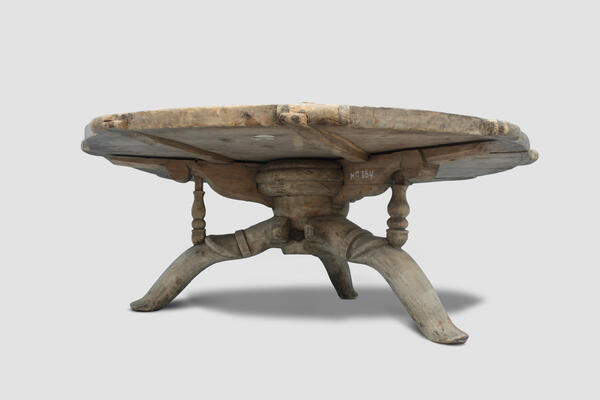
The ritual low table “sier tuom ostuola” on three legs was made by Fedot Pinigin from Teleisky settlement. The exhibit was received by the museum from a relative of the craftsman, Andrey Pinigin.
The Pinigin family is known not only for their carpentry work, but also for their extensive social activities. Fedot Kapitonovich was elected head of Boturussky ulus for many years and was the headman of Teleisky settlement. In 1871, he succeeded in getting a public school opened in the village of Churapcha. He donated funds to construct buildings and was engaged in charity.
In the center of the table top of the exhibit from the museum collection there is a sculptural detail in the form of a profiled round protrusion. The purpose for which it was carved has not been established yet; the interviews with the old residents failed to yield any results. According to the documents kept in the museum, the table was intended for the Ysyakh summer festival. The table top is made of birch root, its edges have relief protrusions, its carved columns rest on wide-spread supports in the shape of animal legs.