#1
Writing table,
Alarm clock
#2
#3
#4
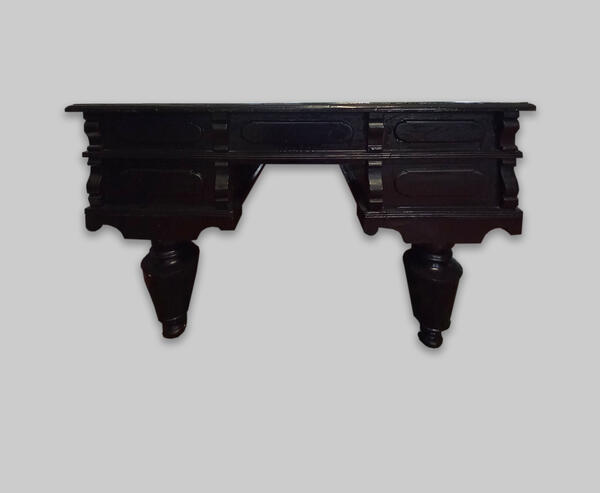
This large office desk was made in the early 20th century. According to a theory, it belonged to Olga Grigorievna Aksakova, the writer Sergey Timofeevich Aksakov’s granddaughter and the founder of a koumissotherapy clinic in the village of Nadezhdino. If this is true, this table may have been located in her office in the clinic.
This massive office desk has several sliding drawers on the side, with another one under the worktop. Its legs are carved, made out of solid wood. The work surface of the table is covered with dark green cloth. According to numerous sources, this color was chosen not for aesthetic, but rather for ergonomic reasons: it was believed that this color helps to focus. That is why there was a fashion not only for office furniture with upholstery of such color, but also, for example, lamps with dark green lampshades.
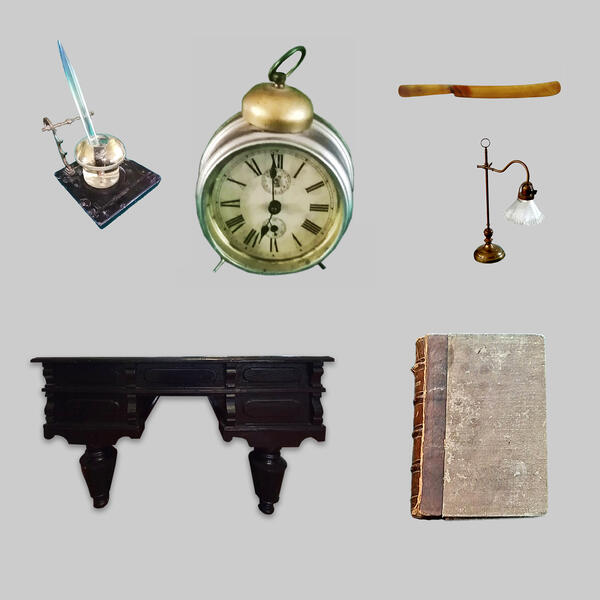
On the office desk, displayed in the “Large sitting room” exposition, there are writing instruments, a desk lamp, an alarm clock, various books, as well as a portrait of Ivan Sergeevich Aksakov – the famous Slavophile, publicist and public figure, and uncle of Olga Grigorievna. She undoubtedly shared his democratic views and warm attitude towards peasants: Olga Aksakova’s generosity was well known throughout the Bashkir region.
Many historians suggest that the first tables appeared not out of a man’s desire to make his life more comfortable, but out of fear of pagan gods, demanding sacrifices. Fearing that they will not accept a sacrifice performed in an ordinary place, the ancient man built special altars for those rituals, which became the ancestors of the modern table. Later, the Egyptians separated the tables by their intended purpose: ones for work, and ones for meals.
Presumably, tables appeared in Russia in the 10th century, that is, almost simultaneously with the appearance of the country itself. In Ancient Russia, the table always occupied an honorable place and usually was the center of the room, regardless of whether it was the boyars’ chambers or a peasant hut. Dahl’s dictionary claims that the Russian word for table — “stol” — was derived from the Old Russian verb “stlat” or “stelit” – meaning lay (something) down, usually used when talking about cloth items, such as table cloth or bedsheets. Back then, the word “stol” not only meant a table for work or lunch, but was also the name of the Tsar’s throne. This is how the Russian word for ‘capital’ — ‘stolitsa’ — appeared in the Russian language.
This massive office desk has several sliding drawers on the side, with another one under the worktop. Its legs are carved, made out of solid wood. The work surface of the table is covered with dark green cloth. According to numerous sources, this color was chosen not for aesthetic, but rather for ergonomic reasons: it was believed that this color helps to focus. That is why there was a fashion not only for office furniture with upholstery of such color, but also, for example, lamps with dark green lampshades.
On the office desk, displayed in the “Large sitting room” exposition, there are writing instruments, a desk lamp, an alarm clock, various books, as well as a portrait of Ivan Sergeevich Aksakov – the famous Slavophile, publicist and public figure, and uncle of Olga Grigorievna. She undoubtedly shared his democratic views and warm attitude towards peasants: Olga Aksakova’s generosity was well known throughout the Bashkir region.
Many historians suggest that the first tables appeared not out of a man’s desire to make his life more comfortable, but out of fear of pagan gods, demanding sacrifices. Fearing that they will not accept a sacrifice performed in an ordinary place, the ancient man built special altars for those rituals, which became the ancestors of the modern table. Later, the Egyptians separated the tables by their intended purpose: ones for work, and ones for meals.
Presumably, tables appeared in Russia in the 10th century, that is, almost simultaneously with the appearance of the country itself. In Ancient Russia, the table always occupied an honorable place and usually was the center of the room, regardless of whether it was the boyars’ chambers or a peasant hut. Dahl’s dictionary claims that the Russian word for table — “stol” — was derived from the Old Russian verb “stlat” or “stelit” – meaning lay (something) down, usually used when talking about cloth items, such as table cloth or bedsheets. Back then, the word “stol” not only meant a table for work or lunch, but was also the name of the Tsar’s throne. This is how the Russian word for ‘capital’ — ‘stolitsa’ — appeared in the Russian language.
#5
Date: early 20th century
Technique: wood, fabric, carpentry
Dimensions: 78×135×82 cm
Collection: Furniture
Copyright: Museum of the Aksakov family
Goskatalog Number: 14666648
Technique: wood, fabric, carpentry
Dimensions: 78×135×82 cm
Collection: Furniture
Copyright: Museum of the Aksakov family
Goskatalog Number: 14666648
#6
Alarm clock
#7
#8
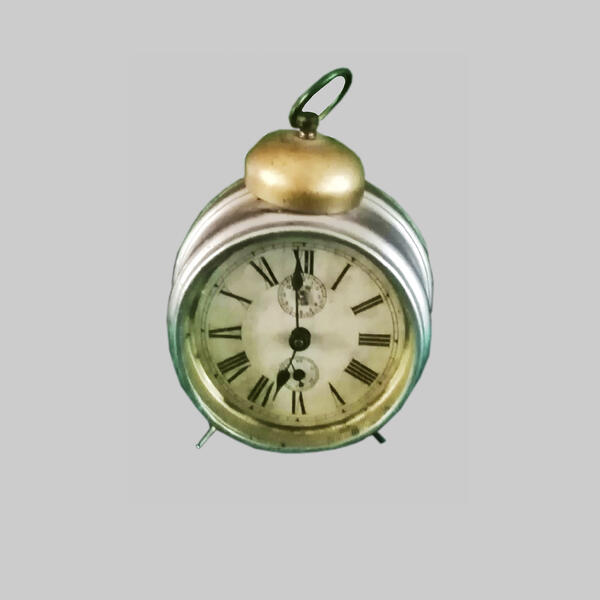
An alarm clock, made by an unknown German company in the early 20th century, stands out immediately on a table in the ‘Large sitting room’. The table used to be in the office of Olga Aksakova, granddaughter of the writer Sergey Aksakov and founder of the clinic in the village of Nadezhdino. That is why we can assume that this clock once sat on a table in the clinic’s office.
The clock’s mechanism is made of yellow metal, and it has a cardboard dial with Roman numerals, with two smaller dials inside, one under the digit XII, and second under the digit VI. The top mini-dial with divisions from 10 to 60 is used to measure independent time intervals in minutes, and the bottom one with divisions from 2 to 12 allows to measure time intervals in hours. On the back side of the alarm clock there are cranks for winding and adjusting the clockwork. As of the present day, this clock is not in working condition.
At the specified time, the alarm clock emits a piercing sound, which is how it got its Russian name — ‘wake-up clock’ — as it is primarily used to make sure one gets up in time. Allegedly, a prototype of the alarm clock dates back to the 4th century B.C., first invented by the ancient Greek philosopher Plato. His design was composed of three vessels, which were connected to each other by tubes. When one vessel was filled up, the water would rapidly pour over into the next one. The lower vessel had an ancient equivalent of a horn installed into it. Once released into the last vessel, the water quickly forced the air out of it directly into the horn, creating a loud noise. With this mechanism Plato signaled his students about the start of a lecture.
In the 15th or 16th century, the great Italian artist and scientist Leonardo da Vinci also invented a device that can be considered a prototype of an alarm clock. It had only two vessels; the water dripped from the top vessel to the bottom one and as it filled up, it powered a mechanism that would lift the sleeping person’s legs. The design of a more familiar to us mechanical alarm clock was first developed by the American clockmaker Levy Hutchins in 1787, but unfortunately, it had a major drawback: it would only ring at 4 AM. Finally, in 1847, the design of the alarm clock, which can be adjusted at any time, was patented by the French inventor Antoine Radier.
The clock’s mechanism is made of yellow metal, and it has a cardboard dial with Roman numerals, with two smaller dials inside, one under the digit XII, and second under the digit VI. The top mini-dial with divisions from 10 to 60 is used to measure independent time intervals in minutes, and the bottom one with divisions from 2 to 12 allows to measure time intervals in hours. On the back side of the alarm clock there are cranks for winding and adjusting the clockwork. As of the present day, this clock is not in working condition.
At the specified time, the alarm clock emits a piercing sound, which is how it got its Russian name — ‘wake-up clock’ — as it is primarily used to make sure one gets up in time. Allegedly, a prototype of the alarm clock dates back to the 4th century B.C., first invented by the ancient Greek philosopher Plato. His design was composed of three vessels, which were connected to each other by tubes. When one vessel was filled up, the water would rapidly pour over into the next one. The lower vessel had an ancient equivalent of a horn installed into it. Once released into the last vessel, the water quickly forced the air out of it directly into the horn, creating a loud noise. With this mechanism Plato signaled his students about the start of a lecture.
In the 15th or 16th century, the great Italian artist and scientist Leonardo da Vinci also invented a device that can be considered a prototype of an alarm clock. It had only two vessels; the water dripped from the top vessel to the bottom one and as it filled up, it powered a mechanism that would lift the sleeping person’s legs. The design of a more familiar to us mechanical alarm clock was first developed by the American clockmaker Levy Hutchins in 1787, but unfortunately, it had a major drawback: it would only ring at 4 AM. Finally, in 1847, the design of the alarm clock, which can be adjusted at any time, was patented by the French inventor Antoine Radier.
#9
Date: early 20th century
Technique: metal, glass, factory production
Dimensions: 18×13 cm
Collection: Technical
Copyright: Museum of the Aksakov family
Goskatalog Number: 16515533
Technique: metal, glass, factory production
Dimensions: 18×13 cm
Collection: Technical
Copyright: Museum of the Aksakov family
Goskatalog Number: 16515533
#10
Book
#11
#12
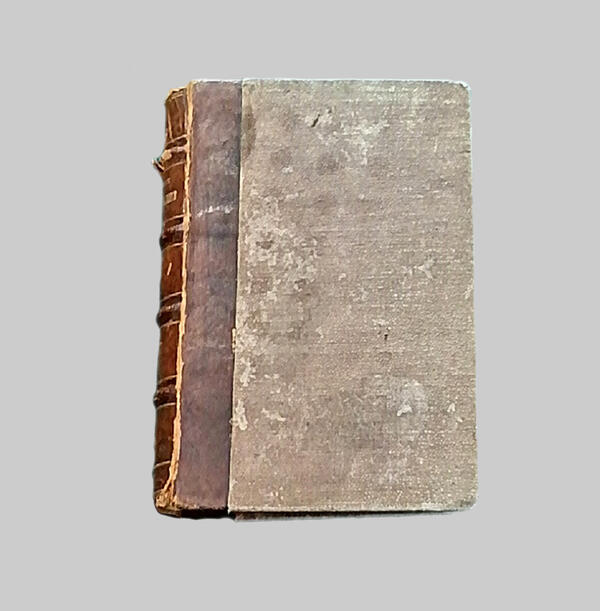
There are various old books in Russian and French on the desk in the large sitting room of the Aksakov Family Museum. Home education of nobles assumed that children began to learn a foreign language as of 4-5 years old, so children from the Aksakov family also spoke several languages. It is possible that they also read the original novel ‘Notes and Adventures of a Noble Man Retiring from the Light’ by Antoine Francois Prevost.
The French writer, also known as the exiled Abbot Prévost (the author himself liked to add the prefix ‘exiled’), became famous world-wide as the author of the first ever psychological novel, The Story of the Chevalier des Grieux and Manon Lescaut. Due to the naturalistic description of the characters and social mores of the time, the novel was instantly banned in France and was first published in Holland in 1731. The same fate befell ‘Notes and Adventures of a Noble Man Retiring from the Light’, where Prevost sharply opposed religious obscurantism and duplicity of class morality. Despite the disgraced fate of both the novels and of Prevost himself in France, his books were widely circulated throughout Europe and often crossed into Russia. The large sitting room presents the edition of 19th century notes, the novel fits into 298 pages.
Antoine Francois Prevost was born at the very end of the 17th century, he was the second of five sons of the Crown Prosecutor Lievain Prévost and Marie Duclet. Even as a child, he amazed those around him with his brilliant intellect. From the age of 16, he was a novice in the spiritual order of the Jesuits, then switched to military service. But he could not bear the harsh discipline he returned to the Jesuits, and then left them because of unhappy love. In 1721, he joined the Benedictine monks at Fontenelle Abbey, then took a monastic vow at the Abbey of Jumièges, and spent the next 7 years in various institutions of the order in Normandy. However, even here it was difficult for him to maintain discipline: in 1728 he personally left the monastery of the Abbey of Saint-Germain-des-Pres and was forced into hiding.
Prevost lived at times in England, at times in Holland, doing literary work and trying to enlist the patronage of noble patrons of the arts. His literary fate was ambiguous: his contemporaries read his great novels and listened carefully to what he published. Nevertheless, as early as the beginning of the 19th century, the fame of his works faded, his publicism became outdated, and the very name of Abbot Prevost lost its former literary weight.
The French writer, also known as the exiled Abbot Prévost (the author himself liked to add the prefix ‘exiled’), became famous world-wide as the author of the first ever psychological novel, The Story of the Chevalier des Grieux and Manon Lescaut. Due to the naturalistic description of the characters and social mores of the time, the novel was instantly banned in France and was first published in Holland in 1731. The same fate befell ‘Notes and Adventures of a Noble Man Retiring from the Light’, where Prevost sharply opposed religious obscurantism and duplicity of class morality. Despite the disgraced fate of both the novels and of Prevost himself in France, his books were widely circulated throughout Europe and often crossed into Russia. The large sitting room presents the edition of 19th century notes, the novel fits into 298 pages.
Antoine Francois Prevost was born at the very end of the 17th century, he was the second of five sons of the Crown Prosecutor Lievain Prévost and Marie Duclet. Even as a child, he amazed those around him with his brilliant intellect. From the age of 16, he was a novice in the spiritual order of the Jesuits, then switched to military service. But he could not bear the harsh discipline he returned to the Jesuits, and then left them because of unhappy love. In 1721, he joined the Benedictine monks at Fontenelle Abbey, then took a monastic vow at the Abbey of Jumièges, and spent the next 7 years in various institutions of the order in Normandy. However, even here it was difficult for him to maintain discipline: in 1728 he personally left the monastery of the Abbey of Saint-Germain-des-Pres and was forced into hiding.
Prevost lived at times in England, at times in Holland, doing literary work and trying to enlist the patronage of noble patrons of the arts. His literary fate was ambiguous: his contemporaries read his great novels and listened carefully to what he published. Nevertheless, as early as the beginning of the 19th century, the fame of his works faded, his publicism became outdated, and the very name of Abbot Prevost lost its former literary weight.
#13
Author: Antoine Francois Prevost
Date: 19th century
Technique: paper, typographic printing
Place: France
Dimensions: 18.5×13×2.5 cm
Collection: Rare books
Copyright Museum: of the Aksakov family
Goskatalog Number: 16515487
Date: 19th century
Technique: paper, typographic printing
Place: France
Dimensions: 18.5×13×2.5 cm
Collection: Rare books
Copyright Museum: of the Aksakov family
Goskatalog Number: 16515487
#14
Bone knife
#15
#18
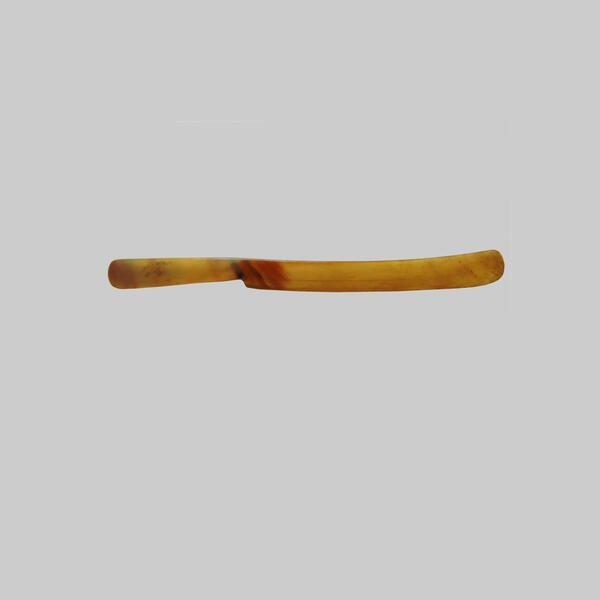
On the desk in the ‘Large sitting room’ there is a light-brown bone knife made in the 19th century. This knife was used in the house of Aksakovs to open letters, as well as to separate pages in books and newspapers. It is made of ivory, a precious material derived most commonly from elephant tusks. Ivory is a very practical material for blades, as it can easily be sharpened and polished.
A knife in and of itself is an ancient tool, but office cutters have only appeared relatively recently. Originally, the most ordinary household or military blades and daggers were often used to open letters and envelopes. At the turn of the 18th-19th centuries, specialized knives for cutting paper became increasingly more widespread. The need for this distinctive variety appeared as a result of the widely spreading paper products.
In the 19th century, the approach to selling paper products was quite different. At that time, a book just bought in a store could not be opened without a paper cutter, as back then, the hydraulic press, which could cut apart the book pages, simply did not exist. Therefore, a large sheet folded several times, containing up to 20 pages of a future book, was simply stitched, joined to others, this was how a book was compiled, which immediately, without trimming, was bound. The pages of such a book could not be turned over without cutting them first. For this, there was bone, wood and metal knives for paper of various types, and thicknesses. Besides, paper cutters were also used to open up letters, which at that time were the only way to communicate at great distances.
Many of the paper cutters that have been preserved to this day, like those presented in the ‘Large sitting room’ collection, are often recognized as outstanding works of decorative and applied art. They could be made of precious metals, ivory, precious stone, etc. Such knives were more of a luxury item or a memorable souvenir rather than a tool with a practical purpose. Modern paper cutters may also be works of art, though, most often, they are purely practical. Moreover, because of the declining use of paper, such cutters are gradually disappearing from everyday use.
A knife in and of itself is an ancient tool, but office cutters have only appeared relatively recently. Originally, the most ordinary household or military blades and daggers were often used to open letters and envelopes. At the turn of the 18th-19th centuries, specialized knives for cutting paper became increasingly more widespread. The need for this distinctive variety appeared as a result of the widely spreading paper products.
In the 19th century, the approach to selling paper products was quite different. At that time, a book just bought in a store could not be opened without a paper cutter, as back then, the hydraulic press, which could cut apart the book pages, simply did not exist. Therefore, a large sheet folded several times, containing up to 20 pages of a future book, was simply stitched, joined to others, this was how a book was compiled, which immediately, without trimming, was bound. The pages of such a book could not be turned over without cutting them first. For this, there was bone, wood and metal knives for paper of various types, and thicknesses. Besides, paper cutters were also used to open up letters, which at that time were the only way to communicate at great distances.
Many of the paper cutters that have been preserved to this day, like those presented in the ‘Large sitting room’ collection, are often recognized as outstanding works of decorative and applied art. They could be made of precious metals, ivory, precious stone, etc. Such knives were more of a luxury item or a memorable souvenir rather than a tool with a practical purpose. Modern paper cutters may also be works of art, though, most often, they are purely practical. Moreover, because of the declining use of paper, such cutters are gradually disappearing from everyday use.
#16
Date: 19th century
Technique: Ivory processing, manual production of natural bone products, sharpening
Dimensions: 20.5×1.5 cm
Collection: Household items
Copyright: Museum of the Aksakov family
Goskatalog Number: 13446004
Technique: Ivory processing, manual production of natural bone products, sharpening
Dimensions: 20.5×1.5 cm
Collection: Household items
Copyright: Museum of the Aksakov family
Goskatalog Number: 13446004
#19
Table lamp
#20
#21
In the 1880s, across the developed world, a new technological fashion is beginning to spread at lightning speed: electric lighting. They were immediately interested in people who were wealthy and savvy in the latest innovations, and by the beginning of the twentieth century, the light from incandescent lamps had spread so much that it ceased to amaze small town residents.
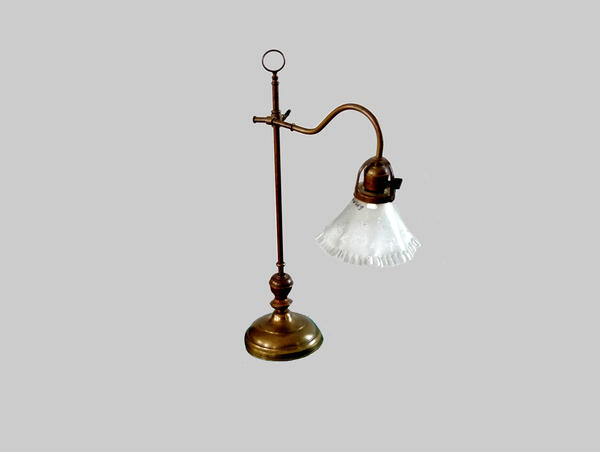
Electric lighting devices most likely came into use in the Aksakov family around this time. The table lamp on display in the large sitting room was produced in the early 20th century. Its lampshade is made of frosted glass in the shape of a tulip and is compact in size. This feature immediately distinguishes an electric lamp from lamps that use fuel or candles: the latter often use a large lamp shade to increase the reflection area of the light source. The stem of this lamp is mounted on a hinge to easily change the position of the lampshade and adjust the light intensity and direction of light flux.
The appearance of electric lighting at the end of the 19th century came at a time of style chaos, which is noticeable, albeit in the restrained, but eclectic outlines of the table lamp from the museum collection. In those days, grown bourgeois class aspirations for the aristocratic respectability of their home revived interest in antiques and led to a revival in architecture and furniture of historical styles of different eras. At the same time, the foremost artists and architects of that time had already begun an intensive search for new artistic paths, which eventually led to the emergence of the Art Nouveau style.
In the electric lamps of the late 19th century, two directions were immediately determined: constructive (light, technological form, devoid of any decor) and decorative (using common style forms of past eras and modernity). Lamps of constructively simple but expressive forms were produced by many electrical engineering firms in the US, Germany, and France. As a rule, they were intended to illuminate work areas and had the ability to adjust the direction of the light flux. The shape of some of them turned out to be so successful that nowadays their serial production is even resumed.
Electric lighting devices most likely came into use in the Aksakov family around this time. The table lamp on display in the large sitting room was produced in the early 20th century. Its lampshade is made of frosted glass in the shape of a tulip and is compact in size. This feature immediately distinguishes an electric lamp from lamps that use fuel or candles: the latter often use a large lamp shade to increase the reflection area of the light source. The stem of this lamp is mounted on a hinge to easily change the position of the lampshade and adjust the light intensity and direction of light flux.
The appearance of electric lighting at the end of the 19th century came at a time of style chaos, which is noticeable, albeit in the restrained, but eclectic outlines of the table lamp from the museum collection. In those days, grown bourgeois class aspirations for the aristocratic respectability of their home revived interest in antiques and led to a revival in architecture and furniture of historical styles of different eras. At the same time, the foremost artists and architects of that time had already begun an intensive search for new artistic paths, which eventually led to the emergence of the Art Nouveau style.
In the electric lamps of the late 19th century, two directions were immediately determined: constructive (light, technological form, devoid of any decor) and decorative (using common style forms of past eras and modernity). Lamps of constructively simple but expressive forms were produced by many electrical engineering firms in the US, Germany, and France. As a rule, they were intended to illuminate work areas and had the ability to adjust the direction of the light flux. The shape of some of them turned out to be so successful that nowadays their serial production is even resumed.
#22
Date: early 20th century
Technique: metal, glass, factory production
Dimensions: 56×27 cm
Copyright: Museum of the Aksakov family
Collection: Household items
Goskatalog Number: 16515552
Technique: metal, glass, factory production
Dimensions: 56×27 cm
Copyright: Museum of the Aksakov family
Collection: Household items
Goskatalog Number: 16515552
#23
Inkwell
#24
#25
As of today, Aksakov’s noble family is known first and foremost for its many talented authors it had gifted to Russian literature. Sergey Timofeevich Aksakov became famous as the author of documentary biographical works, “Notes” about fishing and hunting, as well as an erudite theater and literary critic. His children Konstantin, Ivan, Grigory and Vera Aksakovs, apart from their passionate commitment to Slavophilia, were also major writers. Due to this, an inkwell was an essential element of their house.
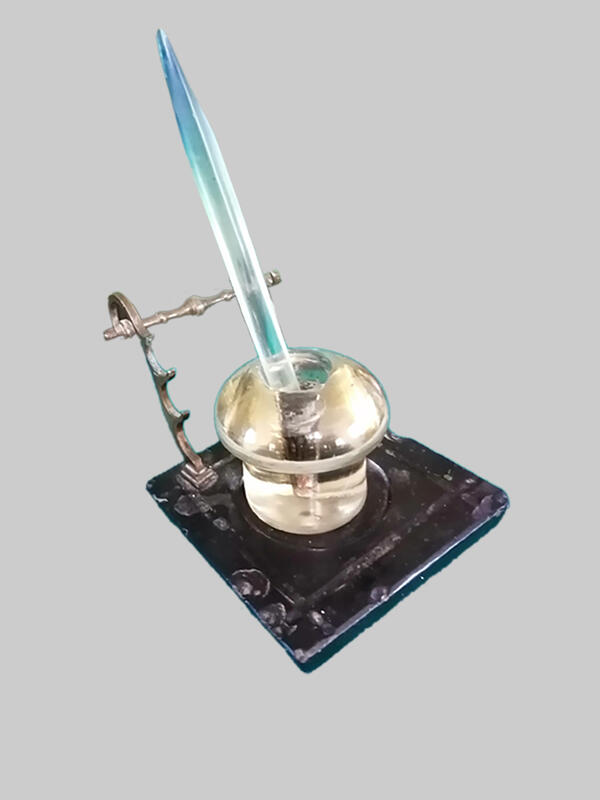
In the collection of the “Large sitting room” there is an inkwell made of transparent glass with a hole in the center. It is mounted on a black metal stand, which in turn has a pen of an unusual shape. An inkwell like this could be easily moved from place to place, which in the large and populated house of the Aksakovs was particularly valuable. This inkwell was made in the beginning of the 20th century, at the sunset of pen writing, a time when much more convenient piston ball pens would soon become popular.
The need for inkwells has first emerged with the emergence of ink pens. The oldest inkwell found so far was discovered during excavations of the ash buried ancient Roman town of Herculaneum, destroyed by an eruption of Mount Vesuvius in 79 AD. It was a clay bowl, at the bottom of which was preserved a dark-colored sediment. It turned out, after a research, that it was residue of an ancient ink, confirming the archeologists’ discovery.
Over time, ink vessel manufacturing began to involve metal, horns or leather. The more familiar glass inkwells were first produced by the British. It was the British glass masters of the 17th century who managed to develop inkwells, equipped with a special cone funnel that prevented ink from escaping even if the vessel was tipped over. Around the same time, special outdoor inkwells with narrow necks started appearing, usually carried in a breast pocket.
Depending on country and age, inkwells were of different sizes and made of various materials: porcelain, metals, stone, polymers and others. For the richer households, craftsmen would create inkwells made of precious metals, lavishly decorated with gemstones, as well as painted and enameled.
In the collection of the “Large sitting room” there is an inkwell made of transparent glass with a hole in the center. It is mounted on a black metal stand, which in turn has a pen of an unusual shape. An inkwell like this could be easily moved from place to place, which in the large and populated house of the Aksakovs was particularly valuable. This inkwell was made in the beginning of the 20th century, at the sunset of pen writing, a time when much more convenient piston ball pens would soon become popular.
The need for inkwells has first emerged with the emergence of ink pens. The oldest inkwell found so far was discovered during excavations of the ash buried ancient Roman town of Herculaneum, destroyed by an eruption of Mount Vesuvius in 79 AD. It was a clay bowl, at the bottom of which was preserved a dark-colored sediment. It turned out, after a research, that it was residue of an ancient ink, confirming the archeologists’ discovery.
Over time, ink vessel manufacturing began to involve metal, horns or leather. The more familiar glass inkwells were first produced by the British. It was the British glass masters of the 17th century who managed to develop inkwells, equipped with a special cone funnel that prevented ink from escaping even if the vessel was tipped over. Around the same time, special outdoor inkwells with narrow necks started appearing, usually carried in a breast pocket.
Depending on country and age, inkwells were of different sizes and made of various materials: porcelain, metals, stone, polymers and others. For the richer households, craftsmen would create inkwells made of precious metals, lavishly decorated with gemstones, as well as painted and enameled.
#26
Date: early 20th century
Technique: glass
Dimensions: 6×7 cm
Copyright: Museum of the Aksakov family
Collection: Household items
Technique: glass
Dimensions: 6×7 cm
Copyright: Museum of the Aksakov family
Collection: Household items
read morehide
00:00
00:00
1x
Writing table, Alarm clock, Book, Lamp, Inkwell
0
 Point your smartphone camera to open in the app
Open in app
Share