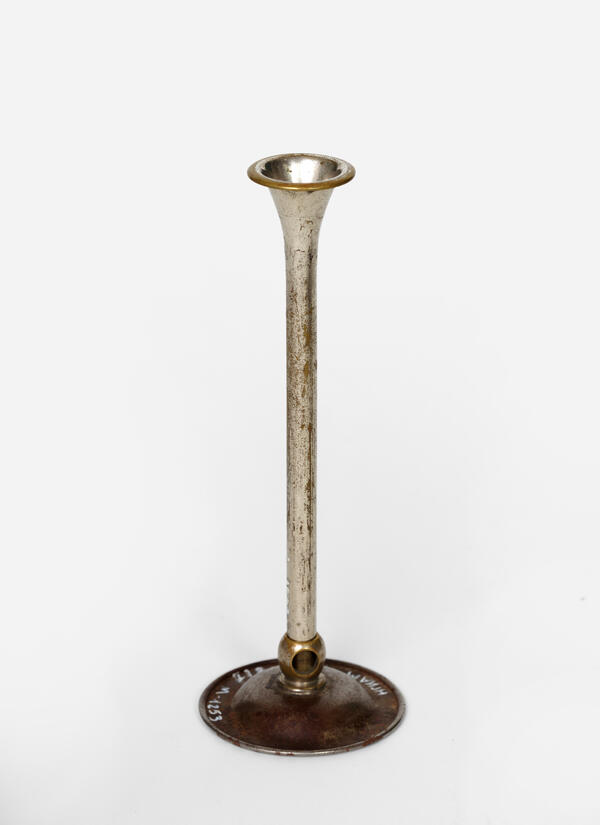
A stethoscope is a medical instrument used by doctors to listen to sounds produced by the heart, lungs and other internal organs. Before its invention, doctors had to place their ear directly against the patient’s body. This diagnostic method, known since Antiquity, is called direct auscultation.
The first stethoscope appeared in 1816. It was invented by the French physician René Laennec, who worked at the Necker Hospital in Paris. According to Laennec’s own account, he once needed to examine a young woman but found it awkward to listen to her heart in the usual way. He therefore rolled a sheet of paper into a tight tube, placed one end against the patient’s chest and the other against his ear. He discovered that the heartbeat could be heard even more clearly through the paper tube.
Laennec subsequently developed a wooden stethoscope in the form of a hollow tube. The instrument made it possible to distinguish sounds that had previously been difficult to hear and to diagnose heart and lung conditions more accurately. He named his invention the stethoscope, combining two Greek words: stethos (chest) and skopein (examine, watch).
In Russia, one of the first to describe the method of listening with a stethoscope was the physician Prokhor Alekseyevich Charukovsky. In 1831, he published a paper dedicated to the use of the new instrument for diagnosing diseases. Over time, the design of the stethoscope evolved. Wooden tubes were replaced by devices with flexible sound-conducting tubes and two earpieces. Later, phonendoscopes with a diaphragm were invented, allowing for better capture of specific sounds.
The stethoscope on display in the museum belonged to Mikhail Sergeyevich Vedeneyev (1894–1967). In 1935, the surgeon moved to Nevyansk and headed the surgical department of the local hospital. Under his leadership, the department was divided into aseptic and septic surgical wards, donor and oncology rooms were opened, and a blood transfusion unit was organized.
During the Great Patriotic War, Vedeneyev served in the Far East. He headed the surgical department of a district hospital in Vladivostok, and then worked at an evacuation hospital in Voroshilov-Ussuriysky (modern-day Ussuriysk). After the war, he returned to work in Nevyansk.
In 1946, Mikhail Vedeneyev was awarded the title of Honored Doctor of the RSFSR, and in 1961, he received the Order of Lenin.