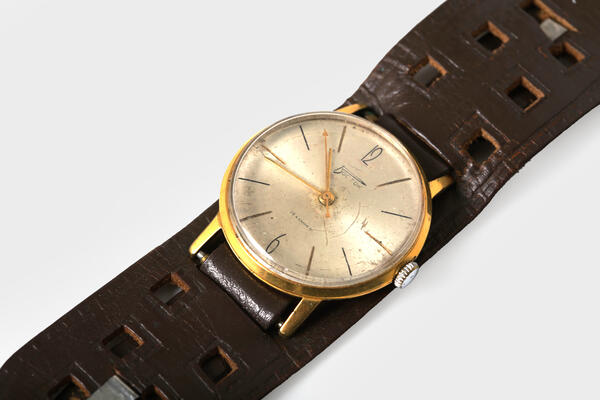
Vostok wristwatches were manufactured at the Chistopol Watch Factory in the Tatar ASSR. The factory’s history began during the Great Patriotic War. In the autumn of 1941, part of the equipment and workforce of the Second Moscow Watch Factory was evacuated to Chistopol, a town on the banks of the Kama River. There, production of watch mechanisms and instruments for military use was established. After the war, the factory continued operating and gradually shifted towards the production of watches for civilian use.
The name Vostok appeared considerably later, in the 1960s. Under this brand, the factory produced various models of mechanical watches, including shock-resistant and water-resistant ones. Chistopol watches were sold throughout the Soviet Union and exported abroad.
The watch on display is equipped with a mechanical caliber 2209 movement with manual winding. Inside the case is a system of gears, springs and other components that drive the hands. To keep the watch running, it must be wound regularly by turning the crown.
The movement contains 18 ruby jewels. These are not decorative elements but small bearings made of synthetic ruby. They reduce friction between moving parts and slow down wear. Another feature of the watch is its shock-resistant balance mechanism. It protects the delicate pivots of one of the movement’s most sensitive components from damage caused by knocks and drops. When fully wound, the watch can run for approximately 38 hours without being wound again.
The watch belonged to Mikhail Vedeneyev (1894–1967), a surgeon who had headed the surgical department at Nevyansk Hospital from 1935. At his initiative, the department was divided into aseptic and septic surgical wards, a blood transfusion unit was established, and donor and oncology rooms were opened.
During the Great Patriotic War, Vedeneyev served in the Far East. He headed the surgical department of a district hospital in Vladivostok and later worked at an evacuation hospital in Voroshilov-Ussuriysky. In 1946, he was awarded the title of Honored Doctor of the RSFSR, and in 1961, he received the Order of Lenin.
The watch remained in the Vedeneyev family for many years. It was donated to the museum by the surgeon’s great-grandson, Valery Semyonov.