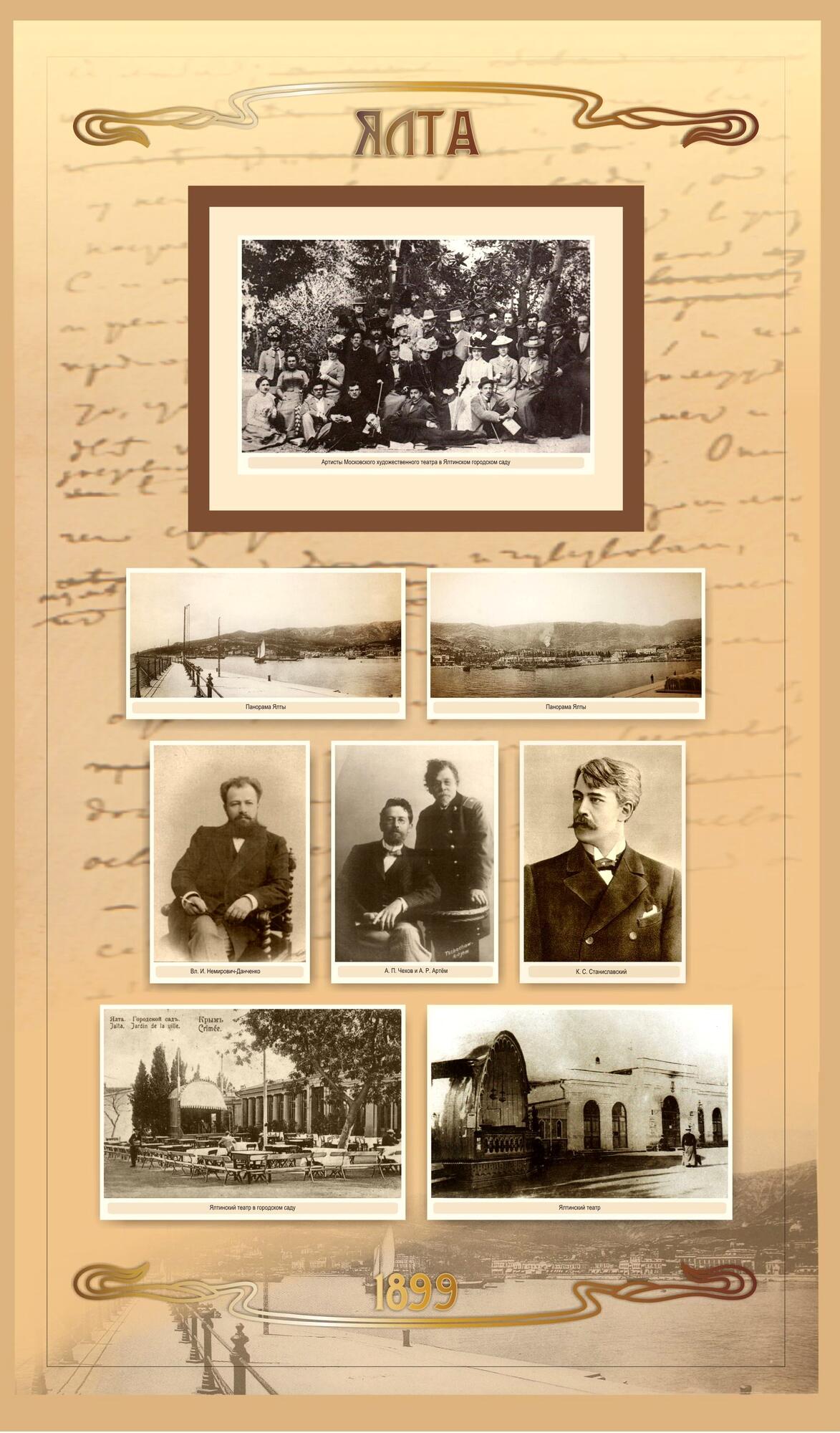


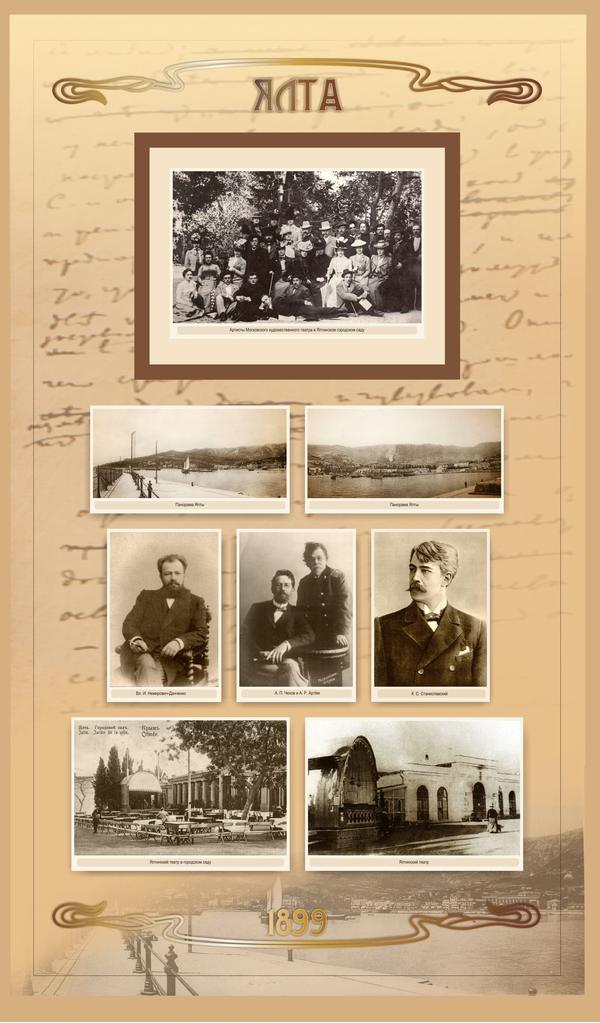
Several display panels of the permanent exhibition are devoted to Chekhov and the Moscow Art Theatre (EmkhaTe-MKT). 17 December 1898, ‘The Seagull’ was premiered at that theatre. The success of the play surpassed all expectations. Since that time, the flying seagull has become the emblem of the theatre. All subsequent productions of Chekhov’s plays by KonstantIn Stanislavsky and VladImir Nemirovich-Danchenko were a howling success but Chekhov never saw them as he could not come to Moscow because of his illness.
In April 1900, the entire theatre company came to the Crimea on a tour to show to Chekhov its plays “The Seagull” and “Uncle Vanya”. All the company had a commemorative picture taken in the Yalta city garden, together with Chekhov and Gorky. The photo in the frame is a group picture of the MKT theatre company in the Yalta city garden. The final pictures on the display panel are two views of the Yalta theatre as it looked in Chekhov’s lifetime.
The Crimea tour of MKT began in the Sebastopol summer theatre. Apart from Chekhov, the performance was also attended by IvAn Bunin, MaxIm Gorky and other literary people who came to the Crimea for the Easter holiday. After several performances in Sebastopol the MKT company went to Yalta. There, at the Chekhov’s “White Dacha” (country home) the company met Mamin-Sibiryak, Serguey Yelpatyevsky and Serguey Rakhmaninov.
The theatre had four plays on its repertoire, two of those by Chekhov. The Yalta tour began with “Uncle Vanya”, it was a complete success. After the performances, there were hot debates in the city garden about the new trends in art. “The performances caused heated arguments, nearly coming to blows, - Stanislavsky noted, - consequently, they achieved the goal”.
23 April, the tour was finished by a performance of “The Seagull”. During the intervals, colored sheets of paper with verses on them were falling down from the upper gallery. The actor Vladimir Luzhsky kept one of those sheets of paper and donated it to the MKAT (MKhAT – the Moscow Art Academic Theatre) museum: the verses were printed in the local printing house and the name of the author was not specified. The poet was a teacher of local girl’s school MikhaIl Gorbatov, a close acquaintance of Chekhov and Gorky. The hero of the occasion, Chekhov, was also honored at the party. A palm branch with a crimson band was given to him as a gift. Chekhov got to know better the actors of the company and wrote his last plays, ‘Three Sisters’ and ‘The Cherry Orchard’ with due account for the specifics of their acting techniques.
In April 1900, the entire theatre company came to the Crimea on a tour to show to Chekhov its plays “The Seagull” and “Uncle Vanya”. All the company had a commemorative picture taken in the Yalta city garden, together with Chekhov and Gorky. The photo in the frame is a group picture of the MKT theatre company in the Yalta city garden. The final pictures on the display panel are two views of the Yalta theatre as it looked in Chekhov’s lifetime.
The Crimea tour of MKT began in the Sebastopol summer theatre. Apart from Chekhov, the performance was also attended by IvAn Bunin, MaxIm Gorky and other literary people who came to the Crimea for the Easter holiday. After several performances in Sebastopol the MKT company went to Yalta. There, at the Chekhov’s “White Dacha” (country home) the company met Mamin-Sibiryak, Serguey Yelpatyevsky and Serguey Rakhmaninov.
The theatre had four plays on its repertoire, two of those by Chekhov. The Yalta tour began with “Uncle Vanya”, it was a complete success. After the performances, there were hot debates in the city garden about the new trends in art. “The performances caused heated arguments, nearly coming to blows, - Stanislavsky noted, - consequently, they achieved the goal”.
23 April, the tour was finished by a performance of “The Seagull”. During the intervals, colored sheets of paper with verses on them were falling down from the upper gallery. The actor Vladimir Luzhsky kept one of those sheets of paper and donated it to the MKAT (MKhAT – the Moscow Art Academic Theatre) museum: the verses were printed in the local printing house and the name of the author was not specified. The poet was a teacher of local girl’s school MikhaIl Gorbatov, a close acquaintance of Chekhov and Gorky. The hero of the occasion, Chekhov, was also honored at the party. A palm branch with a crimson band was given to him as a gift. Chekhov got to know better the actors of the company and wrote his last plays, ‘Three Sisters’ and ‘The Cherry Orchard’ with due account for the specifics of their acting techniques.


