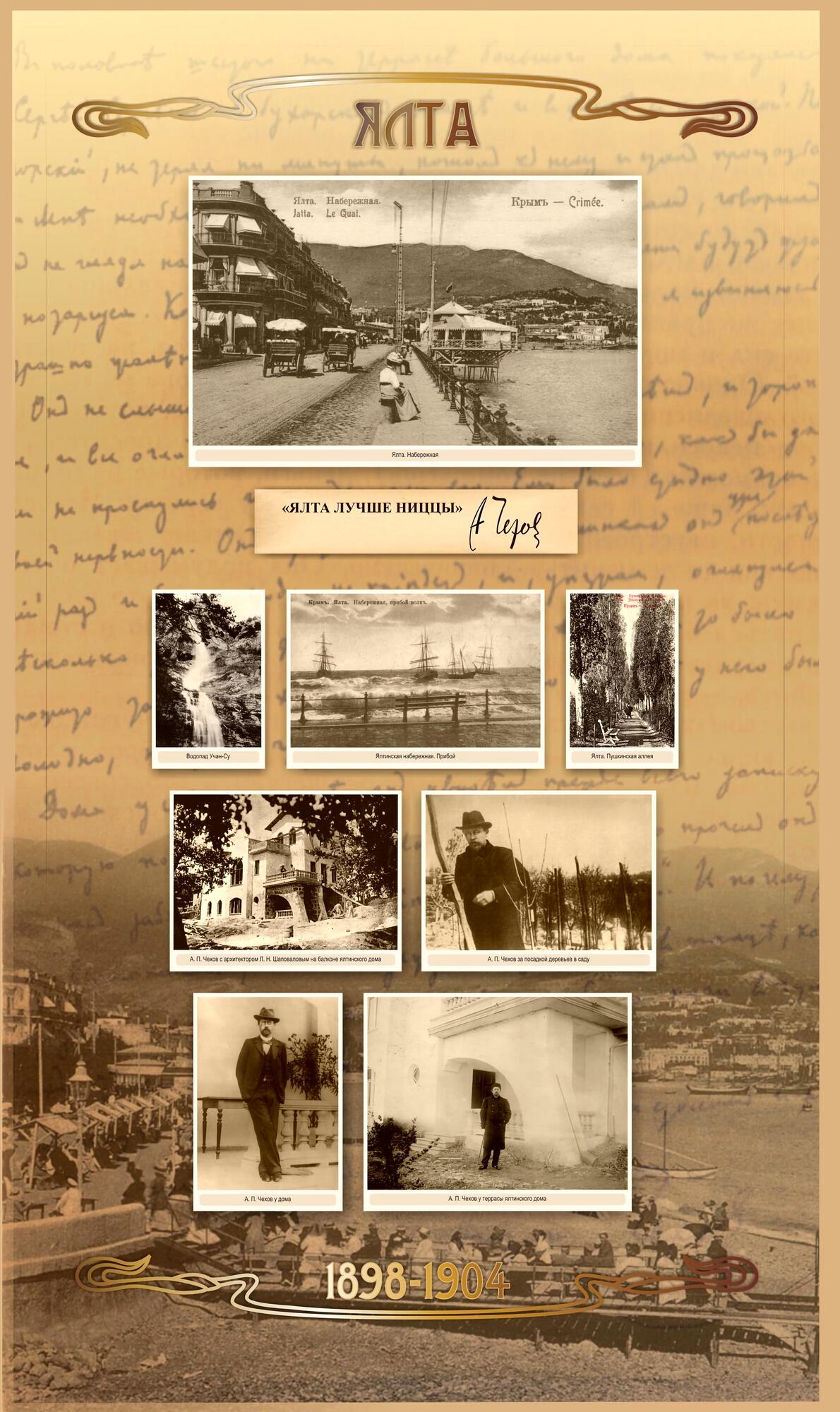


Soon after coming to the Crimea for treatment in September 1898, Chekhov decided to remain in Yalta forever. There were several reasons behind it. First, the writer’s state of health did not allow him living in Moscow over the winter and long trips abroad profited nothing. Second, after his father’s death in October 1898 года Chekhov saw no point in leaving the family in Melikovo.
Giving the reasons for selecting Yalta for permanent residence, Chekhov wrote: ‘Yalta is better than Nice’, claiming that it was cleaner compared to the European resorts. Besides, Yalta was ‘closer to Russia’ as compared to the Caucasus where he was also recommended to move.
In end October 1898, Chekhov, on recommendation of his acquaintance from Yalta, Isaac SinAni, purchased a plot of land in Verkhnyaya Autka near Yalta. He ordered the house design and construction from the architect Leo Shapovalov.
Chekhov liked the purchased plot of land because of its marvelous views of the sea, Yalta itself and its suburbs. Besides, Chekhov dreamed of turning a wasteland into a blossoming garden. The editor of the ‘Russkaya Mysl»(Russian thought) magazine, Vukol Lavrov, presented to Chekhov an autographed copy of the book, “The Flora of Horticulture”: “To my dear friend Anton Pavlovich, as an encouragement of his love for gardening”. It was an illustrated catalogue of greenhouse, glasshouse, garden and vegetable garden plants.
Selecting the plants for his garden, the writer highlighted their names in the book with three pencils – red, crimson and green. He ordered the plants in “Sinop” – a nursery garden near Sukhumi, in nursery gardens of Odessa, in a horticultural shop of Bros. Rosen in Holland, in NikItsky botanical garden in Yalta, and in other places. Chekhov also ordered flower-growing catalogues and consulted those in planting and tending his plants.
Chekhov recorded the names of the trees and flowers he planted in a blue notebook named “The Garden”. In a letter to his sister Maria dated 13 November 1898, he wrote: “I”ve already received many roses and cypresses for my future garden, as a present”.
The house construction was completed in end summer. On 20 July, Chekhov wrote to his sister:
Giving the reasons for selecting Yalta for permanent residence, Chekhov wrote: ‘Yalta is better than Nice’, claiming that it was cleaner compared to the European resorts. Besides, Yalta was ‘closer to Russia’ as compared to the Caucasus where he was also recommended to move.
In end October 1898, Chekhov, on recommendation of his acquaintance from Yalta, Isaac SinAni, purchased a plot of land in Verkhnyaya Autka near Yalta. He ordered the house design and construction from the architect Leo Shapovalov.
Chekhov liked the purchased plot of land because of its marvelous views of the sea, Yalta itself and its suburbs. Besides, Chekhov dreamed of turning a wasteland into a blossoming garden. The editor of the ‘Russkaya Mysl»(Russian thought) magazine, Vukol Lavrov, presented to Chekhov an autographed copy of the book, “The Flora of Horticulture”: “To my dear friend Anton Pavlovich, as an encouragement of his love for gardening”. It was an illustrated catalogue of greenhouse, glasshouse, garden and vegetable garden plants.
Selecting the plants for his garden, the writer highlighted their names in the book with three pencils – red, crimson and green. He ordered the plants in “Sinop” – a nursery garden near Sukhumi, in nursery gardens of Odessa, in a horticultural shop of Bros. Rosen in Holland, in NikItsky botanical garden in Yalta, and in other places. Chekhov also ordered flower-growing catalogues and consulted those in planting and tending his plants.
Chekhov recorded the names of the trees and flowers he planted in a blue notebook named “The Garden”. In a letter to his sister Maria dated 13 November 1898, he wrote: “I”ve already received many roses and cypresses for my future garden, as a present”.
The house construction was completed in end summer. On 20 July, Chekhov wrote to his sister:


