

Before moving to Yalta for permanent residence, Chekhov visited it several times. He saw Yalta for the first time in 1888, on the way from Sebastopol to Feodosia. He did not like the city. ‘Yalta is a mixture of something European resembling the views of Nice, and something middle-class and nundinal. Boxes of hotels where the poor consumptive die of consumption… Those ugly faces of the idle rich with their thirst for halfpenny adventures, scent of perfume instead of the tang of sea air and cedar, miserable dirty quay, sad lights far away in the sea, chatter of young girls and boys who came here to enjoy the nature of which they know nothing – all this, in general, creates a cheerless impression…’, he wrote in one of his letters.
It was only the sea that left a good impression. ‘The sea is wonderful, blue and tender as the hair of an innocent girl. You can live for 1000 years on the seashore and never ger bored…’
In July-August of the next year the writer was in Yalta again. That time he spent there three weeks working at the novel ‘A Dreary Story’. The next visit took place in spring 1894. He stayed in the best Yalta hotel of that time, ‘Rossiya’. There he wrote his short story ‘The Student’ then.
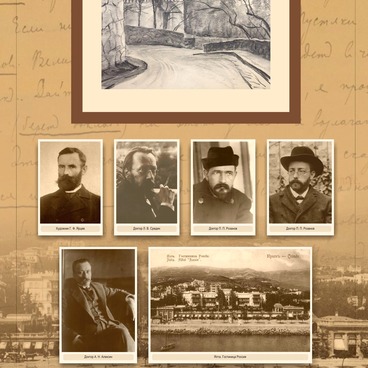
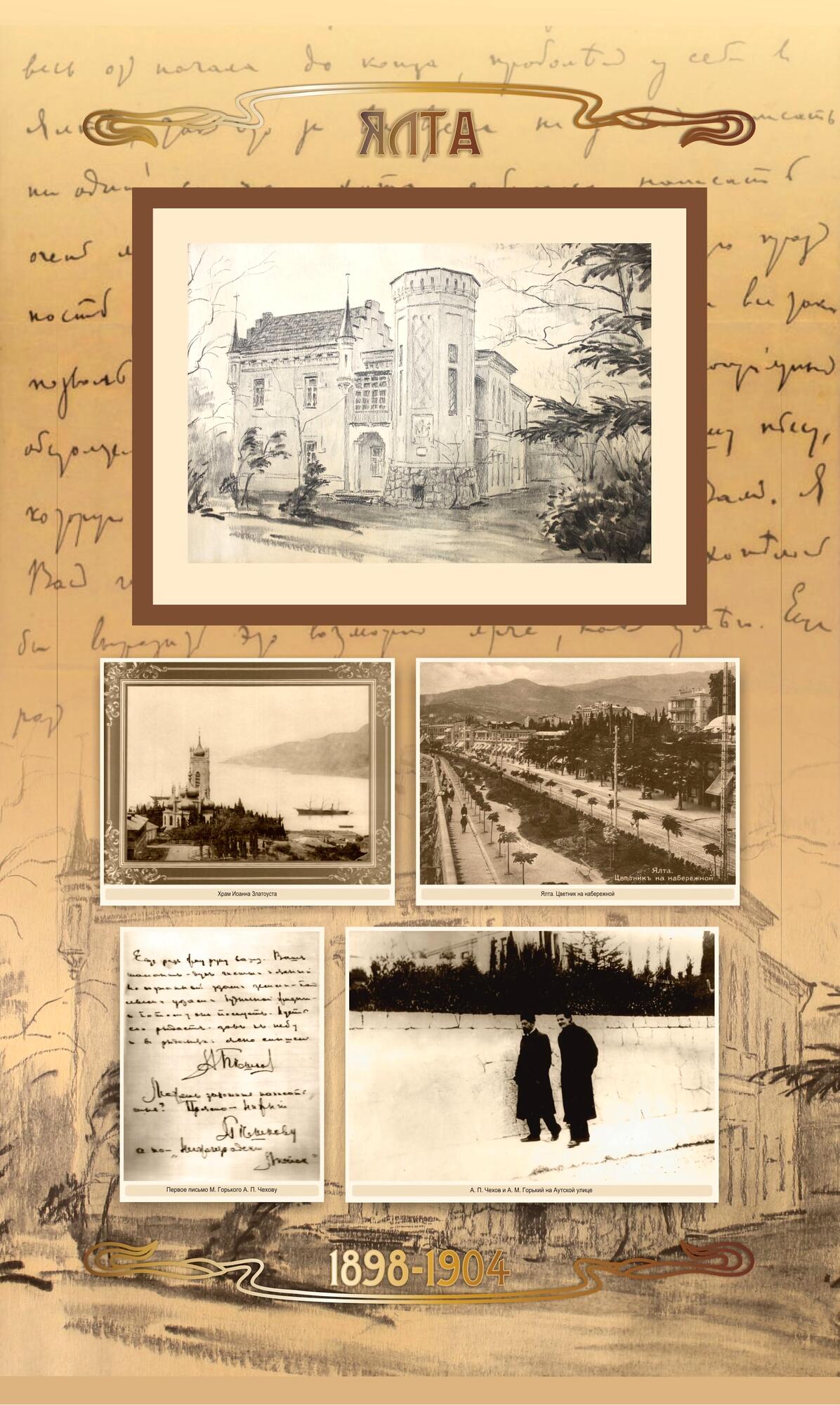
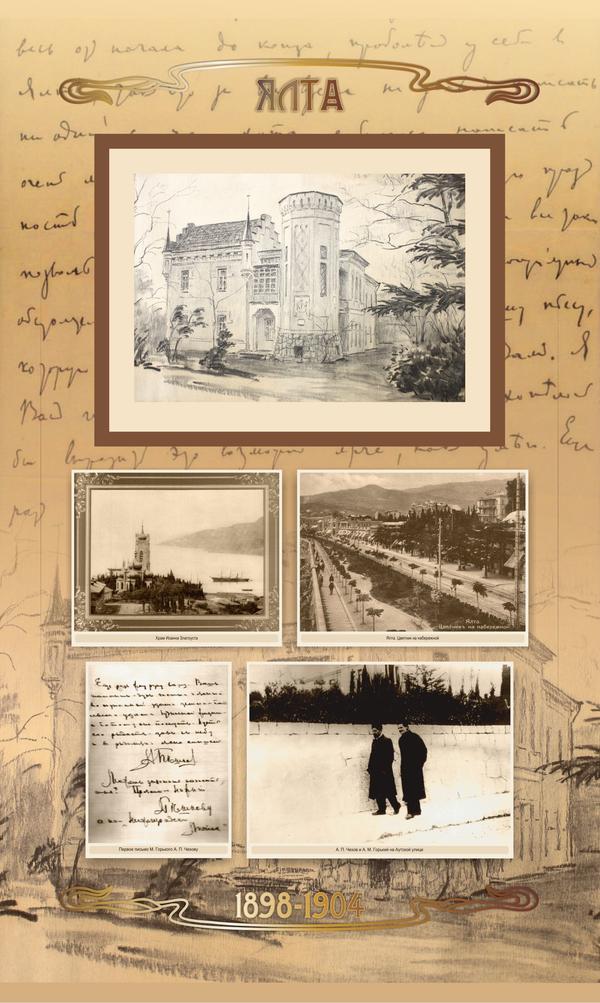
Before his own house was built, the writer stayed in private boarding houses and country houses (‘dAchas’). Those buildings and other Chekhov’s memorial places in Yalta are displayed in the exhibition of the drawings Sergey Chekhov, the writer’s nephew. The picture in the frame on the stand is- the drawing of Ivanov’s dAcha where Anton Pavlovich moved from the dacha of Bushuev in October 1898. To the left of it there is a picture of Chekhov dated 1888, showing how the writer looked when he first visited Yalta. The next two pictures are postcards with the views of Yalta of that time. The final pictures displayed on the panel are the portraits of Chekhov’s acquaintances in Yalta: the writer and medical doctor Sergey Yelpatyevsky and Chekhov’s consulting doctor Isaac Altshuller.
Yelpatyevsky and Chekhov settled in Yalta at the same time. The former remembered: “We started building our houses nearly simultaneously. He was kidding calling my house high on the hill, above Yalta, with a lovely, glorious, unique view of the sea and mountains, - “the VOlogda Region”, while I called his place “a real dump”. I did not like the location in the remote part of untidy AUtka in a hollow near a dusty highway, but Chekhov’s place was homey and cosy, especially after he planted his beautiful garden and the desert location acquired a lived-in look, with two fawning dogs running over the garden and a heron strutting about the yard’.
It was only the sea that left a good impression. ‘The sea is wonderful, blue and tender as the hair of an innocent girl. You can live for 1000 years on the seashore and never ger bored…’
In July-August of the next year the writer was in Yalta again. That time he spent there three weeks working at the novel ‘A Dreary Story’. The next visit took place in spring 1894. He stayed in the best Yalta hotel of that time, ‘Rossiya’. There he wrote his short story ‘The Student’ then.
Before his own house was built, the writer stayed in private boarding houses and country houses (‘dAchas’). Those buildings and other Chekhov’s memorial places in Yalta are displayed in the exhibition of the drawings Sergey Chekhov, the writer’s nephew. The picture in the frame on the stand is- the drawing of Ivanov’s dAcha where Anton Pavlovich moved from the dacha of Bushuev in October 1898. To the left of it there is a picture of Chekhov dated 1888, showing how the writer looked when he first visited Yalta. The next two pictures are postcards with the views of Yalta of that time. The final pictures displayed on the panel are the portraits of Chekhov’s acquaintances in Yalta: the writer and medical doctor Sergey Yelpatyevsky and Chekhov’s consulting doctor Isaac Altshuller.
Yelpatyevsky and Chekhov settled in Yalta at the same time. The former remembered: “We started building our houses nearly simultaneously. He was kidding calling my house high on the hill, above Yalta, with a lovely, glorious, unique view of the sea and mountains, - “the VOlogda Region”, while I called his place “a real dump”. I did not like the location in the remote part of untidy AUtka in a hollow near a dusty highway, but Chekhov’s place was homey and cosy, especially after he planted his beautiful garden and the desert location acquired a lived-in look, with two fawning dogs running over the garden and a heron strutting about the yard’.