The decorative wall shelf displayed in the merchant’s drawing room was created using the open casting technique. It was made at the Kusa ironworks some time between the late 19th and the early 20th century.


Wall shelf
Creation period
Late 19th–early 20th century
Place of сreation
Russia
Dimensions
33 х 24 х 14 cm
Technique
Industrial production
Collection
Exhibition
3
Open in app#1
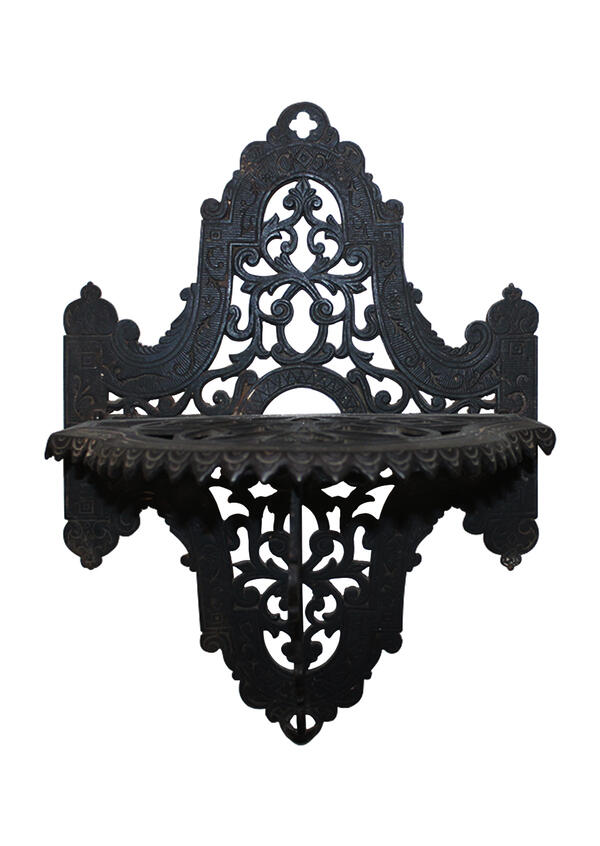
Wall Shelf
#3
#4
In Russia, the art of cast iron casting originated in the Urals in the middle of the 18th century. Before the Russian revolution, the country had several foundries that made products from cast iron, with one of the most famous being the Kasli ironworks.
#5
The Kusa factory, where the shelf from our collection was made, was not as popular as the old foundry in Kasli. It only began to produce artistic items from cast iron in 1883. During its initial years, experienced workers from the Kasli foundry helped local craftsmen master the necessary skills, which greatly contributed to the development of the art of iron casting in Kusa. Meanwhile, the management of the Kusa factory sought ways to make their products stand out from those made in Kasli. For instance, the Kusa ironworks made cast iron reproductions of decorative and applied art objects in the then-popular Art Nouveau style that were brought from the capital, as well as household and artistic items of various designs from other cities of Russia. The factory developed at a rapid pace, and by the early 20th century, the Kusa ironworks managed to catch up with Kasli and begin to produce elegant cast iron items of truly high quality. At the same time, cast products made in Kusa had much lower prices than those of Kasli.
#6
Kusa produced a huge variety of cast iron items. Most of them were household items, such as writing instruments, watch stands, jewelry boxes, frames, decorative plates, and shelves. Exquisite cast iron products enjoyed great popularity before the Russian revolution and adorned the interiors of many houses.
#7
The back of the wall shelf from our collection features the print of the Kusa ironworks, which comprises of just a few letters, “KUS. Z”, enclosed in a rectangular frame. It resembles the print of the Kasli factory. Above the inscription, there is a majestic image of the double-headed eagle, the coat of arms of Russia. The print with the eagle identifies the Kusa factory as a public enterprise.
#8
Tomsk History Museum
read morehide
00:00
00:00
1x
Wall shelf
Creation period
Late 19th–early 20th century
Place of сreation
Russia
Dimensions
33 х 24 х 14 cm
Technique
Industrial production
Collection
Exhibition
3
 Point your smartphone camera to open in the app
Open in app
Share