Font
Color
Graphics
Изображение точки

To see AR mode in action:

1. Install ARTEFACT app for iOS or Android;

2. Find the exhibition «In the World of Fine Arts. The 20th Century»

3. Push the «Augmented reality» button and point your phone's camera at the exhibit;

Скрыть точки интересаПоказать точки интереса
Показать в высоком качестве
#1

Old Vladimir

#4

Valery Grigorievich Kokurin was born in 1930 in Vladimir. He studied at a local art studio under Professor Nikolay Petrovich Sychyov. At the age of 24, Kokurin began working in scientific workshops, specializing in restoration, under the supervision of the architect and restorer Alexander Vasilyevich Stoletov.

Valery Kokurin was interested in a variety of genres, including landscape, portrait, and still life. His works amaze even the most sophisticated viewer with the richness and vibrancy of color palettes. In 1960, the works of Valery Kokurin and other Vladimir artists were displayed in Moscow at the exhibition “Soviet Russia”. As they deviated in their art from the style that was officially recognized in the USSR in the 1950s, Soviet critics coined the terms “Vladimir school of landscape painting” and “Vladimir Impressionists”.

Valery Kokurin, together with Vladimir Yakovlevich Yukin and Kim Nikolaevich Britov, are considered the founders of a new phenomenon in Russian art. Their paintings of those years followed the color rules used in icon painting, embroidery traditions characteristic of church-related utensils, and decorative principles of white stone carving of ancient Vladimir cathedrals.

An original distinguishing feature of this group was the use of uncommonly bright shades. Valery Kokurin had his own interpretation of the pictorial principles of the Vladimir school. The peculiarity of this artist’s style is the increased decorative nature and refined color schemes that he discovered.

Although his painting is based on folklore, it is imbued with the aesthetics of Impressionism, European art, and finally, it is especially sensual and emotional. Kokurin’s artworks made the Vladimir school more spiritual and gave it a special style, lightness and sophistication.

The painter made many creative trips around the country, but throughout his life his hometown and the Vladimir region were his main sources of inspiration. He was one of those artists who always paid much attention to this theme.

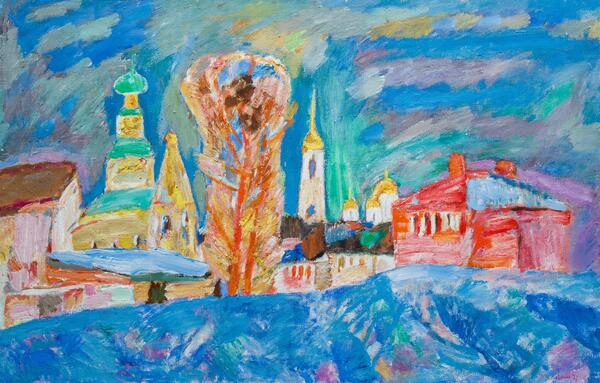
The painting “Old Vladimir” shows how an ordinary landscape can be depicted in an unusually colorful way. The artist used broad, temperamental and vibrant brushstrokes. The polyphony of color, the image of the unique nature and architecture of Vladimir, its streets and monuments of wooden architecture, which can be seen in this work, were characteristic features of the artist’s style.
#3
Name: Old Vladimir
Author: Valery Kokurin
Date of creation: the second half of the 20th century
Place of creation: Vladimir, the USSR
Technique: canvas, oil
Dimensions: 65×100 cm
№: 10363792
#2
Field
#5

Kim Nikolaevich Slavin (1928–1991) was born in Leningrad in 1928. He was the youngest, seventh child in the family. His father, a revolutionary and a specialist at a shipbuilding plant, was arrested in 1937, after which he was executed. In the first years of the Great Patriotic War, Kim Slavin was evacuated and lived in a boarding school.

In 1943, the young man returned to besieged Leningrad on the initiative of the city’s leaders, who were already planning restoration in those terrible days. Children were taught the necessary skills to restore the city. In 1947, Kim Slavin was among the first students to graduate from the art school as a “master of pictorial and decorative works”. He was enrolled in the Leningrad School of Art and Industry (the former Baron Alexander von Stieglitz School).

For seven years he was engaged in the restoration of destroyed architectural monuments of Leningrad and its suburbs. During that period, he also painted over 100 landscapes. In 1960, thanks to these works, he was accepted as a member of the Artists’ Union of the USSR.

The State Russian Museum acquired most of the works of Kim Nikolaevich Slavin. The artist was a Russian intellectual, for him the Motherland and nature formed a single whole. Describing the principles of his art, he emphasized that he sought to be closer to nature and to catch the finest transitions and nuances without diminishing the importance of the drawing.

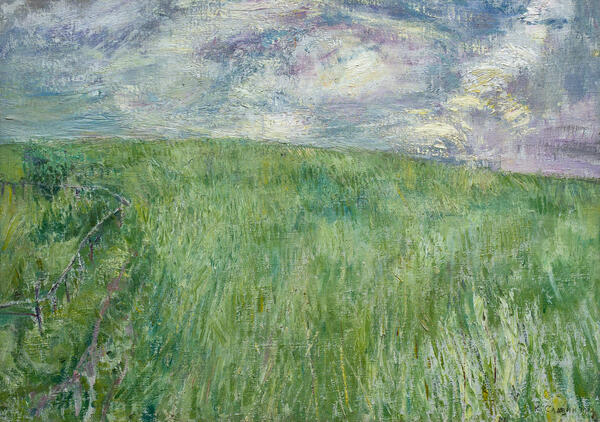
Kim Slavin also painted portraits and still lifes. However, he gained fame and recognition as a master of lyrical landscape: his skill was distinguished by a high professional level of painting and a fine sense of Russian Realism. All this can be observed in the painting “Field”.

Kim Slavin answered the question of the Russian Museum “What do you want to say with your works?” as follows, 

#9

To express my fascination and admiration for the eternal beauty and mystery of Nature. To call others to love, pay attention to, and revere [Nature].

#8

The artist wrote,

#11

Through the landscape, you can express Yourself, any of your emotions, even your deepest feelings. I don’t mean to say that a dramatic state can be simply expressed through, for example, a stormy sky, no — I am talking about something magical that pours out of your soul into the most ordinary landscape.

#6
Name: Field
Author: Kim Slavin
Date of creation: 1974
Place of creation: the USSR
Technique: canvas on cardboard, oil
Dimensions: 50×70 cm
№: 10458111
#7
read morehide

Old Vladimir, Field

0
Point your smartphone camera to open in the app
Share
VkontakteOdnoklassnikiTelegram
Share on my website
Copy linkCopied
Copy
Open in app
To see AR mode in action:
  1. Install ARTEFACT app for 
  2. iOS or Android;
  3. Find and download the «Paintings in Details» exhibition
  4. Push the «Augmented reality» button and point your phone's camera at the painting;
  5. Watch what happens on your phone screen whilst you flip through the pictures.
 
We use Cookies
Cookies on the Artefact Website. We use cookies to ensure that we give you the best experience on our website. If you continue without changing your settings, we'll assume that you are happy to receive all cookies on the Artefact website. However, if you would like to, you can change your cookie settings at any time.
Learn more about useHide
Content is available only in Russian

X

Нашли опечатку?...

%title%%type%