

#1
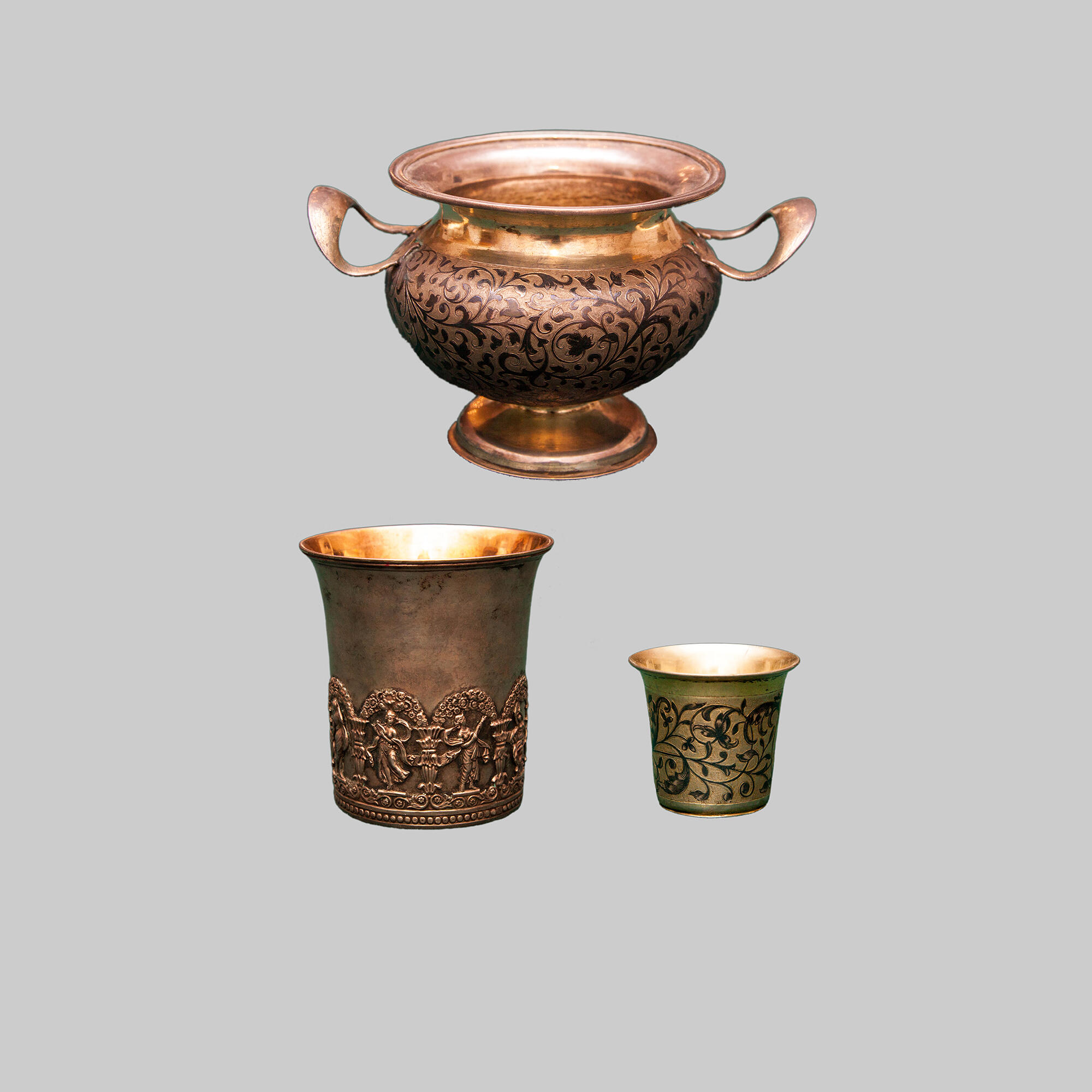
Glass, Silver cylindrical rouse, Sugar bowl
#2
#5
#3
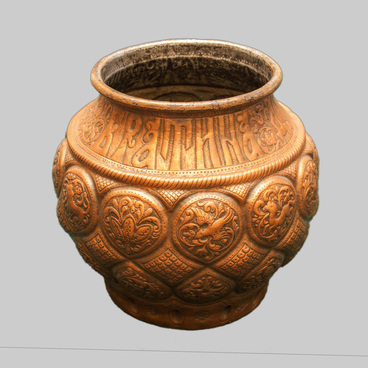
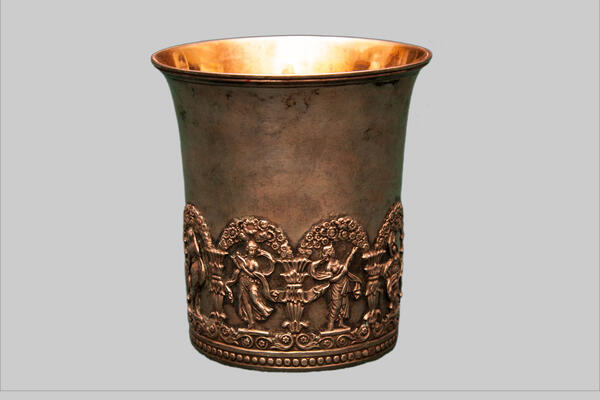
The collection of the Tobolsk Museum Reserve contains a collection of silver tableware, which is of great interest to researchers. A glass takes a special place in the collection — it was made by an unknown author in the first half of the 19th century.
Female figures with musical instruments are minted on a silver background as a reminder of the ancient muses — characters of ancient Greek myths. According to the myths, each muse has its own attribute and symbolic item. They live on Mount Parnassus, at the foot of which the Castalian spring flowed, or on mount Helicon with the Hippocrene spring at the foot. Each illustration is a separate miniature painting on metal.
Russian craftsmen created real works of art, we can easily distinguish them by the characteristic artistic style and assay marks acquired over the years. It is known that in Russia, silver tableware became especially popular under Peter I. In 1711, the first silver set was made by his order. At the beginning of the 18th century, many talented craftsmen appeared, and new ways of creating silver products were invented. Products of this period were decorated with scania – openworks made of specially processed wire, covered with enamel.
Later, Catherine II issued a decree that silver table sets and tableware were made of the highest quality silver. This period was characterized by a lack of imitation, as well as an original combination of different styles. Craftsmen of Moscow, Saint Petersburg, cities of the Russian North, and, first of all, Veliky Ustyug, created items of rare beauty and grace. The works created in the ‘New Russian style’ with the use of national ornaments and stylistics were distinguished by their elegance and festivity. The items of the most famous jewelry companies brought Russia fame on international markets.
Under Paul I, repressions for craftsmen-jewelers became tougher – a craftsman with sticky fingers could easily be exiled to hard labor.
Starting from the 19th century, silverware has gained the value of a family heirloom - it was considered an indicator of the status and taste of its owner. Currently, silver tableware, crafted by the talented silversmiths, decorate private collections and museums.
Female figures with musical instruments are minted on a silver background as a reminder of the ancient muses — characters of ancient Greek myths. According to the myths, each muse has its own attribute and symbolic item. They live on Mount Parnassus, at the foot of which the Castalian spring flowed, or on mount Helicon with the Hippocrene spring at the foot. Each illustration is a separate miniature painting on metal.
Russian craftsmen created real works of art, we can easily distinguish them by the characteristic artistic style and assay marks acquired over the years. It is known that in Russia, silver tableware became especially popular under Peter I. In 1711, the first silver set was made by his order. At the beginning of the 18th century, many talented craftsmen appeared, and new ways of creating silver products were invented. Products of this period were decorated with scania – openworks made of specially processed wire, covered with enamel.
Later, Catherine II issued a decree that silver table sets and tableware were made of the highest quality silver. This period was characterized by a lack of imitation, as well as an original combination of different styles. Craftsmen of Moscow, Saint Petersburg, cities of the Russian North, and, first of all, Veliky Ustyug, created items of rare beauty and grace. The works created in the ‘New Russian style’ with the use of national ornaments and stylistics were distinguished by their elegance and festivity. The items of the most famous jewelry companies brought Russia fame on international markets.
Under Paul I, repressions for craftsmen-jewelers became tougher – a craftsman with sticky fingers could easily be exiled to hard labor.
Starting from the 19th century, silverware has gained the value of a family heirloom - it was considered an indicator of the status and taste of its owner. Currently, silver tableware, crafted by the talented silversmiths, decorate private collections and museums.
#4
Date: 1838
Technique: casting, embossed, plating, rolling
Place: Russia, Moscow
Dimensions: 9,5×8,8×6,7 cm
Collection: Precious metals and stones
Copyright: Tyumen Province State Autonomous Cultural Institution ‘Tyumen Museum and Educational Association’, Structural Division ‘Tobolsk Historical and Architectural Museum Reserve’
Goskatalog Number: 4541444
Technique: casting, embossed, plating, rolling
Place: Russia, Moscow
Dimensions: 9,5×8,8×6,7 cm
Collection: Precious metals and stones
Copyright: Tyumen Province State Autonomous Cultural Institution ‘Tyumen Museum and Educational Association’, Structural Division ‘Tobolsk Historical and Architectural Museum Reserve’
Goskatalog Number: 4541444
#6
Silver cylindrical rouse
#7
#8
A rouse is a vessel for drinking strong drinks, sometimes with a tray or a spherical stalk. A vessel of small size is called a little rouse. Rouses decorated with niello, enamel or calking were common in Russia in the 17th-18th centuries.
One of the famous rouse of the 18th century is considered to be a rouse, which was personally carved by Peter I from a walnut wart – an outgrowth on a tree. The Emperor gave it to the commandant of Moscow, Lord Matvey Gagarin, who later became the Siberian Governor. Lord Matvey Petrovich was awarded for organizing celebrations in Moscow to commemorate the victory of the Russian weapons at Poltava in 1709.
The rouse had a special significance in the army and navy of the Russian Empire. Peter the Great had bequeathed that every day a Russian sailor is entitled to a legitimate rouse of wine at the price of three and a half kopecks. It was believed that vodka and wine help to recover as soon as possible. From the decree of Peter the Great: ‘When providing the crew with a hot breakfast of gruel in the morning, divide the vodka rouse assigned by position into two parts: one-third of the cup shall be given before breakfast and two-thirds before lunch.’
The wine was not usually given to sailors every day, but four rouses a week: on Sundays, Wednesdays, Fridays and Saturdays. And those who didn’t drink were paid nine kopecks a month for each undrunk rouse.
Before drinking a rouse, the sailors took off their caps, made the sign of the cross, and then bowed and passed the vessel in turn. Sailors weren’t supposed to bite or drink after a rouse. Emperor Nicholas II cancelled the naval rouse.
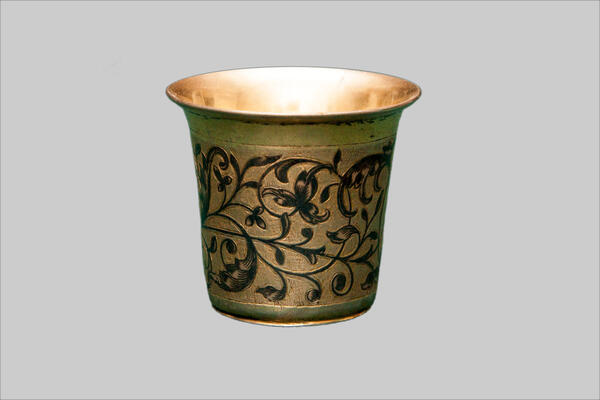
The rouse presented in the exhibition was made by the silversmith Andrey Kovalsky. It’s shaped like a cylinder, on the body of which there are light black garlands of leaves on a gilded chased (decorated with small lines and strokes) background, which makes it a sample of blackened products of the 18th–19th centuries.
Such a blackening drawing technique was especially popular in the 18th century. The crushed niello was applied to the engraved surface of the metal, the object was burned, and then a black or dark gray pattern was developed on it.
In the North, Veliky Ustyug was the center of production of silver products with niello. The elegant and diverse shape of the objects, their magnificent mounting put jewelry of Veliky Ustyug first.
One of the famous rouse of the 18th century is considered to be a rouse, which was personally carved by Peter I from a walnut wart – an outgrowth on a tree. The Emperor gave it to the commandant of Moscow, Lord Matvey Gagarin, who later became the Siberian Governor. Lord Matvey Petrovich was awarded for organizing celebrations in Moscow to commemorate the victory of the Russian weapons at Poltava in 1709.
The rouse had a special significance in the army and navy of the Russian Empire. Peter the Great had bequeathed that every day a Russian sailor is entitled to a legitimate rouse of wine at the price of three and a half kopecks. It was believed that vodka and wine help to recover as soon as possible. From the decree of Peter the Great: ‘When providing the crew with a hot breakfast of gruel in the morning, divide the vodka rouse assigned by position into two parts: one-third of the cup shall be given before breakfast and two-thirds before lunch.’
The wine was not usually given to sailors every day, but four rouses a week: on Sundays, Wednesdays, Fridays and Saturdays. And those who didn’t drink were paid nine kopecks a month for each undrunk rouse.
Before drinking a rouse, the sailors took off their caps, made the sign of the cross, and then bowed and passed the vessel in turn. Sailors weren’t supposed to bite or drink after a rouse. Emperor Nicholas II cancelled the naval rouse.
The rouse presented in the exhibition was made by the silversmith Andrey Kovalsky. It’s shaped like a cylinder, on the body of which there are light black garlands of leaves on a gilded chased (decorated with small lines and strokes) background, which makes it a sample of blackened products of the 18th–19th centuries.
Such a blackening drawing technique was especially popular in the 18th century. The crushed niello was applied to the engraved surface of the metal, the object was burned, and then a black or dark gray pattern was developed on it.
In the North, Veliky Ustyug was the center of production of silver products with niello. The elegant and diverse shape of the objects, their magnificent mounting put jewelry of Veliky Ustyug first.
#9
Author: Andrey Antonovich Kovalsky
Date: 1848
Technique: stamping, blackening, gold plating, chasing
Place: Russia, Moscow
Dimensions: 4.9×5.5 cm
Copyright: Tyumen Province State Autonomous Cultural Institution “Tyumen Museum and Educational Association”, Structural Division “Tobolsk Historical and Architectural Museum Reserve”
Collection: Precious metals and stones
Goskatalog Number: 4541432
Date: 1848
Technique: stamping, blackening, gold plating, chasing
Place: Russia, Moscow
Dimensions: 4.9×5.5 cm
Copyright: Tyumen Province State Autonomous Cultural Institution “Tyumen Museum and Educational Association”, Structural Division “Tobolsk Historical and Architectural Museum Reserve”
Collection: Precious metals and stones
Goskatalog Number: 4541432
#10
Sugar bowl with two handles on a high tray
#11
#12
According to scientific sources, silversmithing in Tobolsk developed at the end of the 17th century. The main customers of the artisans were the Tobolsk bishops, on whose behalf silver crosses and chalices were sent to Siberian churches and monasteries — the necessary attributes of worship. The craftsmen received orders from the voivodes and governors. After 1711, Swedish prisoners were sent to Tobolsk including officers who were engaged in the production of silver sets and other precious products.
Local craftsmen purchased silver from China and the Khanate of Bukhara at the Irbit fair, and 50-100 poods of precious metal were received annually from Bukharians in Tobolsk province. There are names of craftsmen made up of Latin letters in the stamps of silver products made in Tobolsk in the 1770s. These names belonged to the craftsmen of the Polish confederates who were exiled in Tobolsk. However, most of the craftsmen were still Russian.
In the 18th century, the development of silver and copper mines began in Siberia: the first silver was smelted out from the ore from the Kolyvano-Voskresensk mine. At that time, factories appeared here – first copper-smelting, and then ones focused on silver smelting. At the turn of the 18th-19th centuries, a provincial magistrate appeared in Tobolsk, which united Tobolsk silversmiths into workshops, and at that time the position of assay master was approved.
Tobolsk jewelry industry flourished in the 18th century. During the 19th century, silversmithing in Tobolsk gradually disappeared, but the products created by Tobolsk craftsmen are preserved in private collections and museums.
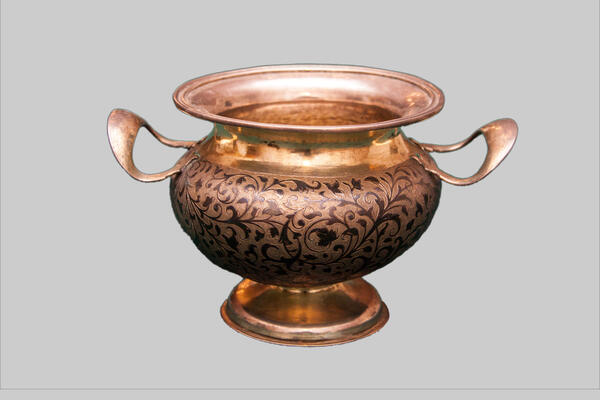
As for the Central Russia, the jewelry industry was born there in the 16th century. The collection of the Tobolsk Museum Reserve has the samples of tableware made in Moscow. One of these exhibits is a sugar bowl with two handles on a high tray. This item was made by craftsman Ivan Avdeev at the end of the 19th century. To decorate the item, the author used black decor, which became very popular in the 18th century. Products made in this technique are recognized as real works of art.
Local craftsmen purchased silver from China and the Khanate of Bukhara at the Irbit fair, and 50-100 poods of precious metal were received annually from Bukharians in Tobolsk province. There are names of craftsmen made up of Latin letters in the stamps of silver products made in Tobolsk in the 1770s. These names belonged to the craftsmen of the Polish confederates who were exiled in Tobolsk. However, most of the craftsmen were still Russian.
In the 18th century, the development of silver and copper mines began in Siberia: the first silver was smelted out from the ore from the Kolyvano-Voskresensk mine. At that time, factories appeared here – first copper-smelting, and then ones focused on silver smelting. At the turn of the 18th-19th centuries, a provincial magistrate appeared in Tobolsk, which united Tobolsk silversmiths into workshops, and at that time the position of assay master was approved.
Tobolsk jewelry industry flourished in the 18th century. During the 19th century, silversmithing in Tobolsk gradually disappeared, but the products created by Tobolsk craftsmen are preserved in private collections and museums.
As for the Central Russia, the jewelry industry was born there in the 16th century. The collection of the Tobolsk Museum Reserve has the samples of tableware made in Moscow. One of these exhibits is a sugar bowl with two handles on a high tray. This item was made by craftsman Ivan Avdeev at the end of the 19th century. To decorate the item, the author used black decor, which became very popular in the 18th century. Products made in this technique are recognized as real works of art.
#13
Author: Ivan Avdeev
Date: 1878
Technique: casting, gilding, niello
Place: Russia, Moscow
Dimensions: 10.5×18 cm
Copyright: Tyumen Province State Autonomous Cultural Institution ‘Tyumen Museum and Educational Association’, Structural Division ‘Tobolsk Historical and Architectural Museum Reserve’
Collection: Precious metals and stones
Goskatalog Number: 4541439
Date: 1878
Technique: casting, gilding, niello
Place: Russia, Moscow
Dimensions: 10.5×18 cm
Copyright: Tyumen Province State Autonomous Cultural Institution ‘Tyumen Museum and Educational Association’, Structural Division ‘Tobolsk Historical and Architectural Museum Reserve’
Collection: Precious metals and stones
Goskatalog Number: 4541439
read morehide
00:00
00:00
1x
Glass, Silver cylindrical rouse, Sugar bowl
Collection
1
 Point your smartphone camera to open in the app
Open in app
Share