

#1
Sovik, Driving reindeer sleds, Kisy
#2
#3
#4
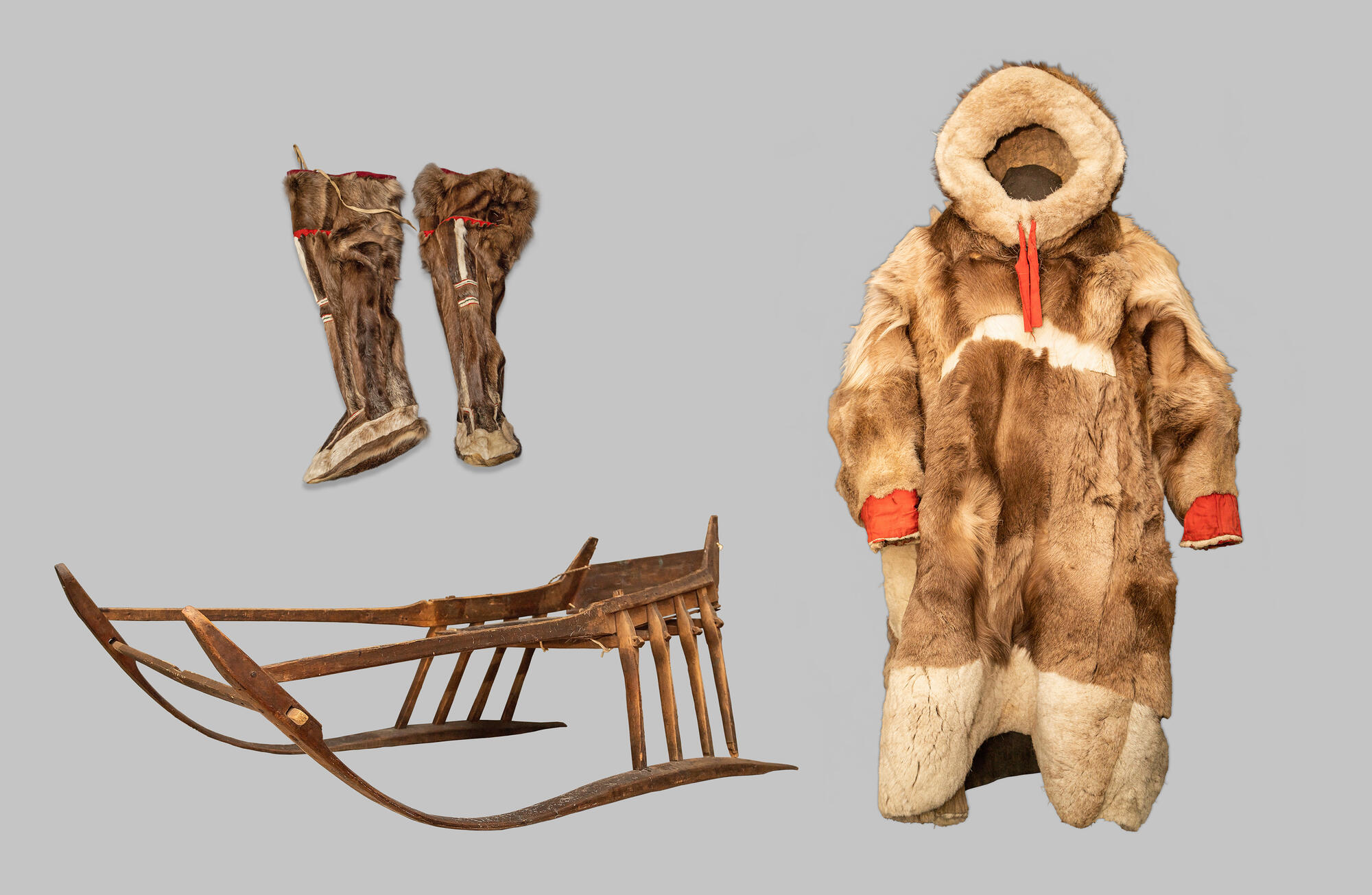
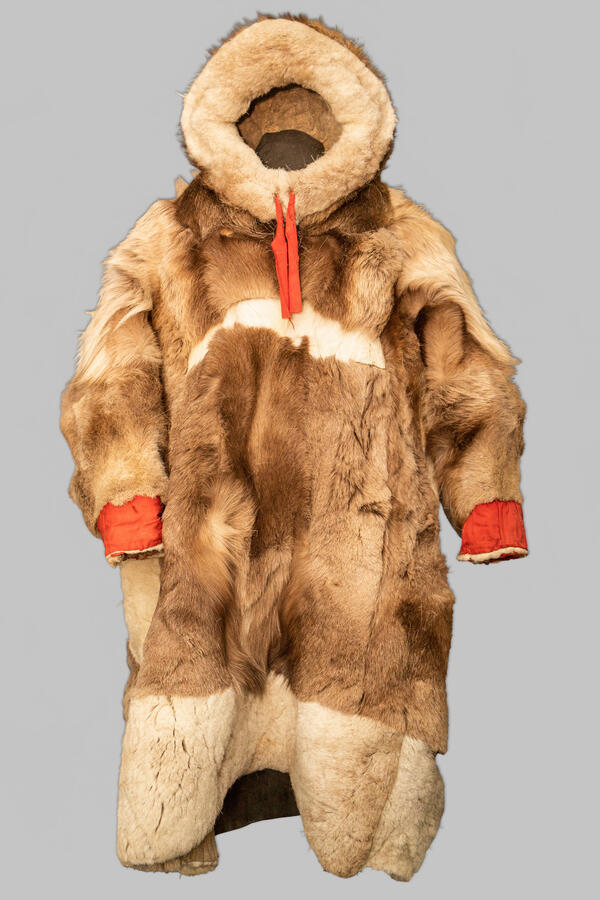
Sovik is the national Samoyed men’s winter outerwear. In the dictionary of Brockhaus and Efron, it has the following definition: “Samoyed fur coat made of reindeer skins with hair up and a hood worn from the head over the deerskin parka”. Another outerwear name is sokuy. It is called sovik, since the hood makes the human head look like the head of a polar owl. Only adult deer skins are used for sovik. Deer fur has a tubular structure. The warm air inside the hair is sealed, thus keeping the temperature inside and providing a warming effect.
This apparel was introduced to the funds in 1989 during a historical and ethnographic expedition in the Krasnoselkupskiy District of the Yamalo-Nenets Autonomous Okrug. The expedition of the Tobolsk State Historical and Architectural Museum-Reserve was led by historian and ethnographer Igor Belich.
The exhibit is completely handmade. The fur coat was sewn by the craftswoman Antonina Irikova. By its design, sovik is a long, dense closed-up shirt with a hood, which was worn over the head. The craftswoman made the sovik out of large and small pieces of gray and white deerskin with the fur outside. The parts were sewn together with small oblique stitches butt-to-butt, while using thin single-core threads. The back of the fur coat was made straight. It slightly expands downwards and is cut out of several rectangular pieces of skins. The central part is made square tapering to the neck and passing into a stand-up collar. It is adjacent to the side rectangular strips that pass into the sleeve. The front part of the sovik consists of a yoke connecting the sleeves with the collar, the central part, and two adjacent side-wide stripes.
This apparel was introduced to the funds in 1989 during a historical and ethnographic expedition in the Krasnoselkupskiy District of the Yamalo-Nenets Autonomous Okrug. The expedition of the Tobolsk State Historical and Architectural Museum-Reserve was led by historian and ethnographer Igor Belich.
The exhibit is completely handmade. The fur coat was sewn by the craftswoman Antonina Irikova. By its design, sovik is a long, dense closed-up shirt with a hood, which was worn over the head. The craftswoman made the sovik out of large and small pieces of gray and white deerskin with the fur outside. The parts were sewn together with small oblique stitches butt-to-butt, while using thin single-core threads. The back of the fur coat was made straight. It slightly expands downwards and is cut out of several rectangular pieces of skins. The central part is made square tapering to the neck and passing into a stand-up collar. It is adjacent to the side rectangular strips that pass into the sleeve. The front part of the sovik consists of a yoke connecting the sleeves with the collar, the central part, and two adjacent side-wide stripes.
#5
Author: Irikova Antonina Ivanovna
Date: 1950-1980 years
Technique: deer skin, fabric, hand sewing
Place: Krasnoselkupskiy District, Yamalo-Nenets Autonomous Okrug, Tyumen Region, Russia
Dimensions: 90×60 cm
Collection: Ethnography of Siberian Tatars and the Peoples in the Russian Far North
Copyright: Tyumen Province State Autonomous Cultural Institution “Tyumen Museum and Educational Association”, Structural Division “Tobolsk Historical and Architectural Museum Reserve”
#6
Driving reindeer sleds
#7
#8
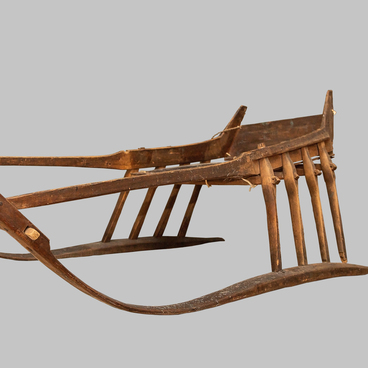
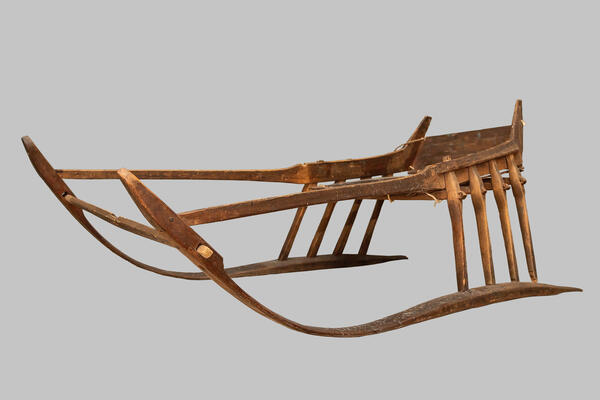
Two-pole driving reindeer sleds are exhibited at the Tobolsk Provincial Museum. The peoples of the North of Western Siberia have always made sleds by taking into account the specifics of what they would ride. For example, women’s sleds were always made a little longer than men’s sleds, since they were also used by children. In addition, such sleds were made slightly lower than men’s ones so that a woman’s foot could reach the runners.
The master made this instance of winter sleds from coniferous wood. The runners were cut out from straight bars and bent up, and the rear ends were cut off for greater mobility of the sled. A seat with a short wide back is fixed on the elms, i.e. square sticks that the master connected the runners with four hooves set vertically on each side.
Reindeer sledding is the most ancient and widespread method of transportation among different peoples of the Far North. Sleds were invented almost two thousand years ago, and since then their design has changed little. To the uninitiated, it may seem that controlling the deer is quite easy. In fact, residents of the tundra learn this from childhood by mastering all the difficulties and secrets of controlling a team that can reach speeds of up to 40 km/h, which is comparable to riding a snowmobile. A speed of 10 km/h is considered an average operating speed.
The deer were controlled in two ways. By the voice, as well as using reins and a thin pole with two tips, i.e. the iron tip to rest on the ground, and the bone one to drive animals. Each reindeer herder has its own set of voice commands to control the team. They are shouted very loudly and clearly. Otherwise, the animal simply will not hear anything or, as it is believed, will not want to hear, since deer are intelligent and have very fine hearing and smell. If the herder has been raising the deer since they were young, they can develop their own set of commands to help them control.
Most of the commands are given to the deer using a long pole. The driver works it with the leading animal, and all the others follow him. In order for the deer to speed up, the animal in front of them is patted on the back with the tip of the pole. To turn, you need to touch one or another side of the animal, and the stop occurs after the reindeer herder pulls the reins on himself.
The master made this instance of winter sleds from coniferous wood. The runners were cut out from straight bars and bent up, and the rear ends were cut off for greater mobility of the sled. A seat with a short wide back is fixed on the elms, i.e. square sticks that the master connected the runners with four hooves set vertically on each side.
Reindeer sledding is the most ancient and widespread method of transportation among different peoples of the Far North. Sleds were invented almost two thousand years ago, and since then their design has changed little. To the uninitiated, it may seem that controlling the deer is quite easy. In fact, residents of the tundra learn this from childhood by mastering all the difficulties and secrets of controlling a team that can reach speeds of up to 40 km/h, which is comparable to riding a snowmobile. A speed of 10 km/h is considered an average operating speed.
The deer were controlled in two ways. By the voice, as well as using reins and a thin pole with two tips, i.e. the iron tip to rest on the ground, and the bone one to drive animals. Each reindeer herder has its own set of voice commands to control the team. They are shouted very loudly and clearly. Otherwise, the animal simply will not hear anything or, as it is believed, will not want to hear, since deer are intelligent and have very fine hearing and smell. If the herder has been raising the deer since they were young, they can develop their own set of commands to help them control.
Most of the commands are given to the deer using a long pole. The driver works it with the leading animal, and all the others follow him. In order for the deer to speed up, the animal in front of them is patted on the back with the tip of the pole. To turn, you need to touch one or another side of the animal, and the stop occurs after the reindeer herder pulls the reins on himself.
#9
Date: second half of the 19th century
Technique: coniferous wood, handmade
Place: Tyumen Region, Russia
Dimensions: 80×93×177 cm
Collection: Ethnography of Siberian Tatars and the Peoples in the Russian Far North
Copyright: Tyumen Province State Autonomous Cultural Institution ‘Tyumen Museum and Educational Association’, Structural Division ‘Tobolsk Historical and Architectural Museum Reserve’
Goskatalog Number: 10913069
Technique: coniferous wood, handmade
Place: Tyumen Region, Russia
Dimensions: 80×93×177 cm
Collection: Ethnography of Siberian Tatars and the Peoples in the Russian Far North
Copyright: Tyumen Province State Autonomous Cultural Institution ‘Tyumen Museum and Educational Association’, Structural Division ‘Tobolsk Historical and Architectural Museum Reserve’
Goskatalog Number: 10913069
#10
Kisy (reindeer skin boots)
#11
#12
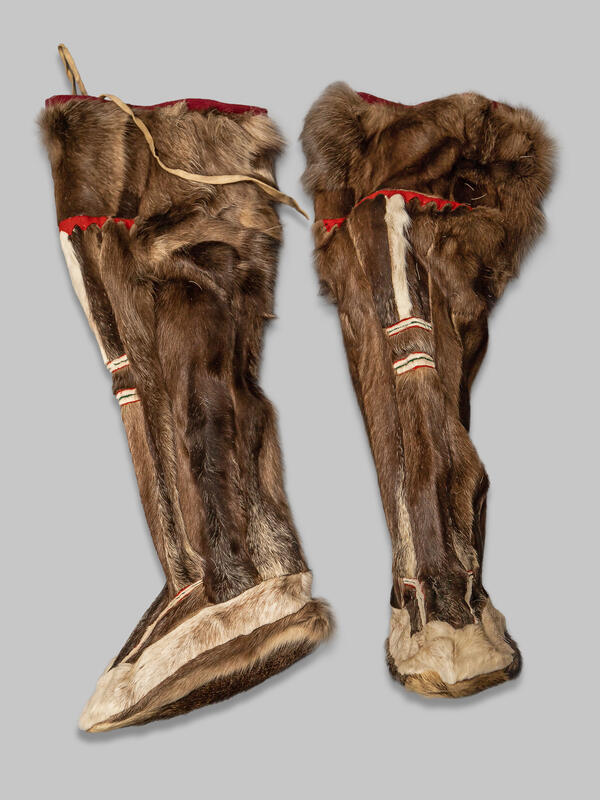
Kisy are the everyday footwear worn by peoples in the Russian Far North, but in recent years this fur footwear can be found more and more frequently in many different parts of Russia. The kisy showcased in the exposition are traditional Selkup winter footwear, made from the skin taken from deer shanks. It is called ‘kamus’ in Russian. This is the part where the animal’s fur has the necessary properties: the fibers on it are very tough, and do not become saturated with moisture, but push it away from the surface. At the same time, it is believed that - unlike horse or elk shank fur - kamus does not creak.
The kisy in the museum are made by hand - the artisan assembled a long bootleg from eight strips of kamus, and connected them together with ordinary cotton threads, decorated with inserts of fur, as well as red and green cloth. The sole also has a kamus: the main piece is in the form of an ellipse that touches the ground, and the upper strip attached to it is an extension piece. It goes from toe to heel and returns back to the toe again, wrapping the sole completely. The artisan connected the resulting shank and sole with a strong and flexible vamp. The seam was additionally reinforced with broadcloth inserts.
Making kamus is a labor-intensive process. The raw materials are first frozen to get rid of excess moisture and stretch them a bit, then they are soaked and, while trying not to break through the skin they clean the layer of subcutaneous connective tissue with scrapers. The resulting skins are carefully dressed and kneaded so that they become soft, elastic, and flexible, and retain heat longer. The better the kamus is prepared, the longer the kisy made from it will last, and the warmer the legs will be even during the coldest times, when the temperature drops below minus 50-60 degrees.
Representatives from different peoples in the Russian Far North have their own special techniques. The Khanty, who are the ones that chiefly make the kisy, put a layer of dried lake sedge on the sole, which is called “shoe grass”, for additional warmth. They also put on a special woolen liner, called a chizh in Russian, and the sole is made of skin that is located between the large and small hooves of the deer: it resembles a brush, and does not slip on the snow. Khanty traditionally sew kisy with reindeer veins instead of threads, and fumigate the fur with smoke to prevent moths from starting to breed. The artisan can sew one pair by hand over the course of an entire year - the time worked depends on the complexity of the ornamentation and workmanship.
The kisy from the collection at the Tobolsk Provincial Museum became part of the funds in 1989, during a historical and ethnographic expedition to the village of Ratta in Krasnoselkupskiy District, Yamal-Nenets Autonomous Okrug. The expedition by the Tobolsk Historical and Architectural Museum Reserve was led by historian and ethnographer Igor Belich.
The kisy in the museum are made by hand - the artisan assembled a long bootleg from eight strips of kamus, and connected them together with ordinary cotton threads, decorated with inserts of fur, as well as red and green cloth. The sole also has a kamus: the main piece is in the form of an ellipse that touches the ground, and the upper strip attached to it is an extension piece. It goes from toe to heel and returns back to the toe again, wrapping the sole completely. The artisan connected the resulting shank and sole with a strong and flexible vamp. The seam was additionally reinforced with broadcloth inserts.
Making kamus is a labor-intensive process. The raw materials are first frozen to get rid of excess moisture and stretch them a bit, then they are soaked and, while trying not to break through the skin they clean the layer of subcutaneous connective tissue with scrapers. The resulting skins are carefully dressed and kneaded so that they become soft, elastic, and flexible, and retain heat longer. The better the kamus is prepared, the longer the kisy made from it will last, and the warmer the legs will be even during the coldest times, when the temperature drops below minus 50-60 degrees.
Representatives from different peoples in the Russian Far North have their own special techniques. The Khanty, who are the ones that chiefly make the kisy, put a layer of dried lake sedge on the sole, which is called “shoe grass”, for additional warmth. They also put on a special woolen liner, called a chizh in Russian, and the sole is made of skin that is located between the large and small hooves of the deer: it resembles a brush, and does not slip on the snow. Khanty traditionally sew kisy with reindeer veins instead of threads, and fumigate the fur with smoke to prevent moths from starting to breed. The artisan can sew one pair by hand over the course of an entire year - the time worked depends on the complexity of the ornamentation and workmanship.
The kisy from the collection at the Tobolsk Provincial Museum became part of the funds in 1989, during a historical and ethnographic expedition to the village of Ratta in Krasnoselkupskiy District, Yamal-Nenets Autonomous Okrug. The expedition by the Tobolsk Historical and Architectural Museum Reserve was led by historian and ethnographer Igor Belich.
#13
Date: 1960s-1980s
Technique: hand-sewn from deerskin from the deer’s shank, broadcloth
Place: Krasnoselkupskiy District, Yamalo-Nenets Autonomous District, Tyumen Region, Russia
Dimensions: 74×31 cm
Collection: Ethnography of Siberian Tatars and the Peoples in the Russian Far North
Copyright: Tyumen Province State Autonomous Cultural Institution ‘Tyumen Museum and Educational Association’, Structural Division ‘Tobolsk Historical and Architectural Museum Reserve’
Technique: hand-sewn from deerskin from the deer’s shank, broadcloth
Place: Krasnoselkupskiy District, Yamalo-Nenets Autonomous District, Tyumen Region, Russia
Dimensions: 74×31 cm
Collection: Ethnography of Siberian Tatars and the Peoples in the Russian Far North
Copyright: Tyumen Province State Autonomous Cultural Institution ‘Tyumen Museum and Educational Association’, Structural Division ‘Tobolsk Historical and Architectural Museum Reserve’
read morehide
00:00
00:00
1x
Sovik, Driving reindeer sleds, Kisy
Collection
Exhibition
0
 Point your smartphone camera to open in the app
Open in app
Share