The clothes of the northern peoples are very practical. They are adapted to the local climate, activities, and way of life. Most of them were made of local materials: buckskin, hides of wild animals and birds (loons, swans, ducks, and others), and fish skin. Rovduga — deer or elk leather — was also widely used. To make the clothes warmer, they were trimmed with the fur of squirrels, foxes, Arctic foxes, and hares. Extremely important were the hides of domestic and wild deer hunted in the taiga. In winter, local people wore one- or two-layer clothes made of buckskin or, rarer, dog skins. In summer, they wore old worn-out winter coats, parkas, malitsas, and clothes made of rovdugs or fabric. Deer sinews were used to make threads.
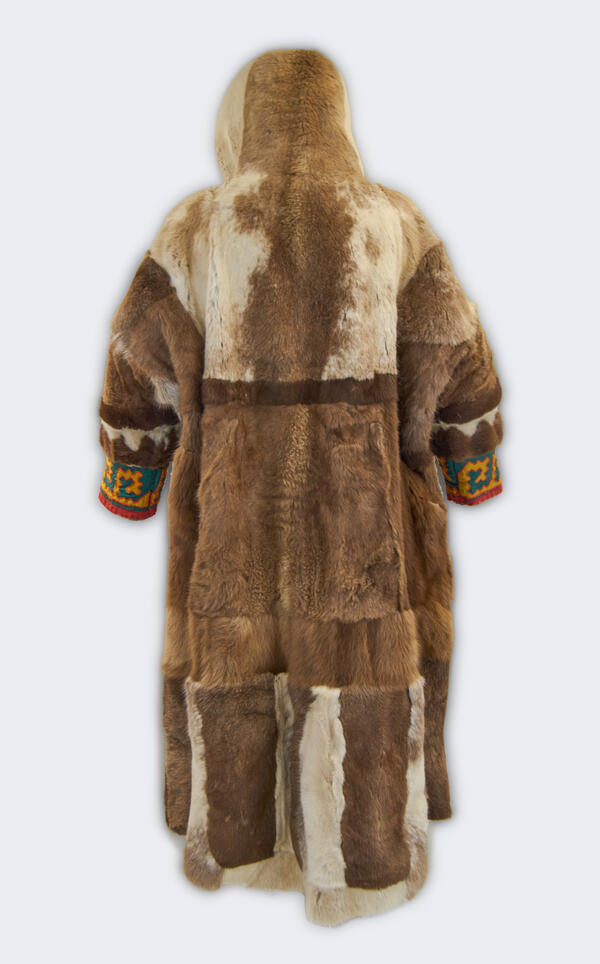
A fur gus’ was worn over a malitsa in severe frosts and snowstorms when the wearer was expected to spend a long time outside, herding deer, hunting, fishing, or migrating. Fur outerwear with a hood worn over a malitsa is known under different names, including sovik, gus’, sokuy, kumshi, kumshin, savak, and sook. The gus’ is sewn with fur outward and directed downward. Like a malitsa, a gus’ has a hole for the head. Its design differs from the one of a malitsa. A gus’ does not include mittens, but has a hood, often trimmed with deer fur or two Arctic fox tails. A gus’ has a loose cut. It is long and has no buttons. The back part of the hood is cut together with the entire back side of the gus’ and made of skin from the head of a deer. Its bottom is wide and is sometimes made of fur of a different color. A gus’ is worn without a belt. Its color depends on the natural tone of the hide, and can be white, dark, or speckled. A gus’ made of white autumn deer skin is considered particularly beautiful. The sleeves are long, wide, narrowed at the wrist, and equipped with cuffs. The cuffs are decorated with national patterns.
The gus’ is a type of
outerwear. The wearer usually does not bring the gus’ inside but leaves it on
the sled. It is put with its back up, with the hood and sleeves folded inside.
When camping in winter, a gus’ can be used as a sleeping bag: it is pulled
together around the legs and the hood and sleeves are turned inside. In this
way, the wearer can lie down on the snow. In case of bad weather in summer, a
woven gus’ made of cloth is worn over a malitsa. It is much shorter than the
winter version.