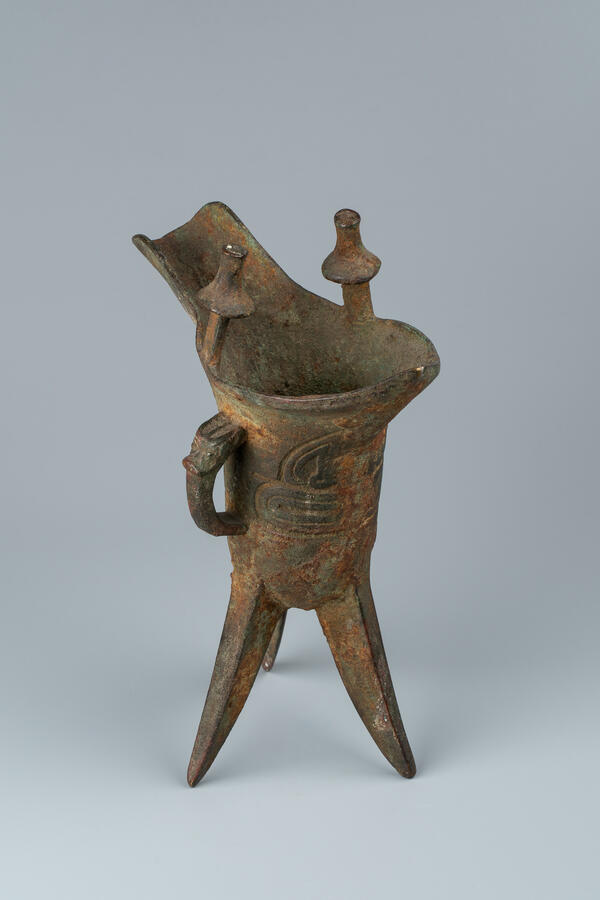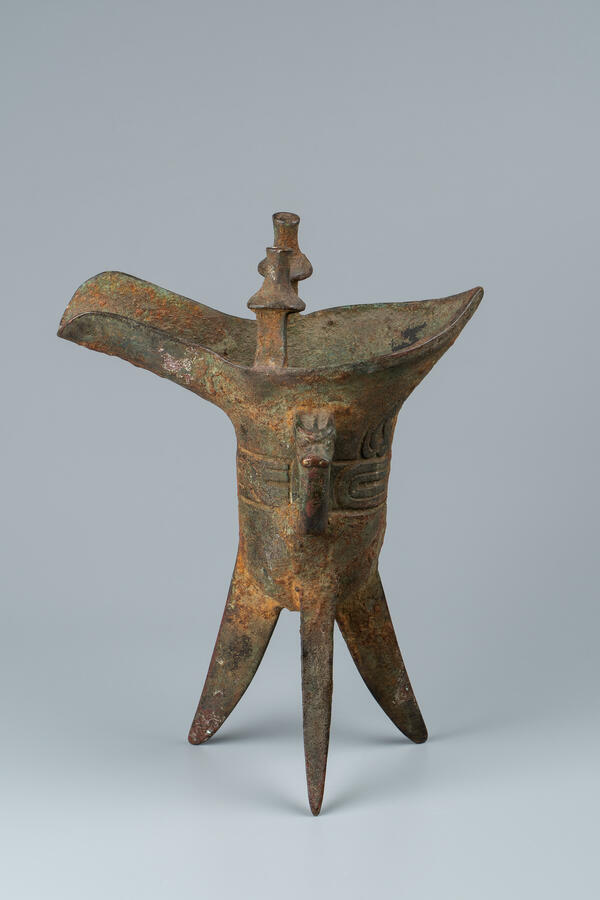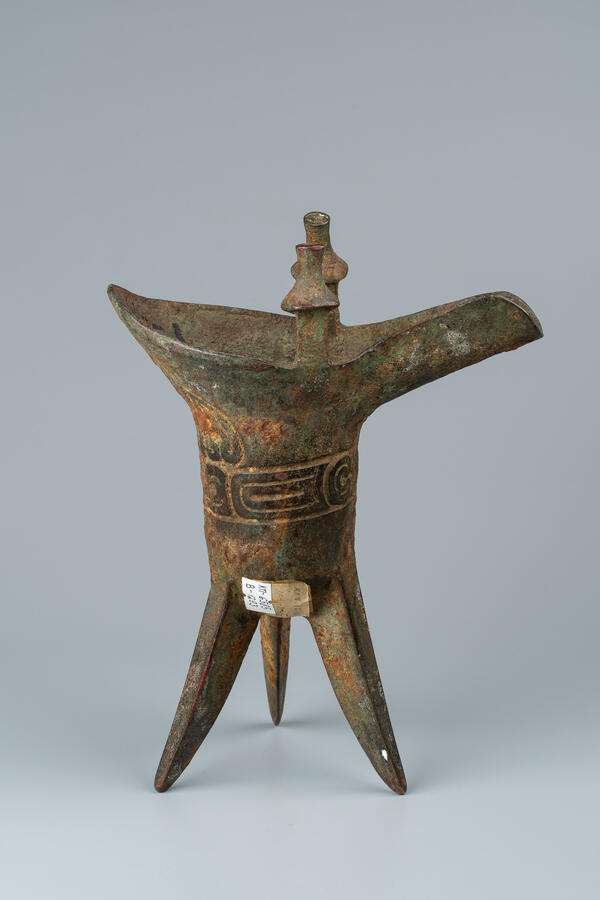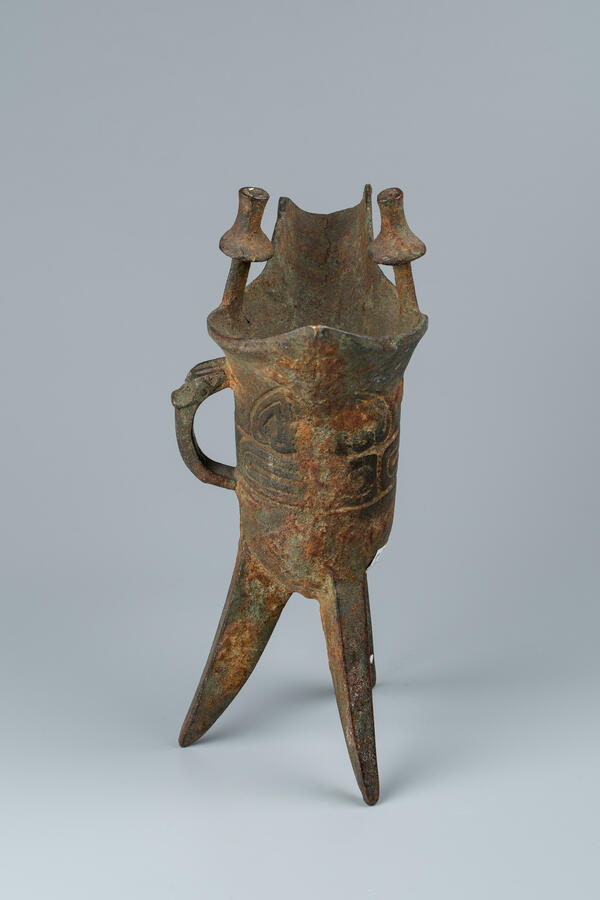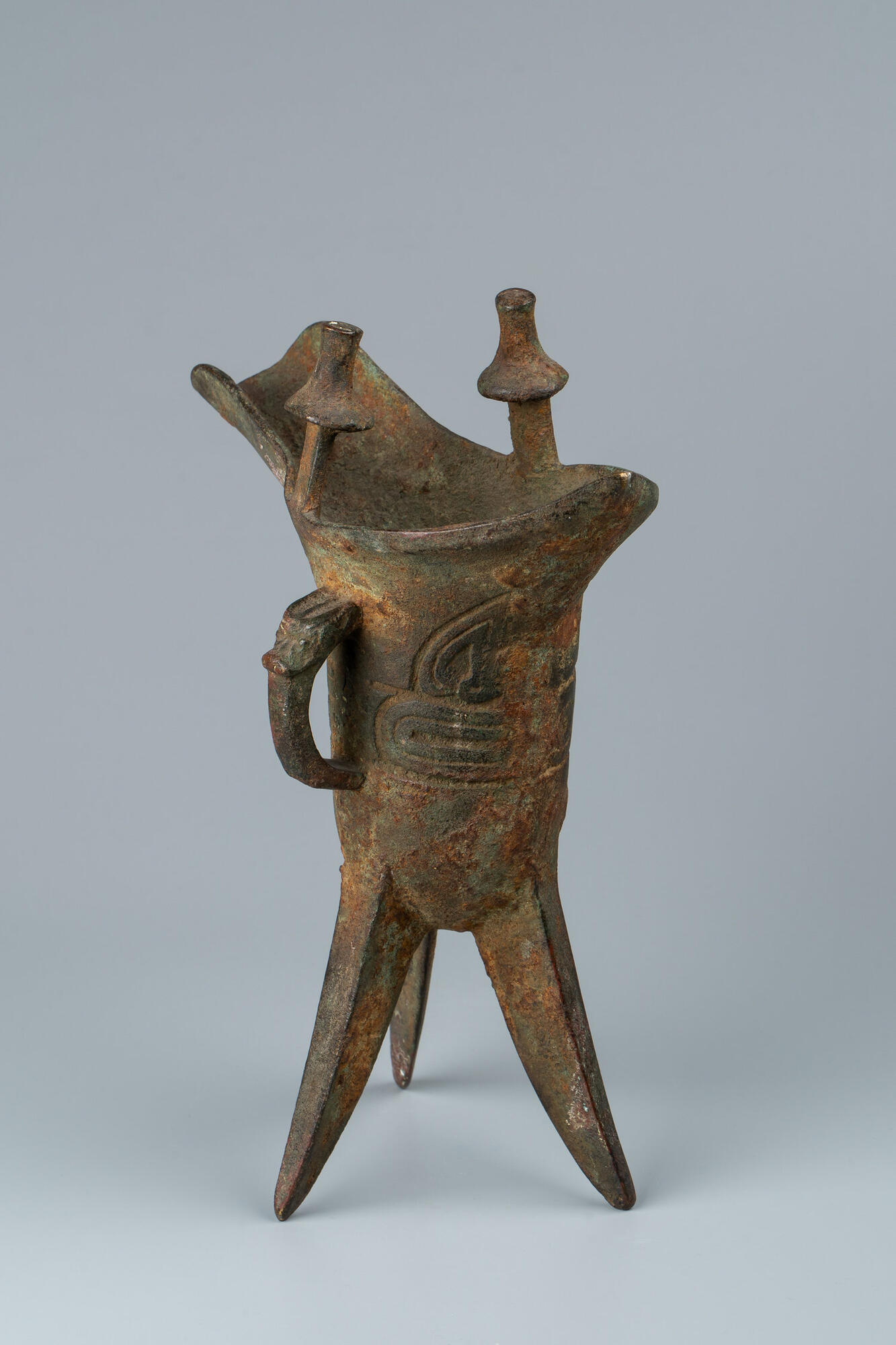


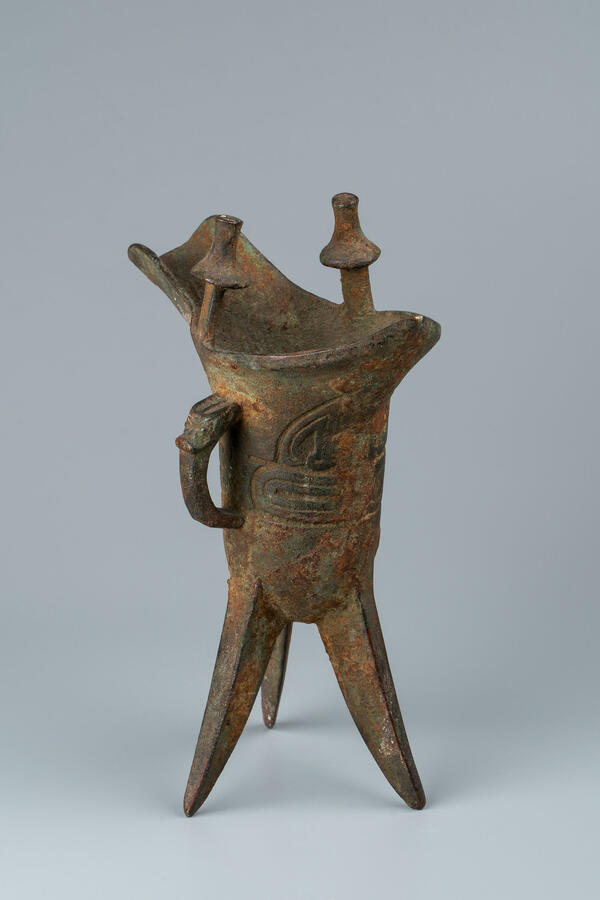
One of the oldest exhibits in the collection of the Samara Regional Art Museum is the sacrificial cup “jue”, which is dated to the second millennium BC. It was made during the reign of the Shang-Yin dynasty (1554 — 1046 BC).
Bronze casting during the second and first millennia BC (the Shang-Yin and Zhou epochs, 11th — 3rd centuries BC) remained the leading handicraft in ancient China. At that time, bronze alloy was considered a precious metal, and items made from it were luxury items, ceremonial and liturgical utensils. They were used as funeral equipment of the nobility, temple offerings and gifts. Even low-income families tried to acquire at least a few bronze vessels, which became main family heirlooms and were often passed down from generation to generation.
“Jue” ritual cups were widespread in ancient China and were most often used for water or wine. These vessels have a very complicated design — a rounded, vertically elongated body, which rests on three long legs, which are slightly curved and turned in different directions. The body ends on one side with a triangular spout, and on the other with a curved wide plate, under which an arc-shaped handle is attached to the central part. The spout and plate design-wise are very similar to the profile image of a bird’s beak and tail, and the cup itself resembles a standing bird, for instance, a sparrow. This explains its original name: the hieroglyph “jue” — or in its other pronunciation tsue — means “sparrow”, “bird”. In addition to the standard form, “sparrow cups” had other design variants: with a body and on four legs, with one leg, without legs, with paired handles-protrusions (similar to horns) sticking out on the sides of the plate.
The cup from the museum collection has a classic shape. Despite its simplicity (which is due to the time of creation) the vessel is not devoid of elegance; the curves of its rather thin legs and smooth lines of the body give the cup a special sophistication.
Bronze casting during the second and first millennia BC (the Shang-Yin and Zhou epochs, 11th — 3rd centuries BC) remained the leading handicraft in ancient China. At that time, bronze alloy was considered a precious metal, and items made from it were luxury items, ceremonial and liturgical utensils. They were used as funeral equipment of the nobility, temple offerings and gifts. Even low-income families tried to acquire at least a few bronze vessels, which became main family heirlooms and were often passed down from generation to generation.
“Jue” ritual cups were widespread in ancient China and were most often used for water or wine. These vessels have a very complicated design — a rounded, vertically elongated body, which rests on three long legs, which are slightly curved and turned in different directions. The body ends on one side with a triangular spout, and on the other with a curved wide plate, under which an arc-shaped handle is attached to the central part. The spout and plate design-wise are very similar to the profile image of a bird’s beak and tail, and the cup itself resembles a standing bird, for instance, a sparrow. This explains its original name: the hieroglyph “jue” — or in its other pronunciation tsue — means “sparrow”, “bird”. In addition to the standard form, “sparrow cups” had other design variants: with a body and on four legs, with one leg, without legs, with paired handles-protrusions (similar to horns) sticking out on the sides of the plate.
The cup from the museum collection has a classic shape. Despite its simplicity (which is due to the time of creation) the vessel is not devoid of elegance; the curves of its rather thin legs and smooth lines of the body give the cup a special sophistication.