Font
Color
Graphics
Изображение точки

To see AR mode in action:

1. Install ARTEFACT app for iOS or Android;

2. Find the exhibition «Gelendzhik: Past and Present»

3. Push the «Augmented reality» button and point your phone's camera at the exhibit;

Скрыть точки интересаПоказать точки интереса
Показать в высоком качестве
#1
Vessel
#2
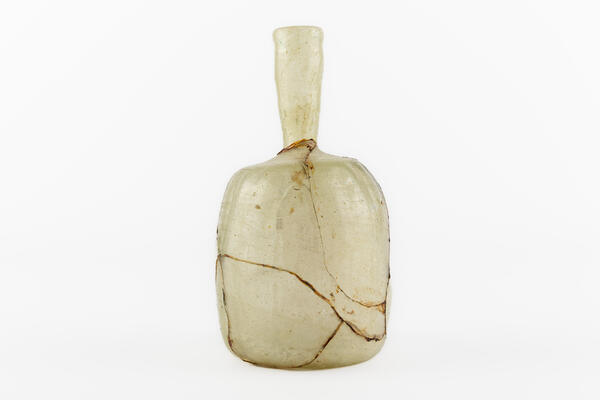
In 1983, archaeologists were excavating a warrior’s burial of the 10th–12th centuries. The excavations were overseen by M.G. Mineev, the head of the pre-revolutionary history department. Along with a saber, fragments of a shield, a knife and a fire-striker, the expedition found a small bottle of green glass. Most likely, it was intended to store water or medicines.

In ancient times, glass making was a very complex and time-consuming process. Glass is produced artificially — unlike wood, stone or metal, it does not occur in nature. Therefore, the improvement of production technology and properties of the material led to the higher quality of glass products. Glassblowing required considerable experience and skill. A glass blower had to understand the principles of interaction of materials that make up the glass mass, as well as to know the properties of dyes and bleaching materials. Artisans had to understand the specifics of the temperature regime at each stage of the production. The control of each stage was very important: it depended on the glass blower whether the molten glass would turn into a beautiful bottle, jug, glass, or bead — or whether it would remain a shapeless piece of glass. All this led to glass products being quite expensive. Transparent glass was especially valued. The cleaner and more transparent it was, the more the vessel would cost.

Glass began to gain popularity because it was a convenient storage material: glass practically does not interact with other substances and protects the content of the vessel from the external environment. However, we all know how fragile this material is, so it is very difficult to transport glass products. Imported glass vessels began to be widely used on the Black Sea coast of the Caucasus in the era of the Greek colonization and would cost a lot of money. They were given as presents, exchanged, and used to keep valuable medicines and aromatic oils.

In the Middle Ages, glass became more accessible in the Northwest Caucasus, but in most cases it was inferior in quality to antique glass. This was due to the gradual deterioration of the ancient centers of production. Some techniques were lost, and it took decades to reproduce them.
#3
Наименование: Vessel
Дата создания: the 14th–15th centuries
Техника: glass, casting
Размеры: height — 17.7 cm, bottom diameter — 8 cm, rim diameter — 2 cm
#4
Glass
#5
Tableware has been around since the Stone Age. The first pots were hand-formed from clay containing numerous impurities (for example, sand), and simply dried in the sun. With the invention of the potter’s wheel and kilns and the improving techniques of raw material processing, ceramic vessels became increasingly elegant and beautiful. New forms emerged, and walls became thinner. But the new level of perfection was set by glass products that impressed with their grace and airiness.

The inhabitants of ancient Near East learned how to make glass several millennia ago. From there, the technology came to Greece and Rome, where talented potters elevated it to the rank of a high art. Vessels became thin-walled, transparent and lavishly adorned. During the antiquity and the Middle Ages, glass product were a rare and expensive commodity on the Black Sea coast of the Northwest Caucasus, since they had to be imported. The production technology of such products was still imperfect. Found in the burial, they testify to the high status of the deceased.

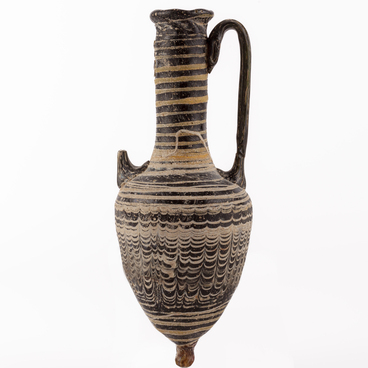
The glass from the museum collection was discovered in 1964 in a paired burial of the 13th –15th centuries that was destroyed during construction work on the territory of the “Pearl of the Sea” sanatorium in the village of Kabardinka, Krasnodar Territory. It was donated to the museum by the employee of the sanatorium A.S. Grishchenko. In the middle, the outer surface of the glass is decorated with a pattern of alternating colored stripes. This style is typical for the East, since the spread of Islam imposed restrictions on the images of living beings. This custom goes back far into the mists of time. It is based on the belief that creating a visual representation of any living being is competing with God who created all living forms. In this way, an artist equates himself to the creator.

In the Middle Ages, despite the gradual expansion of monotheistic religions into the Northwest Caucasus, pagan ideas about the structure of the afterworld and the afterlife were preserved in the region for a long time.
#6
Наименование: Glass
Дата создания: the 13th–15th centuries
Техника: glass, glassblowing
Размеры: height — 8.6 cm, rim diameter — 9 cm, bottom diameter — 4.7 cm
#8
Jug
#9
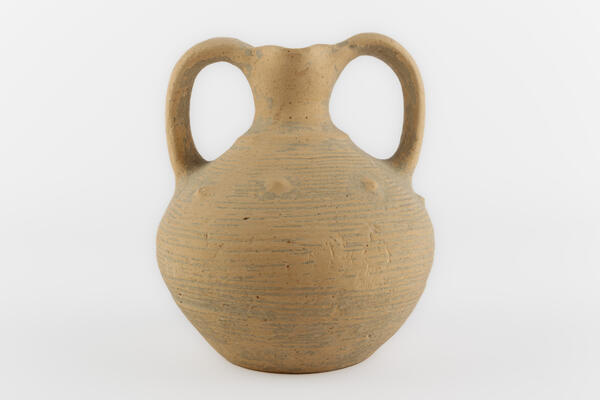
In October 1987, museum employees M.G. Mineev and A.B. Grigoriev discovered a jug made of light clay with a spout. This example of Circassian pottery was found in a destroyed burial of the 10th–12th centuries on the “Potomstvenny” site of the Mikhailovsky Pass state farm in the village of Pshada.

Clay tableware are found during excavations of settlements and burials from the Bronze Age to the Middle Ages. The clay used to make the first vessels contained a large number of various impurities. For example, the ceramics found in the Gelendzhik region often contain sand, calcite and marl. Such containers were mostly handmade (except for imported ones). They were made according to the coil technique and were flat-bottomed. As a rule, the body smoothly continued into the bottom, and the edges were rounded. First, the artisan made the bottom of the vessel and a long coil of clay, which was attached to the bottom with the help of liquid clay. The coil was gradually wound in a spiral, forming a pot or jug of the desired height. The final product was decorated with molded patterns and ornaments, and then fired. The potter’s wheel appeared in the Northwest Caucasus much later. All ceramics were highly valued and considered a true fortune. They were used not only in everyday life, but also in various rituals. Despite the spread of Islam in the 16th century, people continued to believe that the deceased needed various objects for their afterlife, and left everything they needed in the graves. That is why archaeologists find such vessels in burials.

The jug from the museum’s permanent exhibition features molded inlays, which are found on handmade vessels as early as the Bronze Age. Such an ornament could have both aesthetic and ritual functions. The clay of this vessel is practically free of impurities, which indicates the high quality of raw materials. The walls of the vessel are thin and even. Most likely, it was made on a potter’s wheel. All this suggests that the technique of making clay vessels reached a very high level in the Northwest Caucasus in the Middle Ages, and local potters were no longer inferior to foreign ones. Such vessels were typical for the local Circassian tribes and were widely used as tableware.
#10
Наименование: Jug
Дата создания: the 10th–12th centuries
Техника: light clay, potter’s wheel, firing
Размеры: 16,5×15 cm; rim diameter — 5.9×5 cm, bottom diameter — 8.5 cm
#11
read morehide
00:00
00:00
1x
Point your smartphone camera to open in the app
Share
VkontakteOdnoklassnikiTelegram
Share on my website
Copy linkCopied
Copy
Open in app
To see AR mode in action:
  1. Install ARTEFACT app for 
  2. iOS or Android;
  3. Find and download the «Paintings in Details» exhibition
  4. Push the «Augmented reality» button and point your phone's camera at the painting;
  5. Watch what happens on your phone screen whilst you flip through the pictures.
 
We use Cookies
Cookies on the Artefact Website. We use cookies to ensure that we give you the best experience on our website. If you continue without changing your settings, we'll assume that you are happy to receive all cookies on the Artefact website. However, if you would like to, you can change your cookie settings at any time.
Learn more about useHide
Content is available only in Russian

X

Нашли опечатку?...

%title%%type%