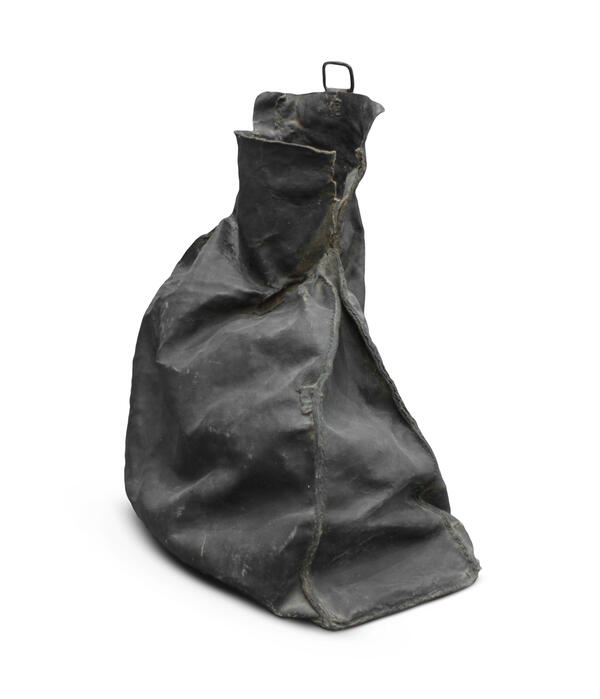
The Churapchinsky Museum named after Andrey Savvin presents a vessel for transporting and storing koumiss, known as a “kogyor” or “simiir”. This flat leather bottle has the shape of a prism, tapering to the top and ending with a narrow neck. The product is stitched with “siri” sinew threads made of leather soaked in animal blood and smoked.
Most nomads of Asia made koumiss containers from similar material — animal skins.
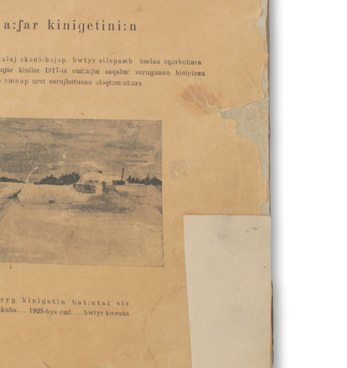
The Bashkirs, for example, stored koumiss in sabos or burdyuks. They were conical-shaped vessels with a square base and a narrow neck and resembled the Yakut simiir. In his work “Yakut food before the development of agriculture”, Andrey Savvin, the folklorist and local historian, the first director of the Churapchinsky Museum noted multiple similarities among the types of koumiss utensils of different ethnic cultures.
A wooden carved “khalya” plug was inserted into the neck of the vessel. When traveling, the sack was closed with the help of two “tylba” sticks tied at both ends. The Yakuts used the same smaller sacks for transportation of liquids, milk, cream, and butter by pack transport in summer. Such packaging allowed for longer storage of dairy products, which did not lose flavor or go off.
The small pouches were called by the diminutive name “simirchah”. They were widely used in the past, but now they are replaced by less convenient but cheaper wooden flasks. Mare’s skin was used to make simirchahs. It was cleaned of wool, soaked in oil or mare fat and smoked for a long time.
Leather was also used in making “hollogos” large koumiss round vats, as well as “tursuk” small buckets and “simir isit” milk pails.
As the ethnographer and publicist Václav Seroshevsky noted in his study “Yakuts”, published in 1896, Yakuts used mainly cow and mare skins for handicrafts.
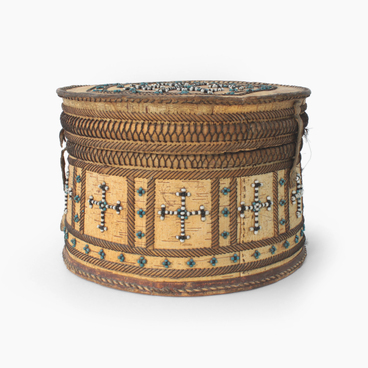
Each piece of tableware was decorated with a
variety of patterns in different techniques.