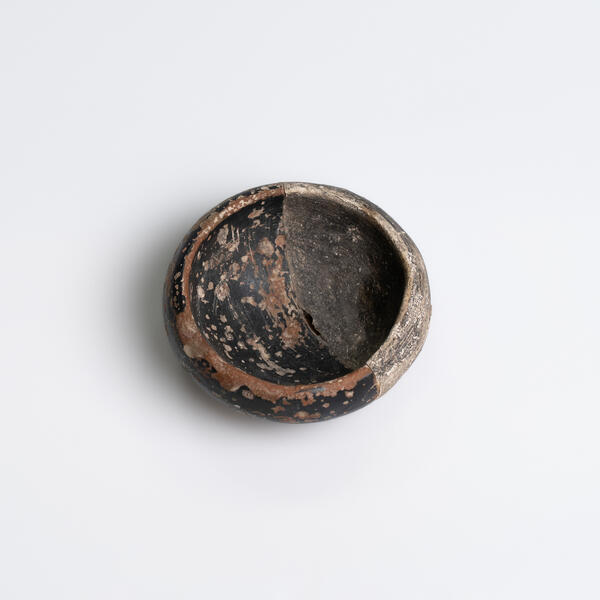
The displayed salt cellar was found in the Masliny settlement in the Northwestern Crimea by a team from Kharkov University as part of the North Crimean archaeological expedition. It has concave walls and a recessed bottom, resembling a hidden ring-shaped tray. It also has an oval beveled edge. The lacquer is of poor quality.
In her work “The Masliny Settlement in Northwestern Taurica”, the archaeologist Viktoria Kotenko noted that the ceremonial tableware was represented by black lacquer pottery. However, the specific weight of these vessels among all the archaeological finds is relatively small, accounting for less than 1% of the total value. Most of the black lacquer ceramics are concentrated in the western part of the settlement and are associated with the towers. Some isolated fragments have been found in the eastern part of the settlement, which is where recessed structures were the main type of housing. The most common forms of black lacquer pottery found in Masliny include fish plates, bowls, kantharoi, and salt cellars.
Salt cellars of this type, found in Maeotian monuments, have a bottom with a recess from below, resembling a hidden ring tray. They have a horizontal or oval beveled edge. According to the materials from the ancient Agora of Athens, this type of salt cellar emerged in the second half of the 5th century BCE and reached a peak of popularity in the second and third quarters of the 4th century BCE. Towards the end of the 4th century, around 315 BCE, the production of salt cellars with concave walls ceased in Attica.
Salt cellars of this type are particularly common in the monuments of the Northern Black Sea region. They form part of a larger complex of black lacquer ceramics found at the Starotitarovsky mound on the Taman Peninsula. A similar salt cellar was discovered in the necropolis of the Yelizavetskoye settlement and dates back to the first half of the 4th century BCE. Other salt cellars from the second and third quarters of the 4th century BCE have been found in stone tombs belonging to the local population in the Eastern Crimea. Earlier versions of such salt cellars can be seen in the Chersonesus necropolis from the late 5th century and early 4th century BCE.
The ancient inhabitants of Chersonesus Chora used the salt from Sasyk-Sivash Lake not only as a seasoning but also as a preservative to store fish and meat. This is evident from the clay amphorae and fishing tools found near the lake. Traces of human habitation in this area date back to the 3rd and 2nd centuries BCE.