#1

Sundial, Toiletry box
#3
#4

#5
Sundials fitted with a ‘noon cannon’ began to come into fashion, first in Europe and then in Russia, between the late 18th and the early 19th century. For a device like this to be used, it was installed on a pedestal situated in a sunny spot in a garden or a park. The device was fixed to a wooden stand with three screws, which allowed to set up the dial in a strictly horizontal position by using a spirit level. Same as any measuring instrument, sundials came with a case.
Sundials were used for checking the accuracy of mechanical clocks. A signal sundial combines two devices: a universal horizontal sundial itself, as well as a mechanism for sounding a signal at local true noon. The sound-producing component is called the ‘noon cannon’.
The showpiece displayed in the museum consists of a magnetic compass with a cylindrical glazed bowl and a tubular level for fixing the dial in a horizontal position, both of which are mounted on a brass disc-shaped base with an engraved inscription ‘Ye. S. Tryndin’. The base also contains a horizontal sundial with a III–XII–YII hour-line and a gnomon, the angle of which can be adjusted for latitudes within the range of 0 to 30 degrees (a gnomon is the ‘heart’ of any sundial; it is an ancient astronomical instrument that allows to determine the angular altitude of the Sun).
The mechanism of the ‘noon cannon’, which consists of a small cannon and a movable igniting lens, deserves special mention. The lens is mounted on two frames fitted with a scale for setting a precise declination angle. When all elements of the mechanism are properly adjusted for the geographic coordinates of the device and the current calendar day, the sundial can tell local solar time during daylight hours. Precisely at true noon, a focused beam of light hits the loaded cannon, causing it to fire.
For the longest time, it was believed that no historical examples of such devices had survived in Russia. However, the expert analysis conducted by Tatyana Fokina, the curator of the clock collection at the Polytechnic Museum, confirmed the authenticity of this sundial. It is a unique item with the status of a ‘limited 1-st rank monument of science and technology’, as stated in the certificate No. 1179 dated December 4, 2014.
#6
Author: Yegor Sergeyevich Tryndin
Date: 1857–1868
Technique: engraving, casting, turning
Dimensions: 28×28×15 cm
Collection: History of engineering
Copyright: Ramenskoye History and Art Museum
Goskatalog Number: 18252073
Date: 1857–1868
Technique: engraving, casting, turning
Dimensions: 28×28×15 cm
Collection: History of engineering
Copyright: Ramenskoye History and Art Museum
Goskatalog Number: 18252073
#7
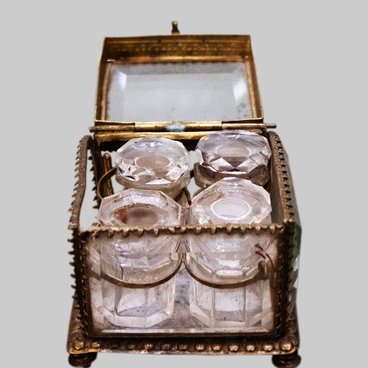
Set of four bottles in a glass cube box for storing perfume
#8

#9
A set of four bottles in a cube-shaped glass box. The box is enclosed in a metal edging, part of which are round legs.
In the 16th–18th centuries, graceful perfume bottles were status items, akin to jewelry and fashionable clothes. Only the nobility could afford such ‘toys.’ The perfume itself was also a product not available to the general public. In the 18th century, it was impossible to imagine a servant or a factory worker wearing perfume. The situation changed fundamentally only in the late 1800s. By this time, even the simplest of maids could keep a bottle of floral perfume on her nightstand, sometimes more than one.
It is believed that the first perfume compounds were created in ancient Egypt. It is possible that the Egyptians adopted the tradition of perfume making from Mesopotamia. One of the cuneiform tablets from the second millennium BC mentions a female perfumer named Tapputi.
In Russia, producers of cosmetics and personal care products began to emerge only in late 19th century. Before that, all perfumes were imported from Western Europe. Since eau de toilette, colognes, and incense were made using plants and herbs, the bottles were initially sold in pharmacies.
When specialized perfume shops emerged, they started offering perfume refills. Of course, they also sold bottles of perfume, but it was considered wasteful to buy a new bottle every time. So people usually either used one bottle, or bought a bottle separately.
Glassmakers quickly saw the profit potential and started creating special gift sets perfume storage. Such sets were often a work of art in themselves and adorned dressing tables of wealthy ladies.
At the turn of this century, the focus on bottle design became even more pronounced. Famous artists took years to design some of them. The perfume refilling business has gradually died out, and the scent of a perfume is now inextricably linked to its package design: both elements are copyrighted and are a source of pride for manufacturers.
#10
Date: late 19th century
Technique: glass, metal
Dimensions: 6×6,7×6,7 cm
Collection: Porcelain, ceramics
Copyright: Ramenskoye History and Art Museum
Technique: glass, metal
Dimensions: 6×6,7×6,7 cm
Collection: Porcelain, ceramics
Copyright: Ramenskoye History and Art Museum
read morehide
00:00
00:00
1x
Sundial, Toiletry box
Collection
0
 Point your smartphone camera to open in the app
Open in app
Share