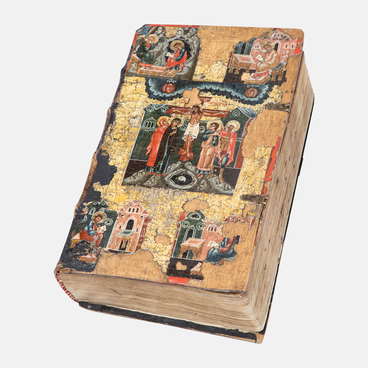
The service to the Venerable Alexander Oshevensky was composed in 1578, under Metropolitan Philip; the prayer was written in 1844, probably, in the Alexander Oshevensky Monastery. In addition, the collection includes the text of the Vyg Old Believer prayer, known today in six versions.
The Vyg Hermitage (Vygoretskaya Coenoby) was located on the Vyg River in the Olonets region and was an important Old Believer spiritual center in the 18th and 19th centuries. In 1701, in the Zadnedubovskaya area of the Kargopol region, the Chazhengsky community arose, which was otherwise called a hermitage or “arable yard”.
In the Vyg Old Believers’ Hermitage, the saints revered in Russia prior to the reforms of Patriarch Nikon enjoyed great popularity. The “Sermon of Remembrance of the Holy Wonder Workers Who Shone Forth in Russia” written by the hagiographer and Old Believer Semyon Denisov mentions about 100 hermits, wonder workers and venerable monks, as well as eight holy wives and 15 holy martyrs.
Among them, the most revered saints were the founders of the Solovetsky Monastery Sabbatius and Zosimas of Solovki: the members of the Vyg Community especially highly regarded the cenobitic monastery founded by the saints as a bulwark of preserving the old faith. They are followed by the holy hermit Alexander Svirsky, the founder of the monastery on the Svir River.
Several works are dedicated to the Venerable Alexander Oshevensky. Those include his hagiography compiled by Hieromonk Theodosius, and excerpts from it: “Instruction” and three miracles — about the fire (vision to Elder Gerasim), the healing of the boy Stefan and the appearance of the monk to “three men”; the service in his honor for April 20, compiled by Alexey Korepanov; the service “for small vespers” and the canon.
In addition to works in traditional genres, the Vyg scribes wrote “creative” tributes, including two “slovo” (a special genre similar to a homily) dedicated to Alexander Oshevensky. These works do not mention biographical information: the author, apparently, did not want to duplicate the texts of the main hagiography, which were already well known to all admirers of the monk.
The manuscript existed in the Oshevensky region,
where, apparently, it was rewritten. The book was donated to the museum by the
researcher of the Russian North Gennady Petrovich Durasov.