Font
Color
Graphics
Изображение точки

To see AR mode in action:

1. Install ARTEFACT app for iOS or Android;

2. Find the exhibition «The fascinating natural world of Kuzbas»

3. Push the «Augmented reality» button and point your phone's camera at the exhibit;

Скрыть точки интересаПоказать точки интереса
Показать в высоком качестве

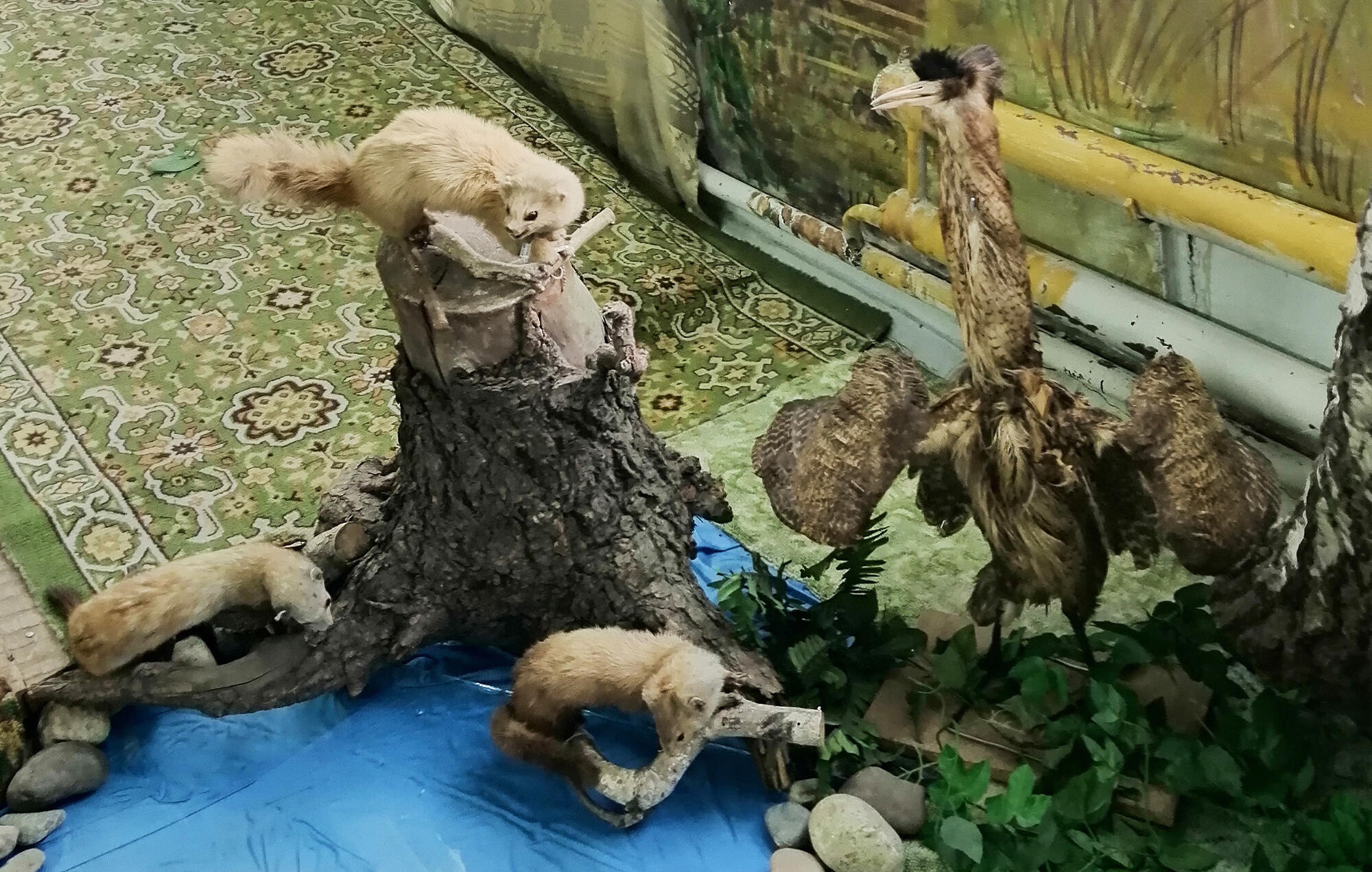
A polecat, A mink,The Siberian weasel, A bittern

0
Open in app
#1
A polecat, A mink, The Siberian weasel, The Eurasian bittern
#10
Author unknown
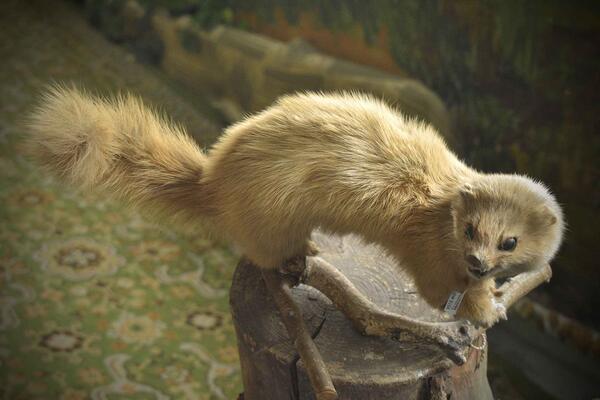
A polecat
#12
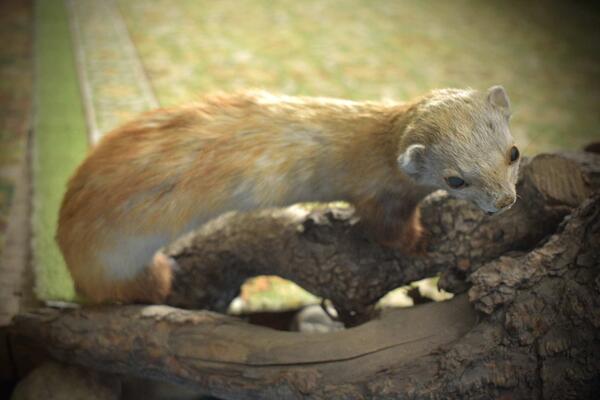
The European polecat is a carnivorous mammal of the Mustelidae family. Its closest ‘relatives’ include stoats, European minks and common weasels. Humans domesticated this valiant predator a long time ago. For more than one century, polecats have been living in households, becoming many people’s favorite pets. Its weight can reach 1.5 kilograms. The animal’s body is typical for mustelids: it is elongated, long and thin. European polecats are very flexible and graceful. Their limbs, in comparison to its long body, look short and stumpy, but they are very strong and sturdy, and are equipped with sharp claws, which help the animal climb any tree and create underground passages expertly. Its coat is pleasant to the touch and fluffy. Closer to their base, its hairs are noticeably lighter, while the ends are darker in shade having changed the hue along their length. In autumn, when the molt is almost complete, the European polecat’s furry coat starts to glisten and shimmers gracefully in the sun. Its beautiful, long and furry tail is characteristic to this species. There are scent glands near it, which secrete a smelly substance to help the animal cope with its enemies. European polecats love forests and tend to live near ravines and water bodies. Sometimes, they move to villages and settlements, and choose to live near humans. These carnivores do not travel deep into the woods and prefer to inhabit the edges of forests where there is no dense vegetation. There are European polecats in mountainous regions. In fact, they can reach heights of several thousand meters above sea level. 

These animals inhabit familiar territories, which they prefer not to leave. This species likes to live in abandoned burrows of European badgers and foxes. They do not often make their own dens in the earth. European polecats can also inhabit haystacks as well as rotting hollowed out trees and not only underground homes. Where these animals live is determined by the landscape they choose to inhabit. The predator eats all types of rodents, various insects, reptiles and birds. Hunting lizards and even poisonous snakes is not that big of a challenge for this carnivore. European polecats also enjoy eating adult as well as baby birds. The animals also love feeding on bird eggs, hence they never miss out on an opportunity to destroy a nest. These mammals, by their nature, are very energetic, agile and inquisitive. In the wild as well as in captivity or within households, they prefer hunting and being active at dusk. European polecats are excellent tree climbers and splendid swimmers. When they are not asleep, these animals are full of energy and simply cannot stay in one place. The mammal prefers to live only within one territory of its own. This species lines its burrows, which it either finds abandoned or digs out, with grass and leaves. Sometimes (in winters), these animals can live in people’s barns, storerooms and basements. In farming communities, European polecats have a reputation of being real troublemakers. After all, they often steal hens and rabbits right from people’s front yards. Such incidents usually happen during famines but not always. In the wild, the European polecat’s enemies can be said to include foxes, wolves, wild cats, large birds of prey, big poisonous snakes, owls and golden eagles. 
#11
Date: The end of the 20th century
Technique a stuffed
Collection: Natural science
Copyright: Promyshlennovsky District Museum of History and Regional Studies
Dimensions: 50.5*9.5*8
Goskatalog Number: 24200901
#13
Author unknown
The European or Russian or Eurasian mink
#15
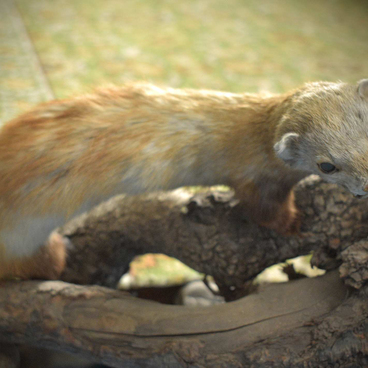
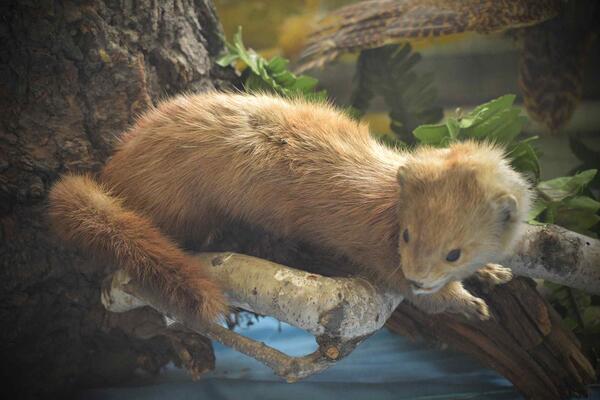
The European mink is a fairly small animal with a smooth, mainly chestnut-colored, coat. It is a highly valued member of the Mustelidae family, and a carnivorous mammal. The animal is a close ‘relative’ of common weasels, European polecats as well as stoats. The length of its body does not exceed fifty centimeters. The creature has got a relatively small but very bushy tail, whose length ranges from twelve to nineteen centimeters. Its weight is no more than 800 grams. Owing to its size, in the wild, the Eurasian mink can get into various crevices, quickly hide whenever danger arises and stay afloat easily.
 
The small predator has a very beautiful dense coat with a thick underfur. The latter stops this animal from getting wet even if it remains in the water for a long time.
 
The Russian mink’s daily diet may consist of rodents, fish, crustaceans, semi-aquatic creatures and insects. When these predators live near settlements, they sneak into barns and hen-houses, and skillfully catch domestic poultry.
 
Eurasian minks prefer eating fresh food. If it is not available, they can even go hungry but for no more than 4 days. One may quite often spot these animals up in the trees. They can feast on birds’ eggs up there. European minks primarily live in forests and fairly close to water bodies, i.e. rivers, ponds, lakes, etc. They prefer to inhabit, breed and hunt in relatively small territories.

These animals build their nesting chambers in dense reeds and bushes. The mammals either make their own burrows or use existing holes in the ground, i.e. natural depressions in the soil, small crevices, abandoned rats’ burrows or tree hollows. The Russian mink’s den remains in continuous use. It can abandon its home only for tow reasons: due to flooding or the absence of food during the winter season. Its burrow is not usually large but it is divided into several sections. There is a main area for sleeping, a toilet and several exits. One of them always leads to a water source, another into brushwood. This animal’s burrow is lined with available natural materials, such as feathers, moss, leaves and dry grass.
 
Eurasian minks are especially active when it is dark. However, if their hunt at night is unsuccessful, these animals can give it another go in the daytime. By nature, they are unfriendly but not aggressive. These mammals prefer to lead solitary lifestyles. The small predators live up to 10 years of age, maximum. However, in captivity, their lifespans are much longer, i.e. more than 15 years. Their natural enemies can be said to include predators such as lynxes, bears, wolves, Eurasian otters, owls, hawks and Eurasian eagle-owls. At present, the only reason European minks are not hunted extensively is because they are bred on special farms for their fur these days. This animal has been on the Red List of Threatened Species since 1996.
#14
Date: The end of the 20th century
Technique a stuffed
Collection: Natural science
Copyright: Promyshlennovsky District Museum of History and Regional Studies
Dimensions: 32*4*14
Goskatalog Number: 24166302
#16
Author unknown
The Siberian weasel
#18
The Siberian weasel is a fairly small carnivorous animal of the Mustelidae family. Its weight does not exceed 700 to 800 grams, and the length of its body together with the tail ranges from 48 to 66 centimeters. The Siberian weasel’s body is very flexible, elongated and nimble. The animal’s head is fairly small with a pointed snout chestnut in color. It is graced with white spots near its nose and what resembles a black mask around its expressive eyes. Its ears are quite small, tidy-looking and rounded in shape. 

The Siberian weasel’s legs are short, with partially webbed feet. Its beautiful and bushy tail is this animal’s pride and joy. It reaches 18 to 20 centimeters in length. In winter, this mammal’s coat is orangish-yellow, while in summer time — orangish-red. Its fur is very thick and soft in winters. The molt occurs in March-May. 
 
Siberian weasels prefer to inhabit coniferous or deciduous forests where a large number of rodents, its staple food, need to live. They like settling down on shores of water bodies, streams and rivers, especially if there are thickets of bushes growing on them. One can quite often come across these animals in various settlements, on the outskirts of towns and cities and near fields. 
 
Siberian weasels stick to their territories. They often make burrows of chipmunks or voles, tree hollows and spots among fallen trees or brushwood their homes. When it is particularly cold, these animals can remain in their shelters for a number of days, and briefly hibernate in them. The mammals are mainly nocturnal creatures but in winters, they may also be active in the daytime. 
 
Siberian weasels can travel up to 10 kilometers in search of food. It is a very inquisitive, agile and nimble animal. These predators can climb trees and rocks, and into crevices and tree hollows. They swim very well and can, in fact, swim out a considerable distance from the shore. Northern water voles, muskrats and river fish quite often become their prey. These animals also hunt small birds, such as sparrows, as well as larger ones, i.e. Eurasian capercaillie and hazel grouse, by stalking them under the snow. During seasons with an abundance of nuts and berries, they can eat those too. 
 
An interesting and characteristic habit of the Siberian weasel is that regardless of where it finds the food, the animal always eats it only at home. The sounds that this mammal makes are similar to those of the European polecat. When irritated, these animals hiss in a whistling manner. They can also produce chirping and trilling sounds. Lynxes, foxes, wolves and European polecats hunt Siberian weasels, but their main enemies are sables. Birds of prey, such as hawks, owls, eagles and Eurasian eagle-owls, also pose a threat to these mammals. 
 
This animal has a beautiful coat, which is widely used in the fur industry. Artists are also quite familiar with these creatures, as their fur is used to make soft paintbrushes, which are described as ‘Kolinsky’, based on the name of this animal in Russian, ‘kolonok’. 
#17
Date: The end of the 20th century
Technique a stuffed 
Collection: Natural science
Copyright: Promyshlennovsky District Museum of History and Regional Studies
Dimensions: 32*18*13
Goskatalog Number: 24166301
#19
Author unknown
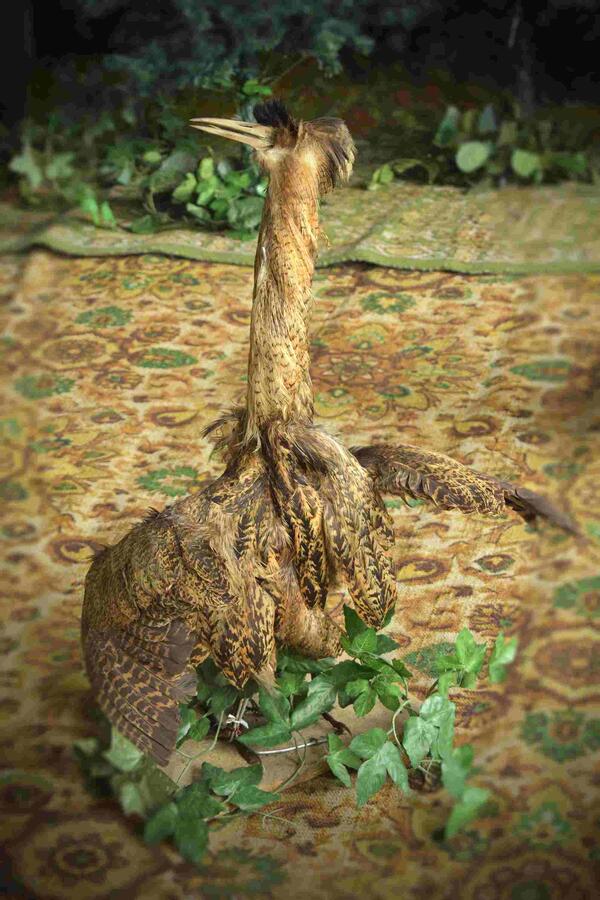
The great bittern
#21
The great bittern belongs to the same family as the heron. Adult birds are, on average, approximately 70 centimeters tall. Females weigh around 1 kilogram, while males are twice as heavy. Their wings are wide, with a span of up to 1.3 meters. The Eurasian bittern’s legs are not very long, thus it wades into shallow but not very deep waters. Hence, it lives in groves of alder trees and willows, and stands of common reeds on the shores of quiet rivers and lakes, and in abandoned peat harvesting sites, reed beds and swamps. 
 
In winter time, Eurasian bitterns migrate south. They return home in April to May and build their nests in a quiet place. Typically, their abodes are simply a heap of bulrush stalks and leaves with a hollow at the top. The bird lays up to 6 eggs in it. 
 
Great bitterns return to Russia from warmer regions in early spring. The migrations south take place from the end of September to the beginning of October, although some birds leave only after it snows for the first time. Eurasian bitterns travel alone in spring as well as autumn. Molting occurs once a year from August to January. In other words, feather replacement often continues once these birds have migrated elsewhere for the winter. 
 
Great bitterns are active when it is dark. Just as many herons, they can stand perfectly still for a long time awaiting their prey, which they grab lightning fast. During the day, the bird stands motionless, typically on one leg, in thick undergrowth, with its head pulled in towards its body and feathers raised. It is difficult to notice it even if you are nearby. These birds differ from their well-known white as snow “relatives” in size and color. The feathers on the great bittern’s back are black with yellow edges while those on its stomach are ochre-colored with lateral lines. Its legs are light green and the bill is black. At even the slightest sign of danger, the bird ‘stands to attention’, raises its bill up high and remains perfectly still. Having adapted such a pose, it completely blends into the surrounding vegetation. The bird can remain motionless for hours, and yet it carefully watches fish and amphibians swimming nearby, ready to attack at any given moment. 
 
The Eurasian bittern eats fish and frogs that it catches with its pointed bill from its hiding spot. These birds can destroy nearby nests, hence they do not venture far from their own abodes. They feed their offspring with tadpoles. 

It is not easy for just about anyone to catch a glimpse of this bird, but many have heard it. The sounds made by the great bittern coming from a foggy swamp can be truly frightening. They resemble the noises made by someone’s feet smacking against the water; the gurgling of a water sprite; the sighs of mermaids, and children crying. It is quite possible that many of the stories told by tourists about mysterious creatures circling their tents all night long have been inspired by these strange noises. The Eurasian bittern produces these sounds by swelling its esophagus, thus transforming it into a resonating organ. In fact, its apt name in Russian, “vyp”, clearly comes from the words “vyt” (howl) and “vopyt” (scream). In reality, the great bittern is a harmless bird, although it can injure one’s eyes and arms with its sharp bill if it feels completely trapped. Hence, it is best not to touch this bird, especially since it was added to Russia’s and Kemerovo Oblast’s Red List of Threatened Species. 
#20
Date: The end of the 20th century
Technique a stuffed bird
Collection: Natural science
Copyright: Promyshlennovsky District Museum of History and Regional Studies
Dimensions: 81*36*34
Goskatalog Number: 24265882
read morehide

A polecat, A mink,The Siberian weasel, A bittern

0
Point your smartphone camera to open in the app
Share
VkontakteOdnoklassnikiTelegram
Share on my website
Copy linkCopied
Copy
Open in app
To see AR mode in action:
  1. Install ARTEFACT app for 
  2. iOS or Android;
  3. Find and download the «Paintings in Details» exhibition
  4. Push the «Augmented reality» button and point your phone's camera at the painting;
  5. Watch what happens on your phone screen whilst you flip through the pictures.
 
We use Cookies
Cookies on the Artefact Website. We use cookies to ensure that we give you the best experience on our website. If you continue without changing your settings, we'll assume that you are happy to receive all cookies on the Artefact website. However, if you would like to, you can change your cookie settings at any time.
Learn more about useHide
Content is available only in Russian

X

Нашли опечатку?...

%title%%type%