

A folding icon is a miniature portable iconostasis. Most often, a folding icon consisted of two or three sections, or panels, less often — of four or five. Such icon was worn on the chest along with a cross or in a big ring on the finger. People took a folding icon with them on the road, on a pilgrimage or military campaign, it was called a travel icon. Folding icons were cast from copper and brass, less often carved from wood — few wooden antique folding panels have been preserved.
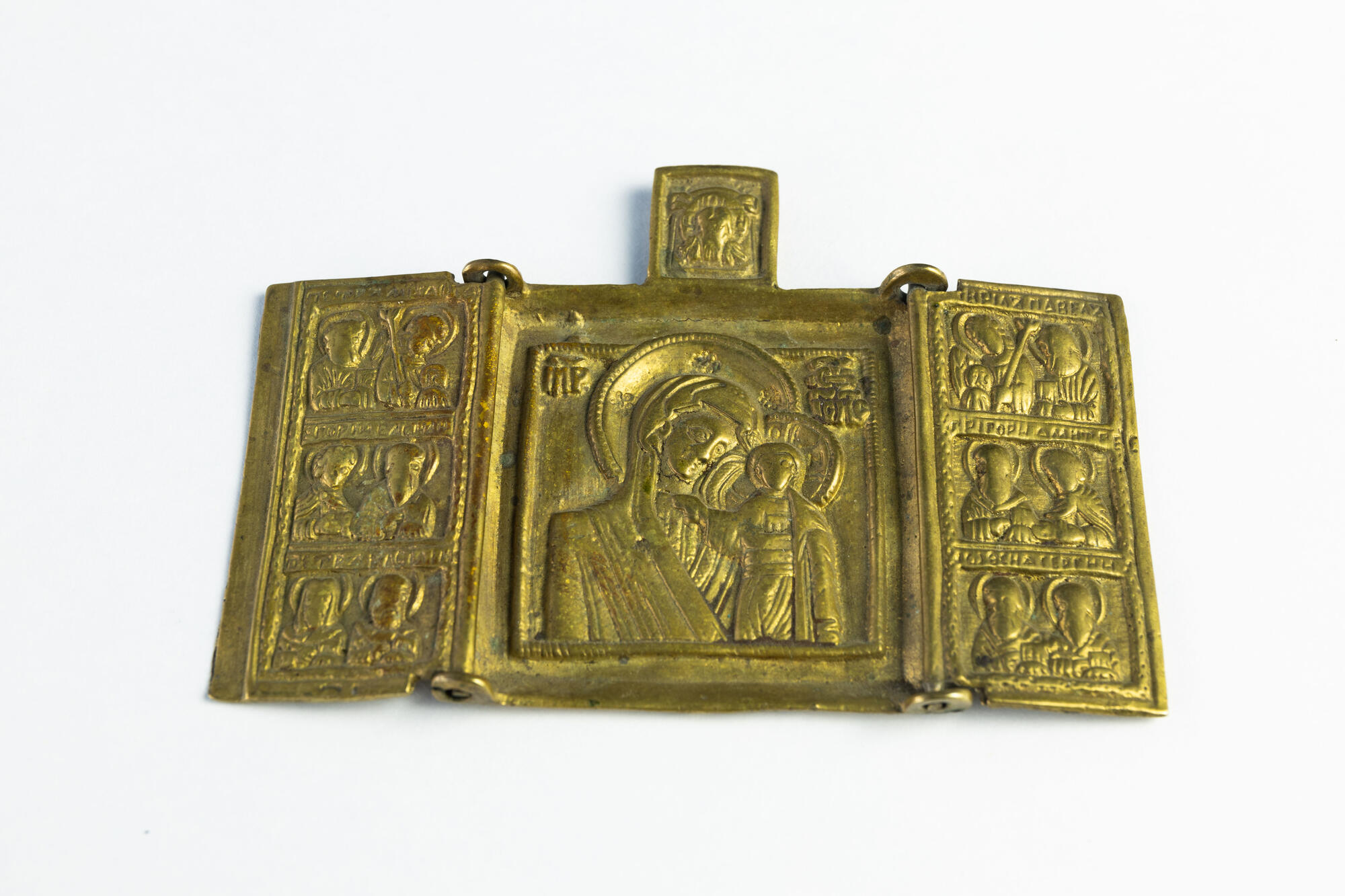
The Glazov Museum displays a copper folding icon which copies the Kazan Icon of the Mother of God. It consists of three panels — this design is called a triptych and is the most common in Russia. The shape of the triptych symbolizes the Holy Doors of the church iconostasis, the entrance to the Kingdom of God.
The central part of the triptych depicts the Mother of God with the Christ Child, who stretches out his hand in a blessing gesture. On the side panels, Orthodox saints are depicted in three rows: Archangel Michael, Apostle Peter, St. Basil the Great, Great Martyr George, St. John Chrysostom, Metropolitan Peter, Archangel Gabriel, Apostle Paul, St. Gregory the Theologian, Great Martyr Dmitry, Saints Athanasius and Blaise. At the top of the triptych is a relief depiction of the icon “The Savior Not Made by Hands”.
In Rus, icons and folding icons appeared in the 10th century, immediately after the Christianization. They were brought from the Byzantine Empire, and subsequently Russian masters copied them. The size of the folding icon is determined by its central part. It depicts the main image, most often an image of Jesus Christ, the icon of the Savior on the Throne, St. Nicholas the Wonderworker, or the Kazan and Vladimir Mother of God icons.
In 1722, a decree of Peter I forbade “displaying carved and cast icons in churches and houses.” The number of copper folding icons, like the one presented in the museum, quickly decreased. Copper casting became the craft of the Old Believers, who were actively persecuted. In time, they turned it into a separate kind of foundry art. The Vygovsky Old Believer craftsmen founded a workshop for casting metal which produced artworks that are considered a unique example of chasing of pre-revolutionary Russia.
The Glazov Museum displays a copper folding icon which copies the Kazan Icon of the Mother of God. It consists of three panels — this design is called a triptych and is the most common in Russia. The shape of the triptych symbolizes the Holy Doors of the church iconostasis, the entrance to the Kingdom of God.
The central part of the triptych depicts the Mother of God with the Christ Child, who stretches out his hand in a blessing gesture. On the side panels, Orthodox saints are depicted in three rows: Archangel Michael, Apostle Peter, St. Basil the Great, Great Martyr George, St. John Chrysostom, Metropolitan Peter, Archangel Gabriel, Apostle Paul, St. Gregory the Theologian, Great Martyr Dmitry, Saints Athanasius and Blaise. At the top of the triptych is a relief depiction of the icon “The Savior Not Made by Hands”.
In Rus, icons and folding icons appeared in the 10th century, immediately after the Christianization. They were brought from the Byzantine Empire, and subsequently Russian masters copied them. The size of the folding icon is determined by its central part. It depicts the main image, most often an image of Jesus Christ, the icon of the Savior on the Throne, St. Nicholas the Wonderworker, or the Kazan and Vladimir Mother of God icons.
In 1722, a decree of Peter I forbade “displaying carved and cast icons in churches and houses.” The number of copper folding icons, like the one presented in the museum, quickly decreased. Copper casting became the craft of the Old Believers, who were actively persecuted. In time, they turned it into a separate kind of foundry art. The Vygovsky Old Believer craftsmen founded a workshop for casting metal which produced artworks that are considered a unique example of chasing of pre-revolutionary Russia.