#1
Russian coin, Siberian coin, Awarding medal
#2
#3
#5
Changed money was delivered to Siberia from the Central part of Russia. But this process was very expensive for the state treasury. Siberia had its own enterprises that extracted precious metals-gold and silver. The first plant – Kolyvano-Voskresensky plant was built there in the 18th century. The Cabinet of Empress Catherine II set an important task for Altai enterprises - to start minting change money from the copper accumulated from smelting of silver. This was enough to start local production. But such coins could only be in circulation in Siberia – from Tara to Kamchatka.
On November 7, 1763, Empress Catherine II signed a decree – at her command, Siberia established its own independent twenty-five-rouble coin. Siberians favorably received the appearance and circulation of Siberian money. However, the coins were not allowed into the Central part of Russia. Siberian money were accumulated in State Treasury vaults, as a result, all taxation of the population was converted to silver. Demand for Siberian coins fell, and over time, copper reserves at local factories were depleted. The Cabinet of the Empress transferred the coinage of money of the Nizhne-Suzunsky mint to the national sample. Finally, Siberian coins stopped being minted in 1781.
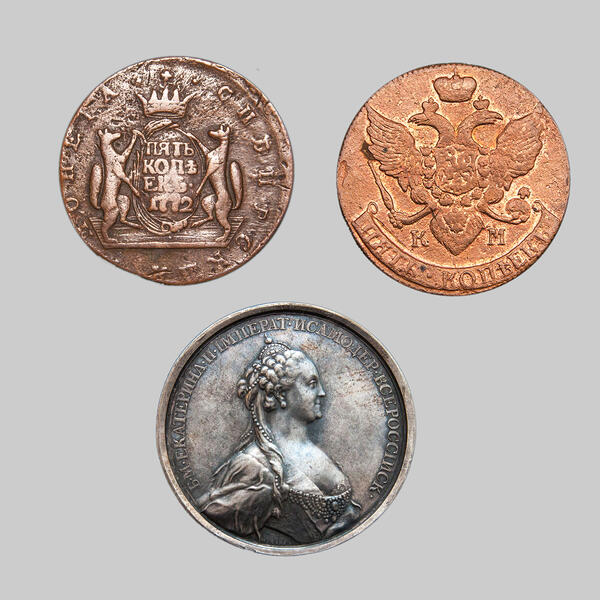
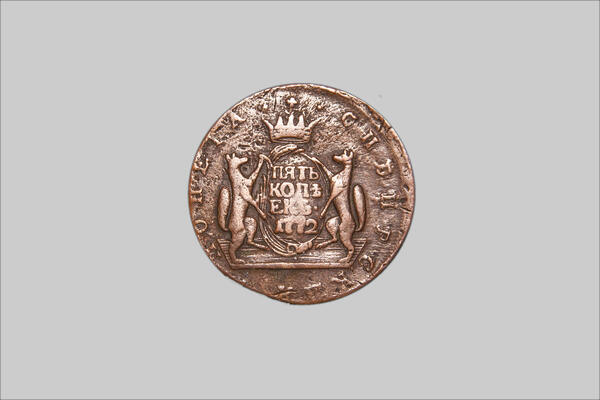
Siberian coins differed from ordinary copper coins in that they contained a certain percentage of valuable metals. Patterns with the monogram of Empress Catherine II were depicted on the main side of the coin. On the reverse side, there is the main wealth of Siberia — sable. There was a shield with the denomination of the coin and the year of issue on the front paws of the animals. From time immemorial, the territory of Siberia, even before joining the Moscow state, was primarily associated with furs.
A riffled edge was the distinctive sign of the Siberian coin — this feature was more relevant to expensive coins. Five kopecks were marked with the inscription ‘Kolyvan copper’, which indicated the quality of the metal from which the coin was minted.
The formation of the collection of numismatics in the Tobolsk Museum Reserve began in the 19th century. The presented item is a real numismatic rarity, the coin dates back to 1772.
On November 7, 1763, Empress Catherine II signed a decree – at her command, Siberia established its own independent twenty-five-rouble coin. Siberians favorably received the appearance and circulation of Siberian money. However, the coins were not allowed into the Central part of Russia. Siberian money were accumulated in State Treasury vaults, as a result, all taxation of the population was converted to silver. Demand for Siberian coins fell, and over time, copper reserves at local factories were depleted. The Cabinet of the Empress transferred the coinage of money of the Nizhne-Suzunsky mint to the national sample. Finally, Siberian coins stopped being minted in 1781.
Siberian coins differed from ordinary copper coins in that they contained a certain percentage of valuable metals. Patterns with the monogram of Empress Catherine II were depicted on the main side of the coin. On the reverse side, there is the main wealth of Siberia — sable. There was a shield with the denomination of the coin and the year of issue on the front paws of the animals. From time immemorial, the territory of Siberia, even before joining the Moscow state, was primarily associated with furs.
A riffled edge was the distinctive sign of the Siberian coin — this feature was more relevant to expensive coins. Five kopecks were marked with the inscription ‘Kolyvan copper’, which indicated the quality of the metal from which the coin was minted.
The formation of the collection of numismatics in the Tobolsk Museum Reserve began in the 19th century. The presented item is a real numismatic rarity, the coin dates back to 1772.
#6
Date: 1772
Place: Russian Empire, Suzunsky Mint
Technique: embossed
Dimensions: 3,7×3,7 cm
Collection: Numismatics
Copyright: Tyumen Province State Autonomous Cultural Institution ‘Tyumen Museum and Educational Association’, Structural Division ‘Tobolsk Historical and Architectural Museum Reserve’
Goskatalog Number: 4082767
Place: Russian Empire, Suzunsky Mint
Technique: embossed
Dimensions: 3,7×3,7 cm
Collection: Numismatics
Copyright: Tyumen Province State Autonomous Cultural Institution ‘Tyumen Museum and Educational Association’, Structural Division ‘Tobolsk Historical and Architectural Museum Reserve’
Goskatalog Number: 4082767
#7
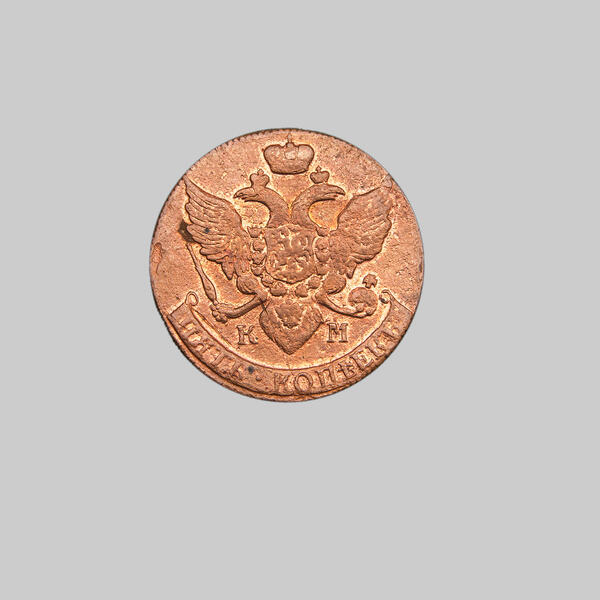
Russian coin. 5 kopeks
#9
#8
The history of the copper coin goes back to Ekaterinburg. It began on June 14, 1725, when a Senate decree was adopted: ‘… At Siberian factories, to make coins from finished products, and which will henceforth be melted, to make planchets from pure red copper, to label the price in the middle and on each edge - a coat of arms with thread marks of different values, namely — rouble, poltina, half a poltina, and grivna…’.
Hence, in the Russian Empire there was a ‘money yard’ — an enterprise for the production of coins, where Swedish-style money was minted. Then they were square-shaped and were issued in a pile of 10 roubles from a pood of metal with denominations of 1.5 kopecks, grivna (ten kopecks), half a poltina (25 kopecks), poltina (50 kopecks) and a rouble. Such coins were inconvenient to handle, and the population used them unwillingly and for a short time. Therefore, the yard was renamed the mint, where they began to produce first planchets, and later coins. It was the largest plant for the production of copper coins in the Empire.
When Empress Catherine II ascended to the Russian throne in 1762, the mint was renamed into the Ekaterinburg mint. Since that time, coins minted in Ekaterinburg had their own unique designation ‘E.M.’ — the Ekaterinburg coin.
A coin from the Tobolsk Museum Reserve with a face value of 5 kopecks was issued in 1790, it was in circulation during the reign of Catherine II – in 1762-1796. The imperial monogram is depicted on its front side, made up of the letter ‘E’ (Ekaterina (Catherine)), the Latin letter ‘J’ (Empress) and the Roman figure ‘II’. There is the Imperial crown above the monogram with laurel and palm branches on the sides tied with a ribbon. The reverse side of the coin shows the state emblem — a double-headed eagle with three Imperial crowns, on the chest — the coat of arms of the city of Moscow, and on its wings — a chain with the medal of St. Andrew. He holds a scepter and an orb in its paws. In the lower part of the coin on the ribbon, the denomination ‘five kopecks’ is indicated. By 1796, almost three-quarters of all copper coins of the Russian Empire had been minted in Ekaterinburg.
Hence, in the Russian Empire there was a ‘money yard’ — an enterprise for the production of coins, where Swedish-style money was minted. Then they were square-shaped and were issued in a pile of 10 roubles from a pood of metal with denominations of 1.5 kopecks, grivna (ten kopecks), half a poltina (25 kopecks), poltina (50 kopecks) and a rouble. Such coins were inconvenient to handle, and the population used them unwillingly and for a short time. Therefore, the yard was renamed the mint, where they began to produce first planchets, and later coins. It was the largest plant for the production of copper coins in the Empire.
When Empress Catherine II ascended to the Russian throne in 1762, the mint was renamed into the Ekaterinburg mint. Since that time, coins minted in Ekaterinburg had their own unique designation ‘E.M.’ — the Ekaterinburg coin.
A coin from the Tobolsk Museum Reserve with a face value of 5 kopecks was issued in 1790, it was in circulation during the reign of Catherine II – in 1762-1796. The imperial monogram is depicted on its front side, made up of the letter ‘E’ (Ekaterina (Catherine)), the Latin letter ‘J’ (Empress) and the Roman figure ‘II’. There is the Imperial crown above the monogram with laurel and palm branches on the sides tied with a ribbon. The reverse side of the coin shows the state emblem — a double-headed eagle with three Imperial crowns, on the chest — the coat of arms of the city of Moscow, and on its wings — a chain with the medal of St. Andrew. He holds a scepter and an orb in its paws. In the lower part of the coin on the ribbon, the denomination ‘five kopecks’ is indicated. By 1796, almost three-quarters of all copper coins of the Russian Empire had been minted in Ekaterinburg.
#10
Date: 1790
Place: Russian Empire
Technique: embossed
Dimensions: 4,1×4,1 cm
Collection: Numismatics
Copyright: Tyumen Province State Autonomous Cultural Institution ‘Tyumen Museum and Educational Association’, Structural Division ‘Tobolsk Historical and Architectural Museum Reserve’
Goskatalog Number: 4088426
Place: Russian Empire
Technique: embossed
Dimensions: 4,1×4,1 cm
Collection: Numismatics
Copyright: Tyumen Province State Autonomous Cultural Institution ‘Tyumen Museum and Educational Association’, Structural Division ‘Tobolsk Historical and Architectural Museum Reserve’
Goskatalog Number: 4088426
#11
Awarding medal ‘Tribute for labours’
#12
#13
In the second half of the 18th century, under the patronage of Empress Catherine II, one of the first scientific and public organizations of the Russian Empire was founded - the ‘Imperial Free Economic Society for the Encouragement in Russia of Agriculture and House-Building.’ The society’s coat of arms depicts “a bee bringing honey to the hive”, a tree, a sheaf, a harrow, a rake and a shovel, and the motto consisted of only one word — “Useful”. Famous noblemen and the richest landowners of Russia joined in the desire to spread useful and necessary information for agriculture and house-building among the people.
One of the most large-scale actions of the company was the promotion of growing new potatoes for Russia. By order of Catherine II, parcels with root vegetables, as well as printed recommendations on the method of cultivation, storage and preparation were sent to all the governors of the country. The Society paid great attention to studying of agricultural issues, and encouraging success in agriculture, Empress Catherine II established awarding medals. These were the first medals in Russia that pointed out non-military services to the state. The Free Economic Society received its own special emblem and permission to use the personal symbol of Empress Catherine II.
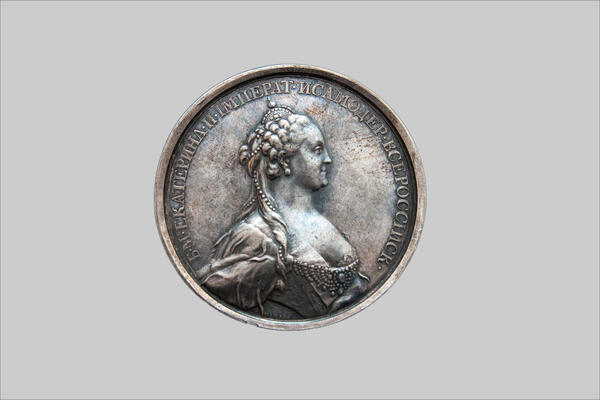
The exposition of the Tobolsk Museum Reserve contains a silver medal “Tribute for labours”. On the front side is a chest portrait of the Empress with a crown on her head. Around the edge of the medal there is an inscription “BY THE GRACE OF GOD, CATHERINE II. EMPRESS AND AUTOCRAT OF ALL RUSSIA” (By the Grace of God, Catherine II Empress and Autocrat of All Russia). On the reverse side, there is an allegorical image of the goddess of fertility Ceres in a wreath of ears and flowers under a palm tree on sheaves. In her left hand, she holds a rod wrapped in two serpents facing each other– a caduceus and a laurel wreath — in her right. In the distance you can see a plowing farmer. At the top around the edge of the medal there is an inscription — “Tribute for labours”. Authors of this medal — Johann Balthasar Gass and Johann Georg Waechter — German medallionists, skilled masters of their craft. They also made medals for Russia “for the conclusion of peace with Turkey in 1774”, in honor of count A. G. Orlov from the Admiralty Board, for the birth of Grand Lord Alexander Pavlovich.
One of the most large-scale actions of the company was the promotion of growing new potatoes for Russia. By order of Catherine II, parcels with root vegetables, as well as printed recommendations on the method of cultivation, storage and preparation were sent to all the governors of the country. The Society paid great attention to studying of agricultural issues, and encouraging success in agriculture, Empress Catherine II established awarding medals. These were the first medals in Russia that pointed out non-military services to the state. The Free Economic Society received its own special emblem and permission to use the personal symbol of Empress Catherine II.
The exposition of the Tobolsk Museum Reserve contains a silver medal “Tribute for labours”. On the front side is a chest portrait of the Empress with a crown on her head. Around the edge of the medal there is an inscription “BY THE GRACE OF GOD, CATHERINE II. EMPRESS AND AUTOCRAT OF ALL RUSSIA” (By the Grace of God, Catherine II Empress and Autocrat of All Russia). On the reverse side, there is an allegorical image of the goddess of fertility Ceres in a wreath of ears and flowers under a palm tree on sheaves. In her left hand, she holds a rod wrapped in two serpents facing each other– a caduceus and a laurel wreath — in her right. In the distance you can see a plowing farmer. At the top around the edge of the medal there is an inscription — “Tribute for labours”. Authors of this medal — Johann Balthasar Gass and Johann Georg Waechter — German medallionists, skilled masters of their craft. They also made medals for Russia “for the conclusion of peace with Turkey in 1774”, in honor of count A. G. Orlov from the Admiralty Board, for the birth of Grand Lord Alexander Pavlovich.
#14
Author: Johann Georg Waechter and Johann Balthasar Gas
Date: 18th century
Technique: embossed
Place: Russian Empire, Saint Petersburg, Saint Petersburg mint
Dimensions: 6,5×6,5 cm
Copyright: Tyumen Province State Autonomous Cultural Institution “Tyumen Museum and Educational Association”, Structural Division “Tobolsk Historical and Architectural Museum Reserve”
Collection: Orders and medals
Goskatalog Number: 4165253
Date: 18th century
Technique: embossed
Place: Russian Empire, Saint Petersburg, Saint Petersburg mint
Dimensions: 6,5×6,5 cm
Copyright: Tyumen Province State Autonomous Cultural Institution “Tyumen Museum and Educational Association”, Structural Division “Tobolsk Historical and Architectural Museum Reserve”
Collection: Orders and medals
Goskatalog Number: 4165253
read morehide
00:00
00:00
1x
Russian coin, Siberian coin, Awarding medal
Collection
0
 Point your smartphone camera to open in the app
Open in app
Share