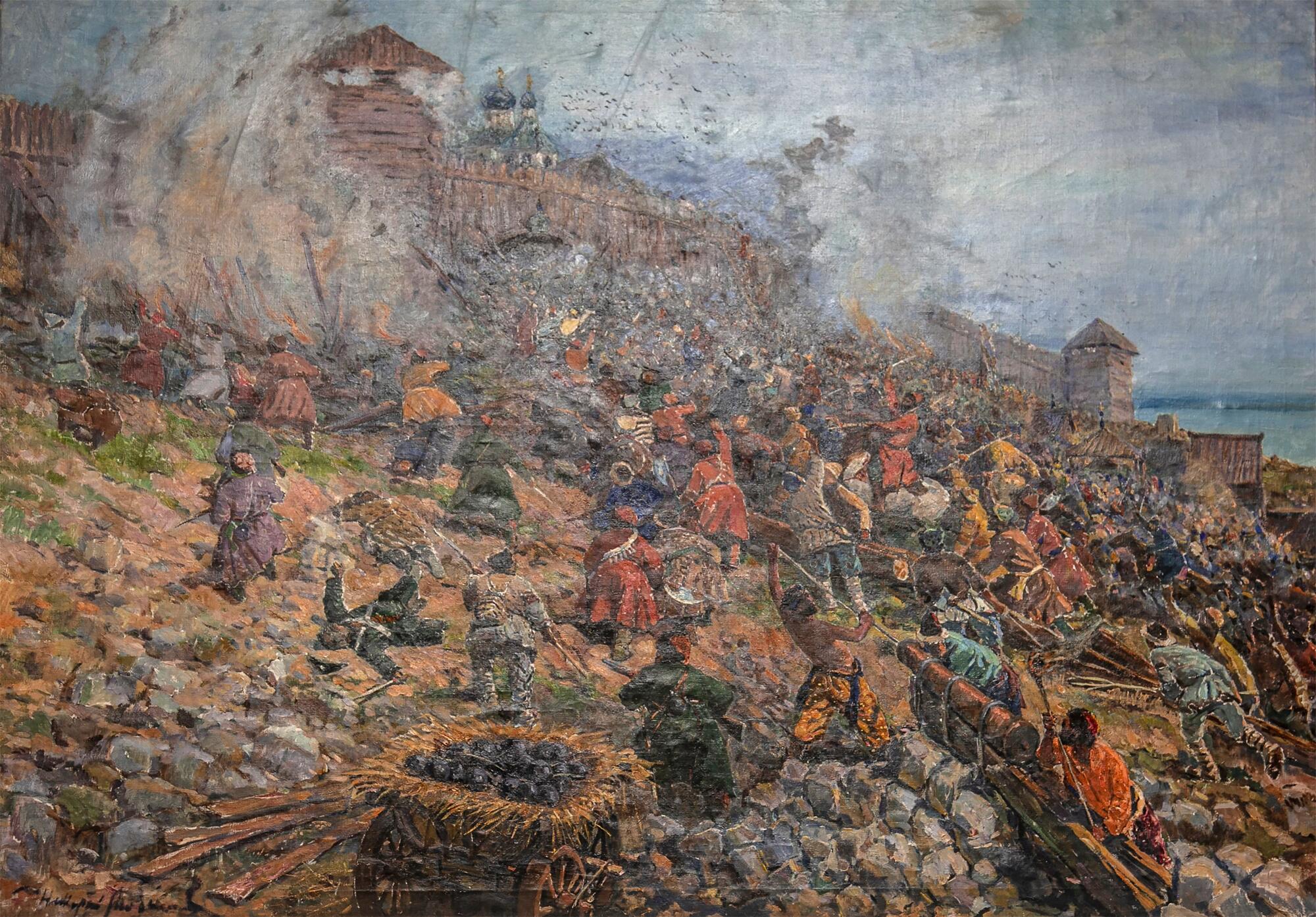


“Bulavin’s Troops Storm Tsaritsyn” was painted by Nikolay Lyubimov in 1939. The canvas measures 199×149 centimeters.
The uprising, led by Kondraty Afanasievich Bulavin, was sparked by the tsarist administration’s demand to turn in the absconded peasants from the Don, in violation of the principle “the Don does not return fugitives”, as well as attempts to return the fugitives by force.
The uprising began on the Don and quickly spread to the Volga. On 7 June, 1708 two Bulavin’s atamans, Ignat Nekrasov and Ivan Pavlov, approached Tsaritsyn with their troops. The siege of the city lasted several days. A detachment from Astrakhan rushed to the aid of the garrison but was defeated by the rebels in a battle on Sarpinsky Island. During the siege the Bulavin’s men filled up the ditch around the fortress with soil.
When the work was finished, Cossacks piled up brushwood under the walls and set it on fire. The fire allowed the rebels to break into the fortress. In the picture the rebels are seen storming up the steep hillside from the Volga. Tsaritsyn’s old archive was burnt down in the fire. Soon after capturing the town, the rebels captured Kamyshin.
On 20 July, 1708 the tsarist troops approached Tsaritsyn and liberated it in stride. Ignat Nekrasov had shortly before taken his detachments back to the Don, to the village of Golubinskaya. Ivan Pavlov lost the town and fled along the Volga and the Kamyshinka to the town of Panshin. The Bulavin’s men, who had been taken prisoner, were hanged along the Don road.
The artist Nikolay Nikolaevich Lyubimov was a native of Tsaritsyn. He founded the first art gallery in the post-revolutionary town and established the first art courses. The heyday of his creative work was in the 1920s–1930s.
The artist was associated with constructivism, but this piece is painted in the historicist style. Nikolay Lyubimov also designed the monument to the revolutionary Yakov Zelmanovich Yerman in Komsomolsky Garden.
The artist’s fate was tragic. He was killed by the Nazis during the Great Patriotic War. A large part of his artistic legacy perished in the fire of war. Some of the artist’s surviving works are housed in the Volgograd Regional Museum of Local History.
The uprising, led by Kondraty Afanasievich Bulavin, was sparked by the tsarist administration’s demand to turn in the absconded peasants from the Don, in violation of the principle “the Don does not return fugitives”, as well as attempts to return the fugitives by force.
The uprising began on the Don and quickly spread to the Volga. On 7 June, 1708 two Bulavin’s atamans, Ignat Nekrasov and Ivan Pavlov, approached Tsaritsyn with their troops. The siege of the city lasted several days. A detachment from Astrakhan rushed to the aid of the garrison but was defeated by the rebels in a battle on Sarpinsky Island. During the siege the Bulavin’s men filled up the ditch around the fortress with soil.
When the work was finished, Cossacks piled up brushwood under the walls and set it on fire. The fire allowed the rebels to break into the fortress. In the picture the rebels are seen storming up the steep hillside from the Volga. Tsaritsyn’s old archive was burnt down in the fire. Soon after capturing the town, the rebels captured Kamyshin.
On 20 July, 1708 the tsarist troops approached Tsaritsyn and liberated it in stride. Ignat Nekrasov had shortly before taken his detachments back to the Don, to the village of Golubinskaya. Ivan Pavlov lost the town and fled along the Volga and the Kamyshinka to the town of Panshin. The Bulavin’s men, who had been taken prisoner, were hanged along the Don road.
The artist Nikolay Nikolaevich Lyubimov was a native of Tsaritsyn. He founded the first art gallery in the post-revolutionary town and established the first art courses. The heyday of his creative work was in the 1920s–1930s.
The artist was associated with constructivism, but this piece is painted in the historicist style. Nikolay Lyubimov also designed the monument to the revolutionary Yakov Zelmanovich Yerman in Komsomolsky Garden.
The artist’s fate was tragic. He was killed by the Nazis during the Great Patriotic War. A large part of his artistic legacy perished in the fire of war. Some of the artist’s surviving works are housed in the Volgograd Regional Museum of Local History.