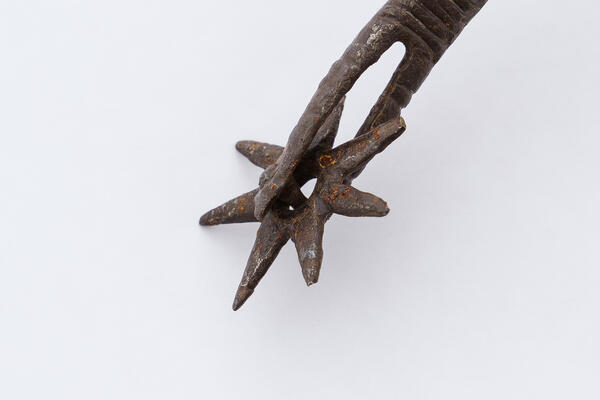
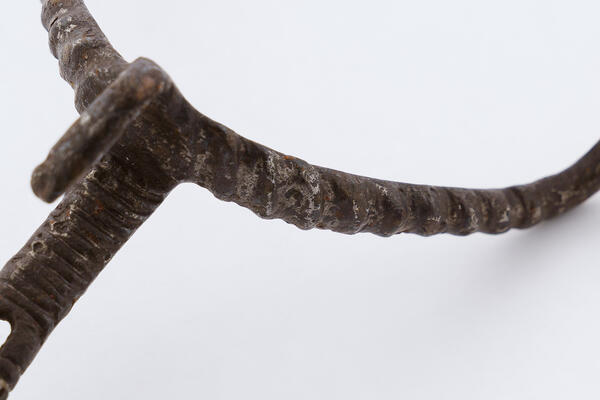
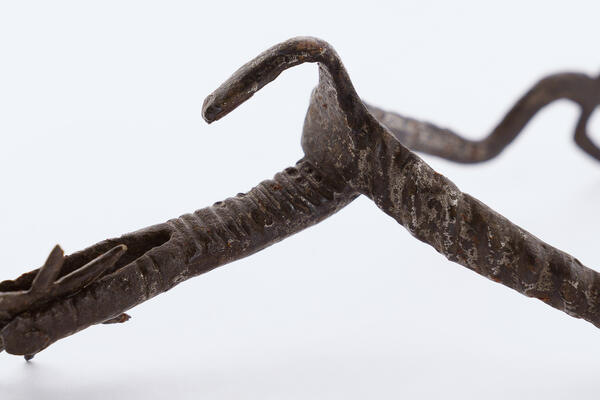
The wheel spur on display at the State Museum-Reserve “Kulikovo Field” is a part of a rider’s equipment and an element of horse control from the 14th and 15th centuries. It consists of two curved arms with rectangular fastenings for straps at the ends, a safety spike, and a holder for the rowel at the base. The rowel is shaped like a seven-pointed star, with an ornament seen on both the arches and the fastenings of the rowel.
Over the centuries, humans have developed a variety of devices to help them control horses. In addition to the bridle, which was placed on the horse and allowed the rider to control the animal more directly, riders during the time of the Battle of Kulikovo had additional tools such as spurs and lashes.
Spurs were an integral part of a rider’s gear; they are metal shackles with spikes or wheels (rowels) attached to the heels of a rider’s boots to assist in controlling the horse. A spur takes the form of an arc, curved in the shape of a heel.
The oldest spurs were found in a burial mound from the 5th century BCE in Slovenia.
At the time, when there were no stirrups, spurs were used to make the horse stop. Those spurs were quite sharp and caused painful blows to the horse. In the 13th–14th centuries, wheel spurs emerged. They were less sharp and more comfortable for both the rider and the horse. During the Middle Ages, riders would wear spurs up to 30 centimeters in length. However, as the wheel could get clogged with dirt, spurs with a blunt protruding part instead of a wheel were created. Currently, these blunt-end spurs are still used for riding.
For a long time, up until the 19th century, horsemen were exclusively associated with warfare. In Russia, as well as in Western Europe, spurs were a symbol of wealth, belonging to a nobleman, a servant, or a palace guard.
By the time of the Battle of Kulikovo, spurs had become widespread. In fact, the richly decorated finds from this period in Veliky Novgorod indicate that military elites used spurs extensively.