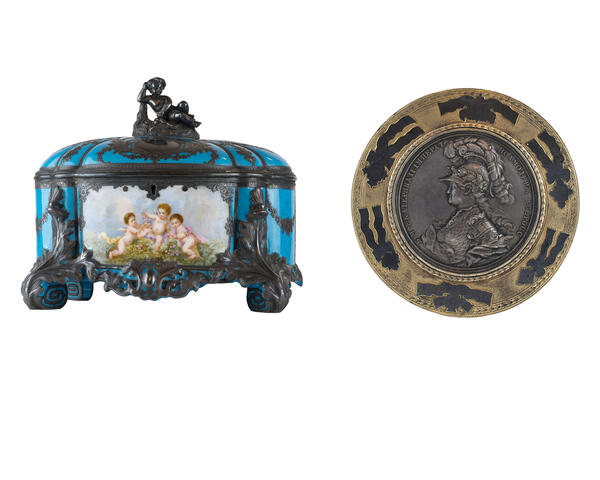
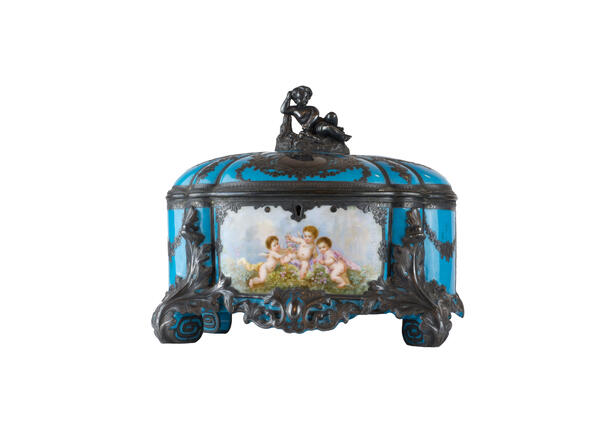
This porcelain box was made at the French Sevres Factory around 1755. It entered the museum as part of the confiscated property of the repressed Nikita Melikov in 1938.
The box is covered with “royal blue” color. In the 1750s, this color was very popular with high society. It was based on bleu celeste, a fashionable turquoise paint that was invented in 1753.
The lid of the item is crowned with a figurine of putti, the so-called image of a pretty little boy, who was often depicted in Renaissance paintings and products made in the Baroque and Rococo style. The figure of the boy, as well as the frame of the legs and the lid of the casket are made of white metal, most likely silver.
The body of the box is decorated with a picturesque polychrome painting depicting three cupids. Bright colors, including another fashionable color at that time, “pink Pompadour” were used in the miniature.
There is a stamp specific for the early items of the Sevres Factory at the bottom of the box. Experts suggest that the year 1755 is indicated on it.
In the “royal period”, during the reign of King Louis XV, masters indicated the dates of items’ production on the stamps of Sevres porcelain items. To do this, they used not only numbers, but also letters, which were placed in the center of the Louis XV monogram on a product. Each letter corresponded to a specific year. This marking has been preserved to this day only on items made of soft “paste”, a special kind of soft porcelain.
Porcelain production in France began with the support of King Louis XV and Madame de Pompadour in 1740, at the Vincennes Castle. Over time, the city of Vincennes developed around it. Today it is the territory of the southeastern suburbs of Paris.
In 1756, the factory was moved to Sevres, near the Bellevue Palace, where Madame de Pompadour lived. Three years later, the Sevres factory acquired the status of a royal manufactory.
Sevres masters had been working with soft porcelain, invented by French ceramists back in the 17th century, since the inception of the factory. Soft porcelain and its glaze differed from hard porcelain in composition and, as a result, lower firing temperature. Thanks to this, the colors did not fade, and the palette of used colors was the richest.
The box is covered with “royal blue” color. In the 1750s, this color was very popular with high society. It was based on bleu celeste, a fashionable turquoise paint that was invented in 1753.
The lid of the item is crowned with a figurine of putti, the so-called image of a pretty little boy, who was often depicted in Renaissance paintings and products made in the Baroque and Rococo style. The figure of the boy, as well as the frame of the legs and the lid of the casket are made of white metal, most likely silver.
The body of the box is decorated with a picturesque polychrome painting depicting three cupids. Bright colors, including another fashionable color at that time, “pink Pompadour” were used in the miniature.
There is a stamp specific for the early items of the Sevres Factory at the bottom of the box. Experts suggest that the year 1755 is indicated on it.
In the “royal period”, during the reign of King Louis XV, masters indicated the dates of items’ production on the stamps of Sevres porcelain items. To do this, they used not only numbers, but also letters, which were placed in the center of the Louis XV monogram on a product. Each letter corresponded to a specific year. This marking has been preserved to this day only on items made of soft “paste”, a special kind of soft porcelain.
Porcelain production in France began with the support of King Louis XV and Madame de Pompadour in 1740, at the Vincennes Castle. Over time, the city of Vincennes developed around it. Today it is the territory of the southeastern suburbs of Paris.
In 1756, the factory was moved to Sevres, near the Bellevue Palace, where Madame de Pompadour lived. Three years later, the Sevres factory acquired the status of a royal manufactory.
Sevres masters had been working with soft porcelain, invented by French ceramists back in the 17th century, since the inception of the factory. Soft porcelain and its glaze differed from hard porcelain in composition and, as a result, lower firing temperature. Thanks to this, the colors did not fade, and the palette of used colors was the richest.