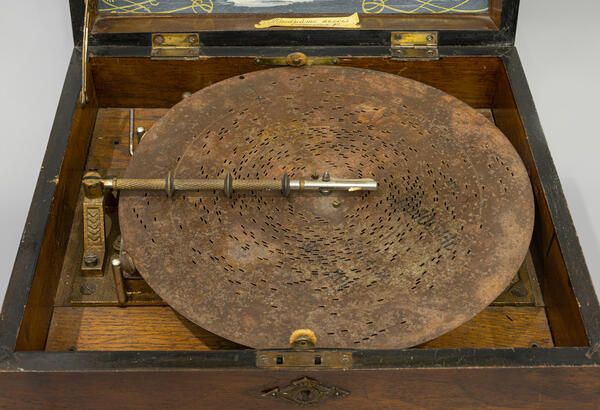
The Nizhny Lomov Museum of Local Lore houses a “Fortuna” music box. It was made in the early 20th century at the factory of Julius Heinrich Zimmermann. The company founder, known in Russia as Yulius Genrikhovich, was born in a German town called Sternberg. After completing his studies as a banker, in 1876, the future entrepreneur moved to St. Petersburg, the capital of the Russian Empire.
In St. Petersburg, Julius Heinrich Zimmermann founded a store and music publishing house, began producing brass instruments and supplying other musical instruments. His company also had branches in Moscow, Riga, London, and Leipzig.
Zimmermann’s store and factory, “a supplier to the court of His Imperial Majesty”, were located in the heart of St. Petersburg, on 34 Bolshaya Morskaya Street. Many popular magazines and newspapers featured advertisements for his company.
In 1886, the new headquarters of the company were founded in Germany. From 1893 onwards, the products of Zimmerman factories participated in world fairs where they won many gold medals. In 1901, the manufacturer was awarded the Order of Saint Stanislaus for his achievements.
In 1900, before receiving the above-mentioned award, Julius Heinrich Zimmermann established the production of “Fortuna” music boxes. They became popular among merchants and were particularly melodious. They could be found in inns and wealthy houses in Nizhny Lomov.
Later, new models appeared — “an orgophone” and “a cantophone”. Russian advertisements of that time described the former as “a new and improved hand organ with a pleasant, melodious sound.” A cabinet orgophone with 26 double voices cost 35 rubles, while a single-voice instrument was 10 rubles cheaper.
The music box was discovered by Sergey Terentyuk, a local resident, during the demolition of a barn. After opening the instrument, Sergey remembered how he received it as a gift from his grandmother who lived in Ryazan Oblast. The mechanism had been inactive for a long time and the box had fallen into disrepair. The owners remembered about the box when they heard that the local museum was accepting donations. This is how the music box found its way into the collection of the Museum of Local Lore. Its employee Boris Konstantinovich Pastukhov managed to repair the mechanism and put the box into operation.