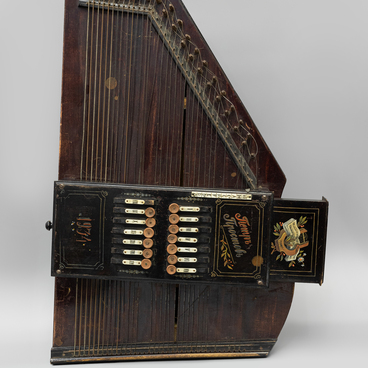
The emergence of diatonic button accordions (known in Russian as “garmon”) in the Russian Empire dates back to the early 1840s. Privileged social classes, as noted in literary sources, purchased “hand harmonicas” from abroad, and through serf servants, the musical instruments appeared and became popular in the country.
There is a theory that foreign craftsmen who were invited to the Tula arms factories might have brought the diatonic accordions. Among the artisans of Tula, there was a belief that the diatonic accordions were invented by the gunsmiths Sizov and Shkunaev. According to some information, musical instruments known as “harmonicas” were produced as early as the 1830s in the Tula Governorate, although it is unknown whether those were mouth harmonicas (organs) or actual diatonic accordions.
By the mid-19th century, the artisanal production of diatonic accordions became widespread in the Tula, Novgorod, Vologda, and Vyatka Governorates. It is known that by the 1880s, this craft was developing in St. Petersburg, as well as in the Tver, Volyn, Moscow, Siberian, Yaroslavl, Nizhny Novgorod, Kostroma, and Oryol Governorates.
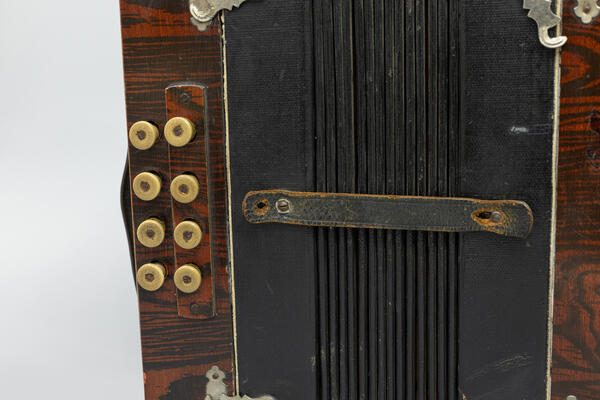
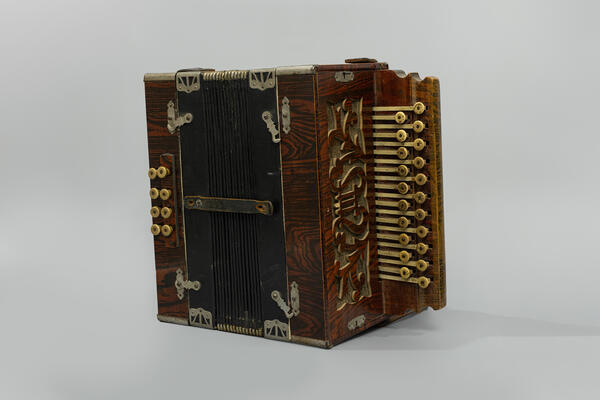
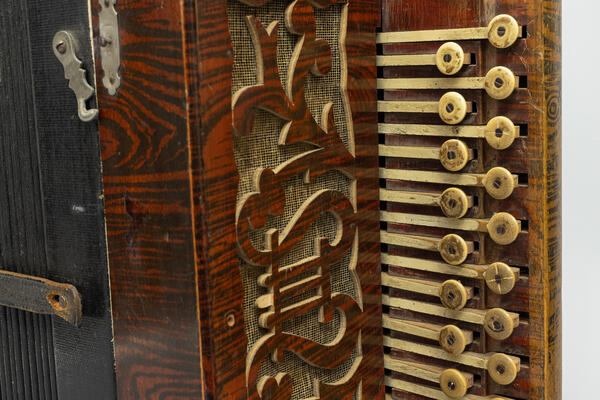
One of the first single-row diatonic accordions was the Tula eight-key instrument with accompaniment for the left hand. A distinctive feature of this instrument was that pressing the same key produced sounds of different pitches, depending on whether the bellows were being expanded or compressed. Later, such instruments were named “Russian tuning diatonic accordions”.
The main problem with the first Tula diatonic accordions was not even the limited range of sounds, but the lack of freedom in the accompaniment. This determined the further development of the Russian single-row diatonic accordion. The desire to perform local song folklore motifs on the musical instrument led to creating various types of diatonic accordions. Many of them were named according to their place of manufacture and distribution. In the Russian Empire, diatonic accordions from Saratov, Kasimov, Cherepovets, Yelets, Siberia, Smolensk, and many other types emerged.
The Saratov instrument,
for example, was similar to the Tula one in terms of tuning and the number of
sounds produced. However, a third key was added for the left hand, and some
Saratov diatonic accordions had four keys in the bass part, as well as two
bells.