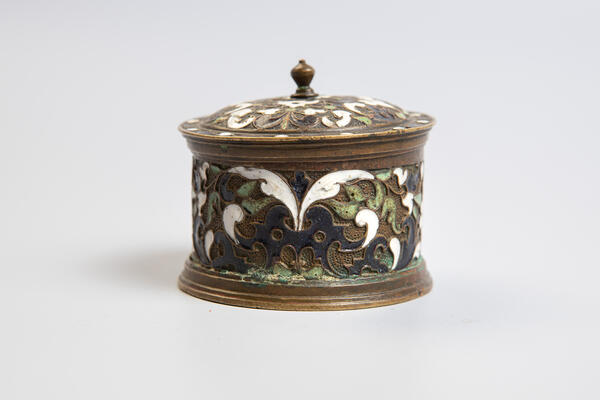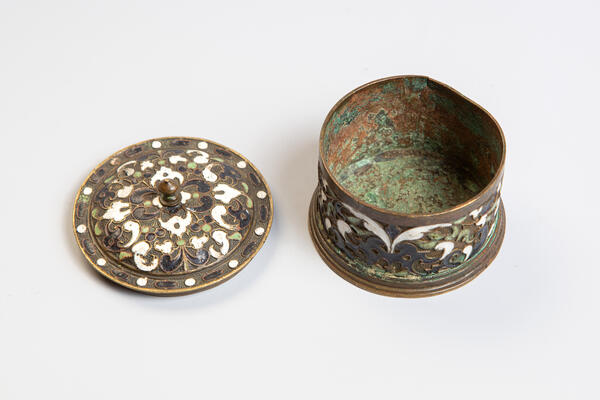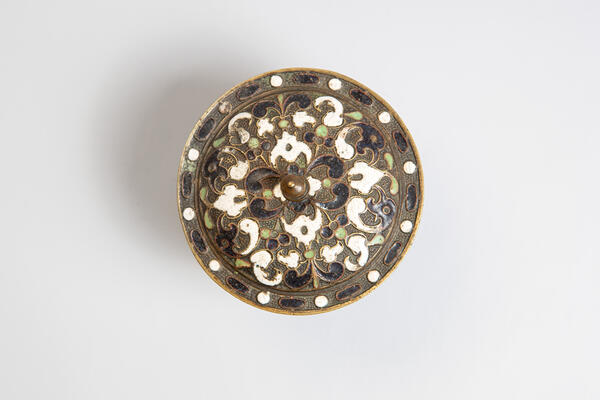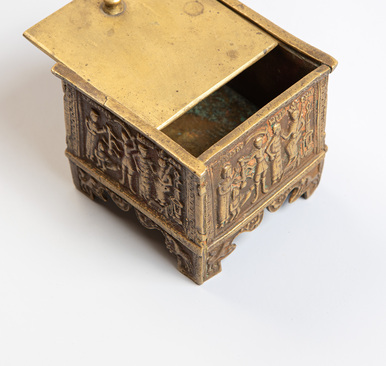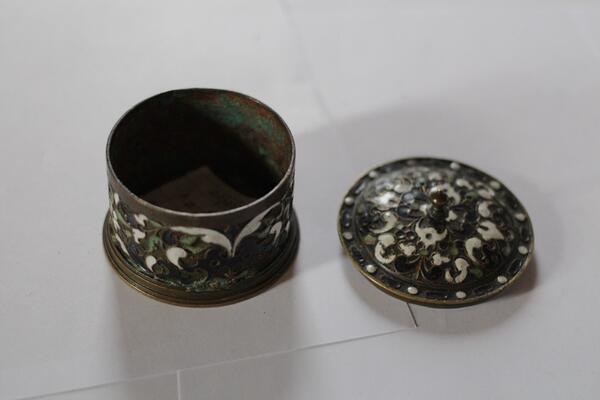
The permanent exhibition “The World of the Streltsy” includes several trinket boxes made by Russian artisans of the 17th and 18th centuries. This bronze trinket box is an example of the cloisonné technique. Since ancient times, jewelers have used such metal coatings for decorative purposes. Cloisonné enameling also had a practical function: enamels protected the surface of objects from corrosion.
The very first records that mention the use of enamel in Rus date back to the 10th century. At that time enamel was called “finift” (the name derived from the Greek word meaning “mix”). This decorative technique came to Russia from Byzantium. At first, it was used to decorate church interiors, ritual chalices, goblets, icons, as well as book frames. Enamel was then valued as much as precious stones.
Enamel is made of vitreous fusible powder. The variety of colors and properties of coatings is due to the addition of metal oxides, which are called colorants. For example, potassium, sodium and lead oxides make enamel fusible, but reduce its resistance to corrosion. Aluminum and magnesium, on the contrary, increase the melting point of the enamel and make it stronger.
Metal oxides add color to the enamel coating: cobalt makes it blue and black, cadmium — red, copper — green, tin — white, and iron — brown. One of the most popular technologies is applying enamel powder to the metal surface and then firing the item in a kiln at a temperature of 700–900 degrees. Under such conditions, the enamel melts and covers the surface of the metal.
Artisans had to master different techniques: engraving, filigree, and granulation. Trinket boxes often became objects of great value, since not only enamel, but also ivory, leather, and precious metals, such as gold and silver, were used for decoration. In addition, the boxes were inlaid with precious stones — rubies, sapphires or emeralds, as well as semi-precious stones — carnelian, turquoise, and sometimes decorated with corals.
The very first records that mention the use of enamel in Rus date back to the 10th century. At that time enamel was called “finift” (the name derived from the Greek word meaning “mix”). This decorative technique came to Russia from Byzantium. At first, it was used to decorate church interiors, ritual chalices, goblets, icons, as well as book frames. Enamel was then valued as much as precious stones.
Enamel is made of vitreous fusible powder. The variety of colors and properties of coatings is due to the addition of metal oxides, which are called colorants. For example, potassium, sodium and lead oxides make enamel fusible, but reduce its resistance to corrosion. Aluminum and magnesium, on the contrary, increase the melting point of the enamel and make it stronger.
Metal oxides add color to the enamel coating: cobalt makes it blue and black, cadmium — red, copper — green, tin — white, and iron — brown. One of the most popular technologies is applying enamel powder to the metal surface and then firing the item in a kiln at a temperature of 700–900 degrees. Under such conditions, the enamel melts and covers the surface of the metal.
Artisans had to master different techniques: engraving, filigree, and granulation. Trinket boxes often became objects of great value, since not only enamel, but also ivory, leather, and precious metals, such as gold and silver, were used for decoration. In addition, the boxes were inlaid with precious stones — rubies, sapphires or emeralds, as well as semi-precious stones — carnelian, turquoise, and sometimes decorated with corals.