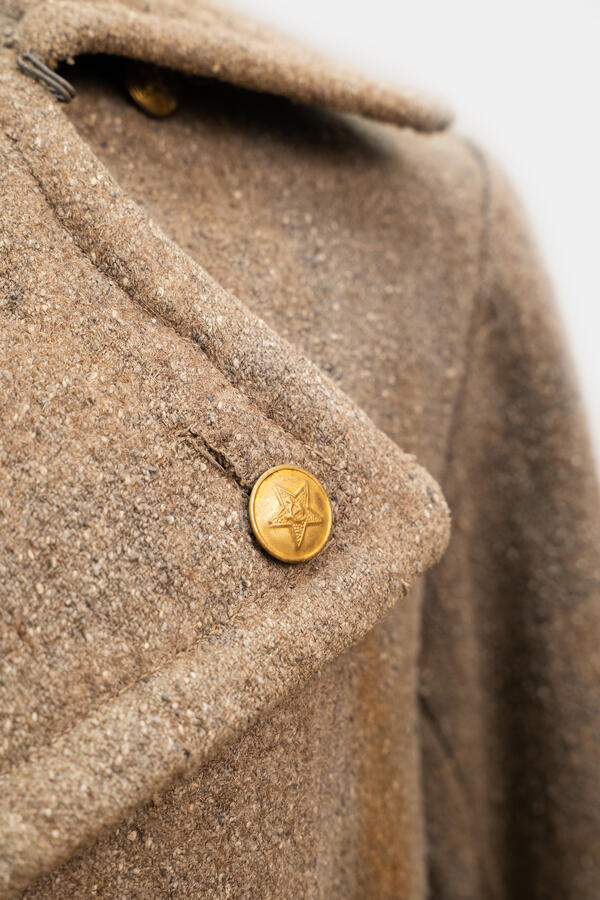
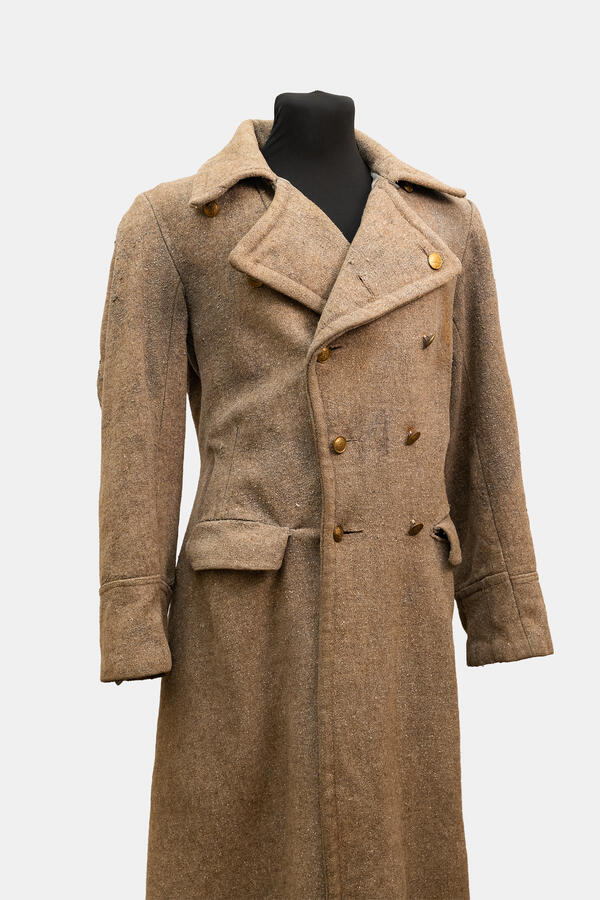
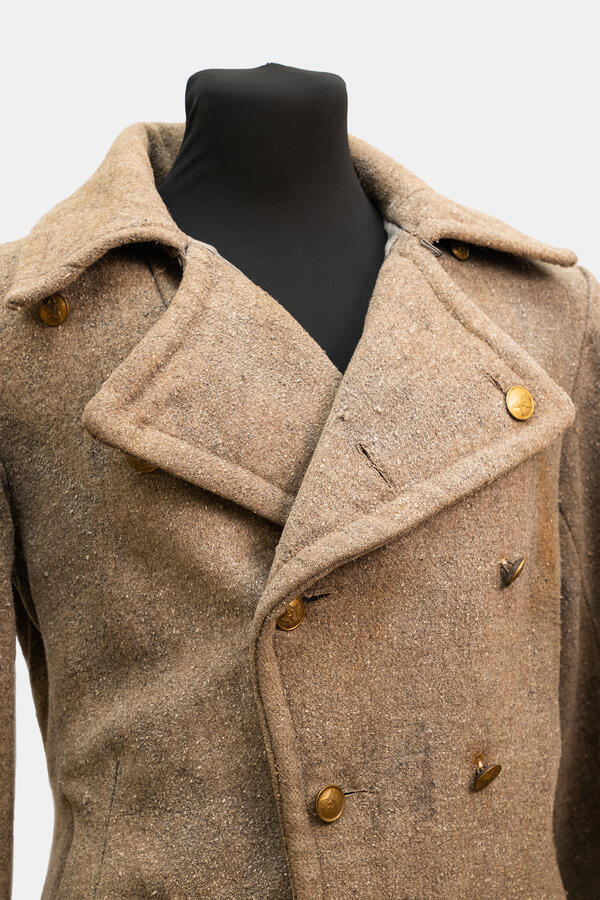
The overcoat presented in the museum belonged to Viktor Vasilyevich Vityazev, a participant in the Petsamo–Kirkenes offensive, sergeant of the 238th Infantry Regiment.
Petsamo is a historical and geographical area that was part of Finland from 1920 to 1944. The administrative center of this region was the city of Petsamo, now an urban-type settlement of Pechenga. In that area, in the autumn of 1944, an offensive operation was carried out by the troops of the Karelian Front and the Northern Fleet against the German grouping. The operation is also known in Soviet and Russian historiography as the Tenth Stalin’s Blow.
In general, one can say that there were three stages of the operation. The first was the breakthrough of the German fortified positions on the “granite rampart” and the capture of Petsamo. The second consisted in the acquisition of the areas which housed nickel production facilities of Kolosjoki, and entry into the territory of Norway. The third stage was the liberation of the cities of Kirkenes and Nautsi. The “granite” (or Lapland) defensive rampart was a German permanent defensive structure consisting of three lines. The depth of the defense was up to 150 kilometers, and its length was up to 100 meters.
During the September offensive of the 19th and 26th armies, Soviet Karelia was completely cleared of enemy troops. This improved the strategic position in the northern sector of the Soviet-German front and created all conditions for the complete liberation of the Arctic from German occupation.
Viktor Vityazev served in the 205th Infantry Division and participated in the battles in the Kestenga direction. There, the offensive was conducted along the Louhi—Kestenga —Sofporog —Kuusamo highway. On September 17, 1944, on the Kestenga —Kuusamo highway, under heavy enemy artillery fire, Vityazev shot down an enemy car with a machine gun. He was wounded in that battle. On March 8, 1945, in the battles for the settlement of Zechendorf, he killed two German soldiers. Vityazev was awarded the medal “For Courage”.
The medal “For Courage” was awarded to those who distinguished themselves by exhibiting courage and bravery in the defense of the Fatherland and the performance of military duty. It was established in 1938. The first ever nominal decree awarded this medal to the Red Army border guards whose surname was Gulyaev. They detained a group of saboteurs at Lake Hassan.