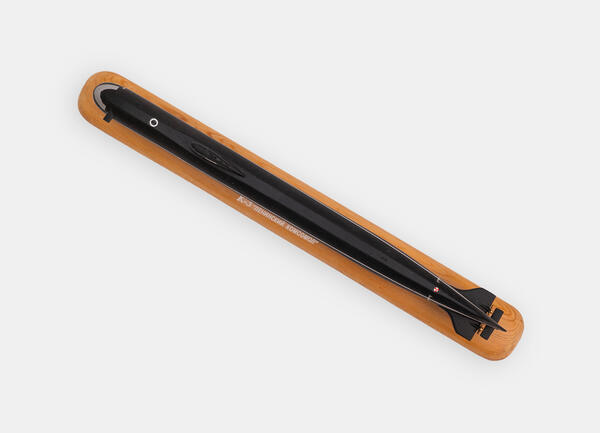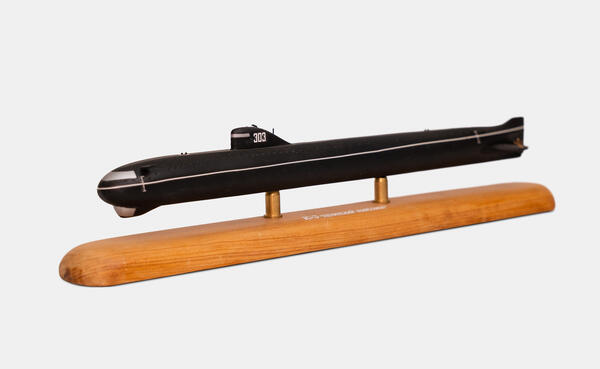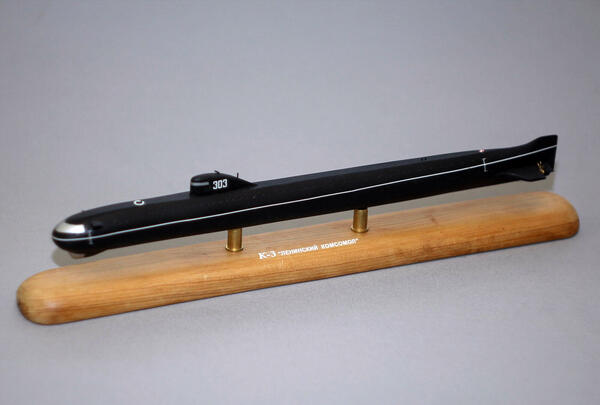
“K-3 Leninsky Komsomol” was the first Soviet and third nuclear-powered submarine in the world, the lead ship of Project 627 “Kit”. The submarine was in service with the Northern Fleet from 1958 to 1987. The “Kit” project was a series of the first Soviet nuclear-powered submarines. As a result of the successful implementation of Project 627, the Soviet Union became the second country in the world to have a nuclear submarine fleet. The ships of Project 627-627A had impressive characteristics for their time, although they also had some significant drawbacks that were addressed in subsequent designs. A total of 13 submarines were built and commissioned between 1957 and 1963, serving in the Northern Fleet. Later, four of them entered service with the Pacific Fleet.
The creation of the USSR’s first nuclear-powered submarine was a national challenge. 35 institutes and about 100 industrial enterprises of the Soviet Union collaborated to address this issue. The submarine was laid down at the Sevmash Plant in Severodvinsk in 1955. The nuclear-powered vessel was constructed in a remarkably short period of time, and this achievement represented a groundbreaking development for both the industry and the navy.
In 1962, the K-3 Leninsky Komsomol vessel became the first Soviet submarine to reach the North Pole. Another important episode in the service history of the K-3 submarine was her trip to the equator. The voyage of the first Soviet nuclear vessel into warm waters was necessary to test the quality of the submarine’s special propulsion system in various conditions. In that area, the submarine was also tested as a target ship and traveled at different speeds at different depths, moving hundreds of miles away from support vessels and reapproaching them.
In 1991, the K-3 was finally withdrawn from the Northern Fleet. At the end of 2002, she was delivered to be scrapped to the city of Polyarny at the 10th Shipyard. Spent nuclear fuel was removed from the submarine.
In 2021, the Leninsky Komsomol submarine was transported from the town of Snezhnogorsk, Murmansk Oblast, to Kronstadt. Specialists of the Kronstadt Marine Plant replaced 80% of the coating of the light hull and other parts, as well as repaired the superstructures of the light hull. Presently, a local museum houses the submarine.