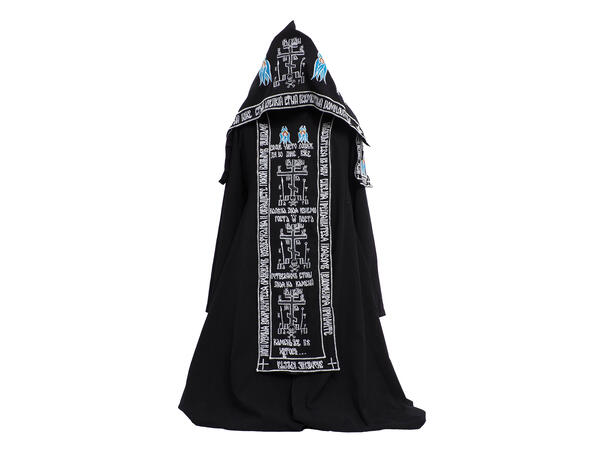
The schema (monk vestment) was sewn in the city of Sofrino, Moscow oblast, in 2010. Metropolitan bishop of Tomsk and Asinovsk Rostislav donated it to the museum.
The schema was made of black сrêpe, a rough fabric, with a black lining sewn to the vestment. The outer side of the schema is decorated with embroidery.
The style of such vestment traditionally consists of two parts: analabos and koukoulion. Analabos is a square or rectangular cloth with shoulder mantles — the fragments that cover the shoulders. The analabos has a round neck hole, it is tied with several ties at the front in such a way that the front part covers the chest, and the back part lies on the back. Usually, a cross was depicted behind. Analabos symbolically reminds the monk of the burden he assumed — to follow Christ.
The koukoulion is an upper vestment in the form of a pointed cowl with two long strips of fabric that cover the back and chest. The analabos and koukoulion from the museum collection are decorated with machine embroidery. It is made with cotton threads in white, blue, yellow, and brown colors.
On the analabos there is an eight-pointed Orthodox cross at the foot, as well as the instruments of the Passion of Jesus and the Totenkopf. There are crosses, seraphim and prayer texts on the koukoulion.
The schema monks, which served in the Ust-Kirghiz Theotokos Alexievsky monastery, had such vestments, but their vestments were not decorated and had a simpler fabric. It was the first Russian settlement on the territory of Seversk, the closed administrative-territorial unit. The schema monks were monks who had reached the highest spiritual level and were tonsured twice.
According to archival documents, 200 schema monks from among the former Tomsk service people founded the monastery in 1605, a year after the construction of the Tomsk fortress. In 1656, after the nomad raids and the flooding of the river, during which the first church was washed away, the monastery was moved to the city of Tomsk, where it is located today. And in its place, at the Kirghizka river delta, there were farmlands and a dacha of the monastery, called Archimandrite small settlement. The Pokrovskaya Church was built here.
The monks who lived here, besides praying, were engaged in household chores: cultivated farm fields, fished, and prepared firewood. On all church holidays, residents of the village of Beloborodovo, which was two miles away from the settlement, came to the Pokrovskaya Church, although they officially belonged to the parish of the Prophet Elias Church in the village of Iglakovo. According to the stories of Beloborodovo residents, monks from the monastery often came to visit them, talked about their outlook and the future.
The schema was made of black сrêpe, a rough fabric, with a black lining sewn to the vestment. The outer side of the schema is decorated with embroidery.
The style of such vestment traditionally consists of two parts: analabos and koukoulion. Analabos is a square or rectangular cloth with shoulder mantles — the fragments that cover the shoulders. The analabos has a round neck hole, it is tied with several ties at the front in such a way that the front part covers the chest, and the back part lies on the back. Usually, a cross was depicted behind. Analabos symbolically reminds the monk of the burden he assumed — to follow Christ.
The koukoulion is an upper vestment in the form of a pointed cowl with two long strips of fabric that cover the back and chest. The analabos and koukoulion from the museum collection are decorated with machine embroidery. It is made with cotton threads in white, blue, yellow, and brown colors.
On the analabos there is an eight-pointed Orthodox cross at the foot, as well as the instruments of the Passion of Jesus and the Totenkopf. There are crosses, seraphim and prayer texts on the koukoulion.
The schema monks, which served in the Ust-Kirghiz Theotokos Alexievsky monastery, had such vestments, but their vestments were not decorated and had a simpler fabric. It was the first Russian settlement on the territory of Seversk, the closed administrative-territorial unit. The schema monks were monks who had reached the highest spiritual level and were tonsured twice.
According to archival documents, 200 schema monks from among the former Tomsk service people founded the monastery in 1605, a year after the construction of the Tomsk fortress. In 1656, after the nomad raids and the flooding of the river, during which the first church was washed away, the monastery was moved to the city of Tomsk, where it is located today. And in its place, at the Kirghizka river delta, there were farmlands and a dacha of the monastery, called Archimandrite small settlement. The Pokrovskaya Church was built here.
The monks who lived here, besides praying, were engaged in household chores: cultivated farm fields, fished, and prepared firewood. On all church holidays, residents of the village of Beloborodovo, which was two miles away from the settlement, came to the Pokrovskaya Church, although they officially belonged to the parish of the Prophet Elias Church in the village of Iglakovo. According to the stories of Beloborodovo residents, monks from the monastery often came to visit them, talked about their outlook and the future.