If one has to choose the only type of Chinese applied art that best conveys the attention to detail of Chinese craftsmen, such an object will be an ivory mystery ball.
Chinese puzzle balls are decorative objects that consist of several concentric spheres. Each sphere inside the ball rotates freely and is cut from the same single piece of material as all others. These works of art usually consist of three to seven layers, and the largest ball in the world consists of 42 spherical shells.
Such balls were usually made of ivory, resin, wood, jade and other materials.
The first step in making “lattice balls inside balls” is to turn one piece of bone into a perfect ball, after which several conical holes are drilled in it at the required distance, which converge exactly in the center of the ball. Then the master uses a ruler to mark in each hole how many balls he wants to chisel out inside the outermost layer. And only then can he proceed directly to carving out the balls, starting with the one lying in the very heart of the future “lattice ball”. The master has to rely solely on his own instincts, experience and the sharp blade of his cutter, since the holes made do not allow him to see what is happening inside the ball. All subsequent balls are also chiseled out from the inside.
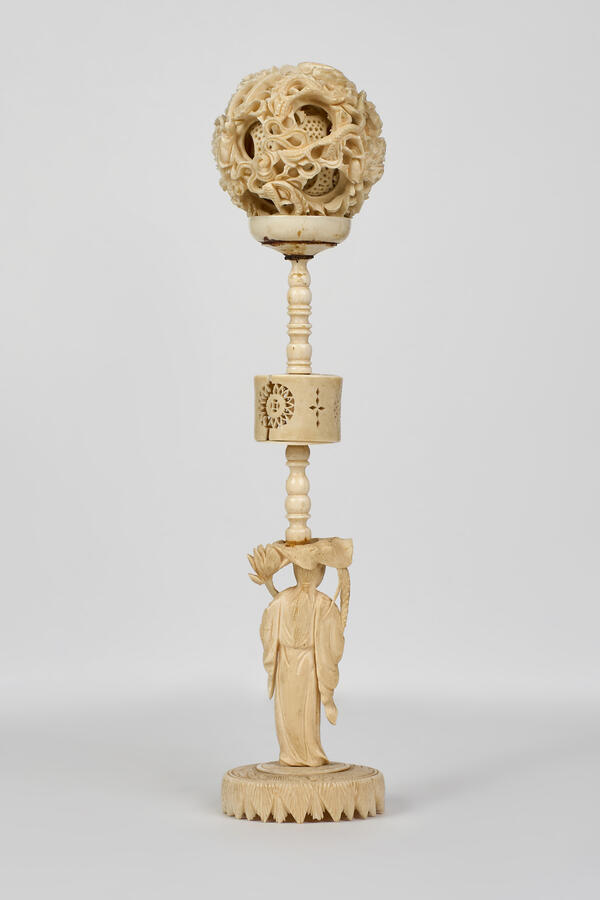
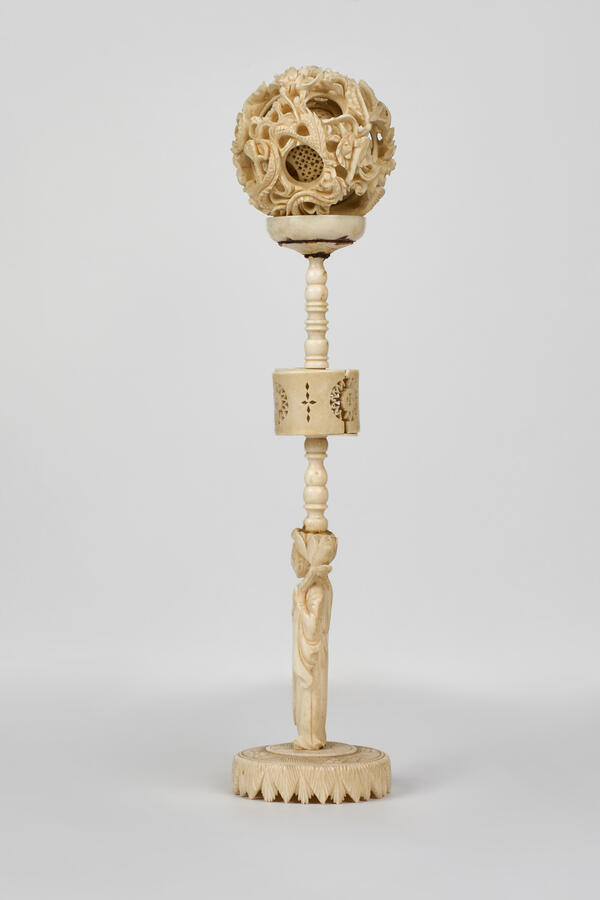
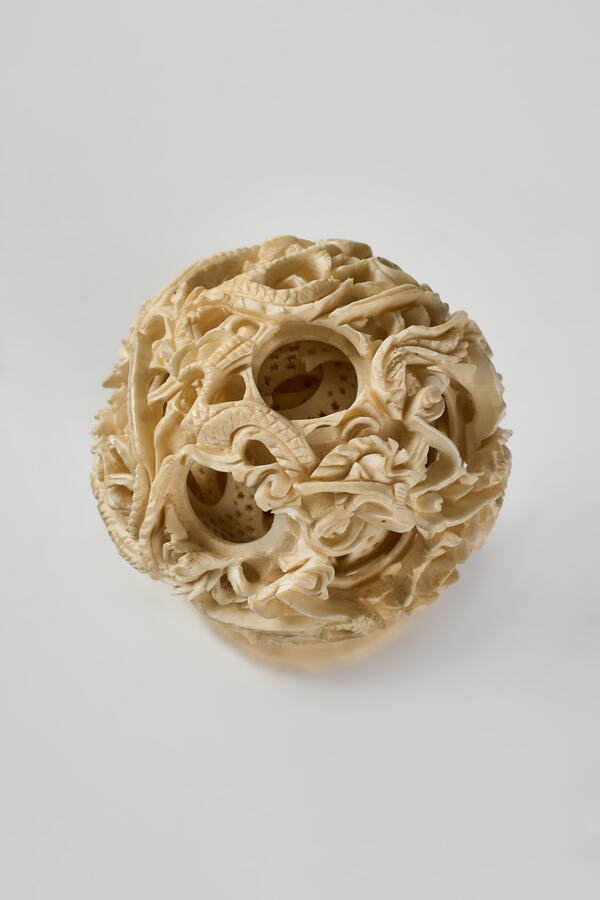
The bone exhibit from the Astrakhan Art Gallery is a composition that includes two parts: a stand and a multi-layered ball (a ball in a ball). The latter is created through continuous openwork carving, which forms a floral pattern and includes dragon motifs. The dragons’ eyes are tinted for extra expressiveness.
The ball stand is a figurine of an old man with a
bouquet of lotuses in his hands. He is placed on an openwork base in the form
of an inverted flower decorated with floral patterns. A carved frame is mounted
on the shoulders of the old man, divided in two by a carved drum. Presumably,
all segments are removable and were stored in a special box. The top of the
stand is crowned with a platform for the ball.